Deployment Stages
1. Core Stage
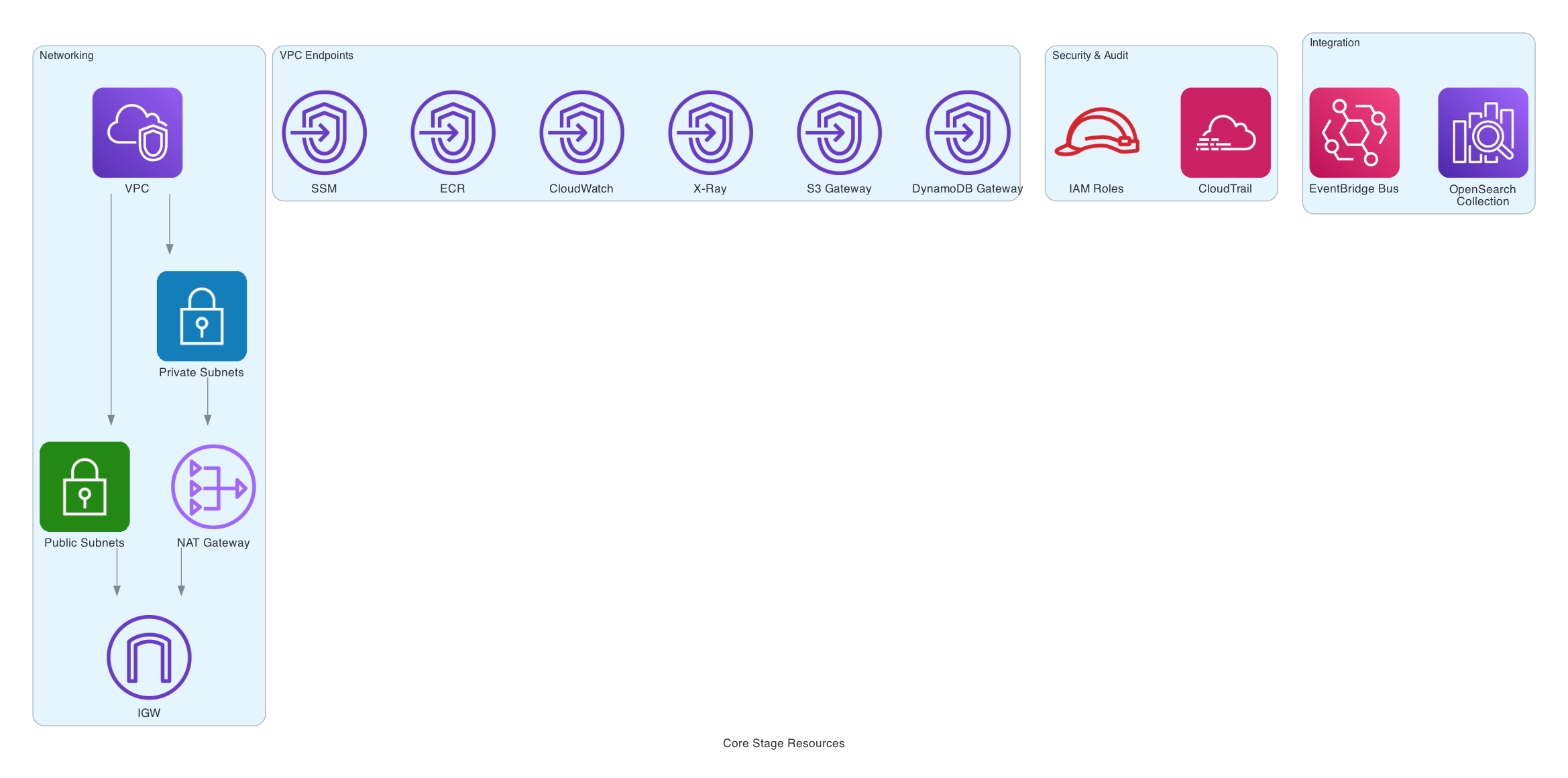
Deploys foundational infrastructure required by all other stages.
- VPC with public/private subnets, NAT gateways
- VPC Endpoints for private AWS service connectivity (SSM, SSM Messages, EC2 Messages, Secrets Manager, CloudWatch Logs, CloudWatch Monitoring, Lambda, API Gateway, Cloud Map, S3, DynamoDB)
- Security groups and IAM roles
- CloudTrail audit logging
- EventBridge event bus
- Amazon SQS queue with dead-letter queue for async messaging
2. Containers Stage
Builds and pushes container images for all microservices using a dedicated CodePipeline.
| Service | Language | Architecture |
|---|---|---|
payforadoption-go | Go | AMD64 |
petlistadoption-py | Python/FastAPI | AMD64 |
petsearch-java | Java/Spring Boot | AMD64 |
petsite-net | .NET | AMD64 |
petfood-rs | Rust/Axum | AMD64 |
petfoodagent-strands-py | Python/Strands | ARM64 |
Pipeline: Source Stage → Parallel Build Stage (all 6 services)
3. Storage Stage
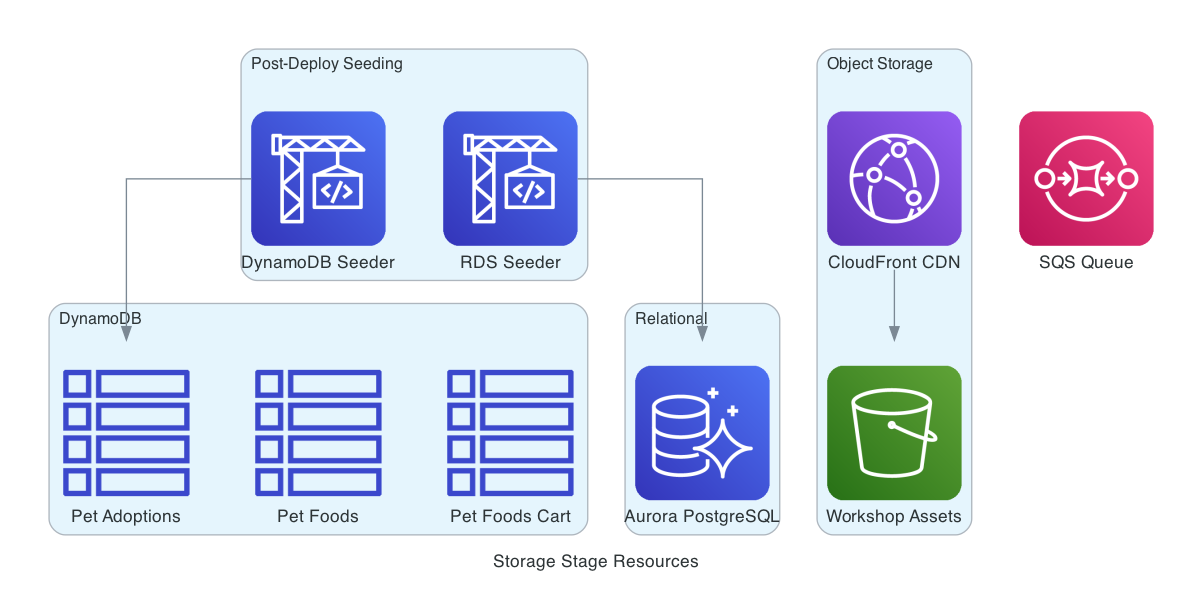
Deploys data persistence and messaging resources.
- Amazon DynamoDB — Pet adoption, pet foods, and pet foods cart tables
- Amazon Aurora PostgreSQL — Relational database for structured data
- Amazon S3 — Workshop assets bucket with pet images, CloudFront CDN
Post-deployment steps: DynamoDB seeding and RDS seeding run as CodeBuild steps.
4. Compute Stage
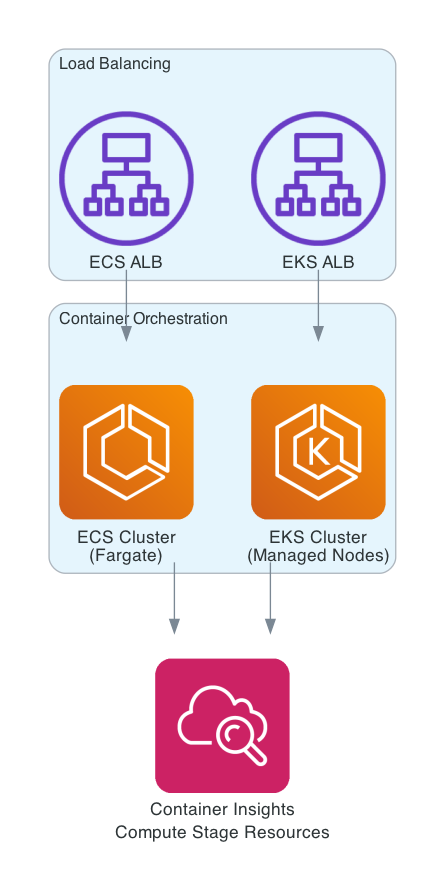
Deploys container orchestration platforms and optional search infrastructure.
- Amazon ECS — Fargate cluster for microservice tasks
- Amazon EKS — Kubernetes cluster with managed node groups (EC2)
- Application Load Balancers — Traffic distribution for ECS and EKS
- Container Insights — Enabled on both clusters
- OpenSearch Serverless — Collection, ingestion pipeline, and application (optional, requires
ENABLE_OPENSEARCH=true)
Note
Lambda functions and microservice task definitions are deployed in the Microservices Stage, not here. This stage only creates the clusters and load balancers.
5. Microservices Stage
Deploys all microservices, serverless functions, canaries, and WAF rules.
Microservices
- 4 ECS services: payforadoption-go, petlistadoptions-py, petsearch-java, petfood-rs
- 1 EKS deployment: petsite-net (with CloudFront distribution)
- 1 Bedrock AgentCore deployment: petfoodagent-strands-py
Lambda Functions
| Function | Runtime | Purpose |
|---|---|---|
| StatusUpdater | Node.js | Updates pet adoption status in DynamoDB |
| UserCreator | Python | Creates user records in Aurora PostgreSQL |
| RdsSeeder | Python | Seeds Aurora PostgreSQL |
| TrafficGenerator | Node.js | Generates synthetic traffic |
| PetfoodStockProcessor | Node.js | Processes food stock events from EventBridge |
| PetfoodImageGenerator | Python | Generates pet food images via Bedrock |
| PetfoodCleanupProcessor | Node.js | Cleans up expired food listings |
| DynamoCapacityTest | Python | DynamoDB write capacity testing |
Canaries
- TrafficGeneratorCanary — CloudWatch Synthetics canary for continuous traffic
- HousekeepingCanary — Periodic cleanup of stale resources
WAF (optional)
- Regional WAF on ALB (requires
CUSTOM_ENABLE_WAF=true) - Global WAF on CloudFront (requires
CUSTOM_ENABLE_WAF=true)
Stage Dependencies
flowchart TD
    subgraph CoreWave["Core Wave (parallel)"]
        Core["Core Stage"]
        Containers["Containers Stage"]
    end
    subgraph BackendWave["Backend Wave (parallel)"]
        Storage["Storage Stage"]
        Compute["Compute Stage"]
    end
    CoreWave --> BackendWave
    BackendWave --> Microservices["Microservices Stage"]