Culture · Japan
Culture · Japan
For over a thousand years, Kyoto was the imperial capital of Japan — a city of temples, tea houses, and garden philosophy where a different aesthetic logic governs every surface, every season, and every hour of the day. No city in the world rewards slow, attentive travel quite like this one.
While Tokyo dazzles with its velocity and modernity, Kyoto offers something rarer: depth. The city survived the Second World War largely intact and preserves over 1,600 Buddhist temples, 400 Shinto shrines, and 17 UNESCO World Heritage sites. Walking its older districts — particularly Gion, Higashiyama, and the preserved machiya (townhouse) streets of Nishiki — you encounter a Japan that has been tended with extraordinary care for centuries.
The seasonal calendar shapes the experience profoundly. Cherry blossom season (late March to early April) and autumn foliage (mid-November) are transformative but crowded. For a more serene visit, come in early June (just before the rainy season) or February, when cold days and thin crowds leave the garden temples nearly empty.
Practical tip
The IC card (Suica or ICOCA) is essential — a rechargeable transit card that works on buses, subways, and trains throughout the Kansai region. Kyoto's bus network is comprehensive but confusing; the subway is fast and simple. Many of the eastern temples (Higashiyama) are best reached on foot or by taxi in the early morning, before tour groups arrive from Osaka.
Kyoto rewards a neighbourhood-by-neighbourhood approach. Each district has its own atmosphere: Gion, the geisha quarter, is best walked at dusk when ochaya (teahouses) glow behind paper screens; Arashiyama in the western hills offers bamboo groves and riverside temples; the Philosopher's Path (Tetsugaku-no-michi) north of Nanzenji follows a canal lined with cherry trees and connects a chain of garden temples.
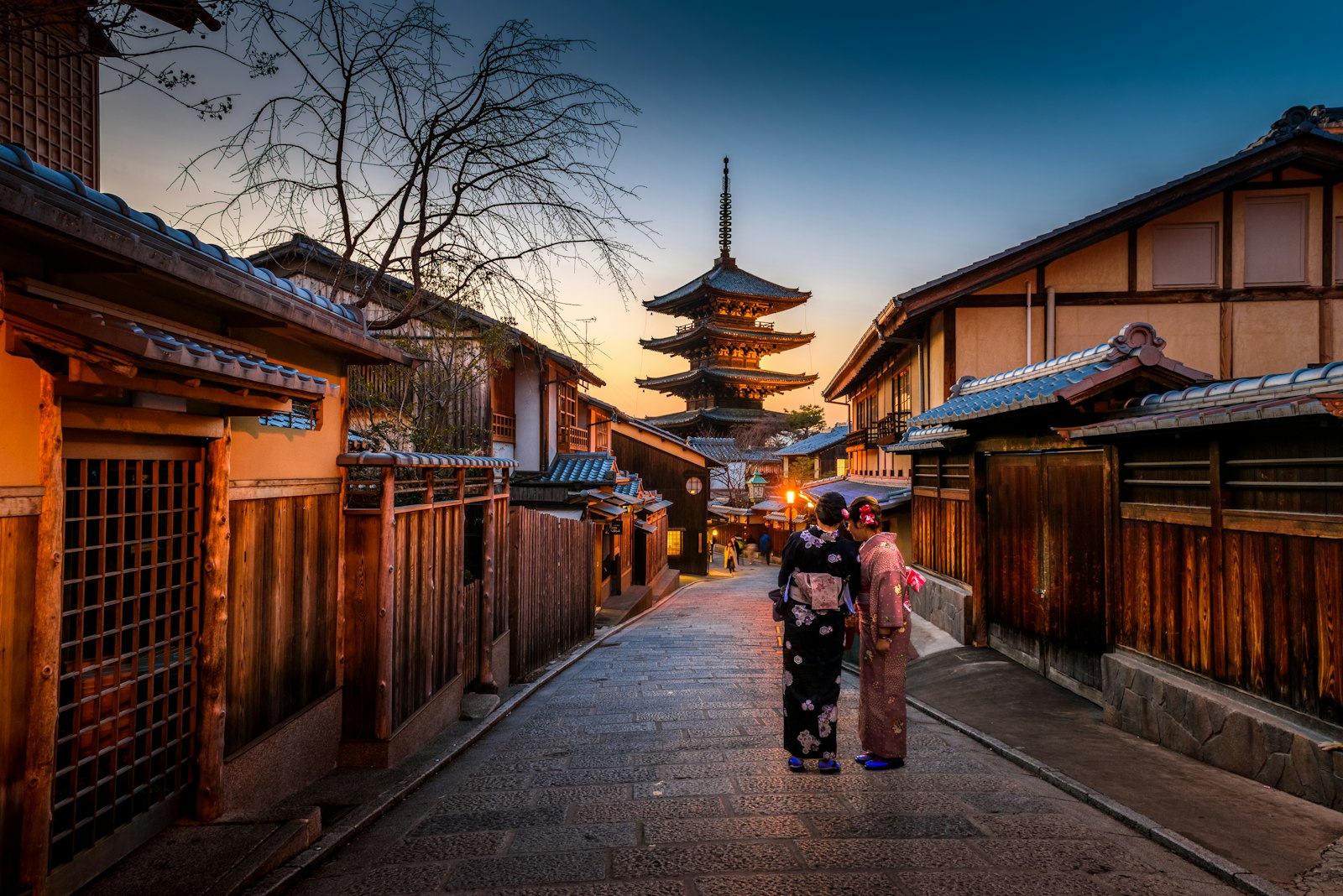
Kyoto's preserved geisha district — wooden ochaya lining stone-paved lanes, occasional glimpses of maiko (apprentice geisha) in full kimono. Visit at dusk on Hanamikoji Street.
Evening essentialThousands of vermillion torii gates winding up a forested hillside to the mountain summit shrine. Go before 7 am or after 5 pm to escape the worst crowds — the upper trails are almost always quiet.
Dawn visit recommendedBamboo groves, monkey parks, river boats, and the extraordinary Tenryuji garden — a UNESCO-listed composition of moss, raked gravel, and shaped pines that frames the hills behind perfectly.
Half-day excursionThe eastern foothills preserve some of Kyoto's most atmospheric streets — stone-paved lanes lined with craft shops leading to Kiyomizudera, the wooden temple that cantilevers over a forested ravine.
Morning walk recommended
Cherry blossom season (late March–early April) and autumn foliage (mid-October–late November) are Kyoto's most celebrated times — the city is magnificent but extremely crowded and expensive. Accommodation must be booked months in advance during these periods. June and September offer warm weather with fewer crowds; January and February are cold but serene, with temple gardens dusted with occasional snow.
The Gion Matsuri festival in July is one of Japan's most important — an entire month of processions, street food, and traditional performances. Arrive in the final week for the grand parade of wooden floats through the city centre.
Staying in a traditional machiya (wooden townhouse) or ryokan (Japanese inn) elevates the Kyoto experience considerably. A good ryokan includes a tatami room, futon bedding, kaiseki dinner, and a communal onsen — it is one of Japan's most distinctive hospitality experiences. Central locations in Nakagyo or the eastern Higashiyama area place you within walking distance of the major sites. For those who prefer a hotel, the Ritz-Carlton Kyoto on the Kamogawa River is superbly positioned.
Budget guide
Budget travellers staying in hostels can manage on ¥6,000–10,000 (€35–60) per day. A modest but comfortable experience — business hotel, restaurant meals — runs ¥18,000–30,000 (€110–180) per day. A quality ryokan with kaiseki dinner and breakfast typically costs ¥30,000–70,000 (€180–420) per person per night. The major temples charge ¥500–1,000 (€3–6) entry each.
Kyoto cuisine (Kyo-ryori) is among Japan's most refined — delicate seasonal ingredients prepared with minimal intervention to let natural flavours and textures lead. Kaiseki, the multi-course tasting menu derived from the tea ceremony tradition, is the city's highest culinary expression. Tofu dishes, yudofu (simmered tofu in dashi broth), and obanzai (Kyoto-style small shared dishes) reflect the city's Buddhist temple cooking heritage.
The Nishiki Market — a narrow covered arcade known as "Kyoto's Kitchen" — is the best place to sample local produce, pickles, fresh tofu, and grilled skewers. For coffee and a slower morning, Kyoto's specialty coffee scene is quietly excellent, clustered particularly around the Shimogamo and Nakagyo districts.
From the Amalfi Coast to Patagonia's granite towers — there's always another journey waiting.
Browse all guides