All Resources
One place to search every blog, video, code sample, and guide published for Amazon Bedrock.

Build a Serverless AI Application with AWS Lambda and Amazon Bedrock
A beginner tutorial that builds a question-answering API: API Gateway receives the request, a Python Lambda function calls a foundation model through the Amazon Bedrock Converse API, and the answer is returned to the user. Covers granting the Lambda execution role IAM permission for bedrock:InvokeModel and walks through the handler code.

Build an AI Resume Analyzer with Amazon Bedrock
A step-by-step Python tutorial for a resume analyzer that extracts text from a PDF resume, builds a prompt that compares it with a job description, and calls a foundation model through the Amazon Bedrock Converse API to return structured feedback on skills and fit. The app gets a Streamlit front end.
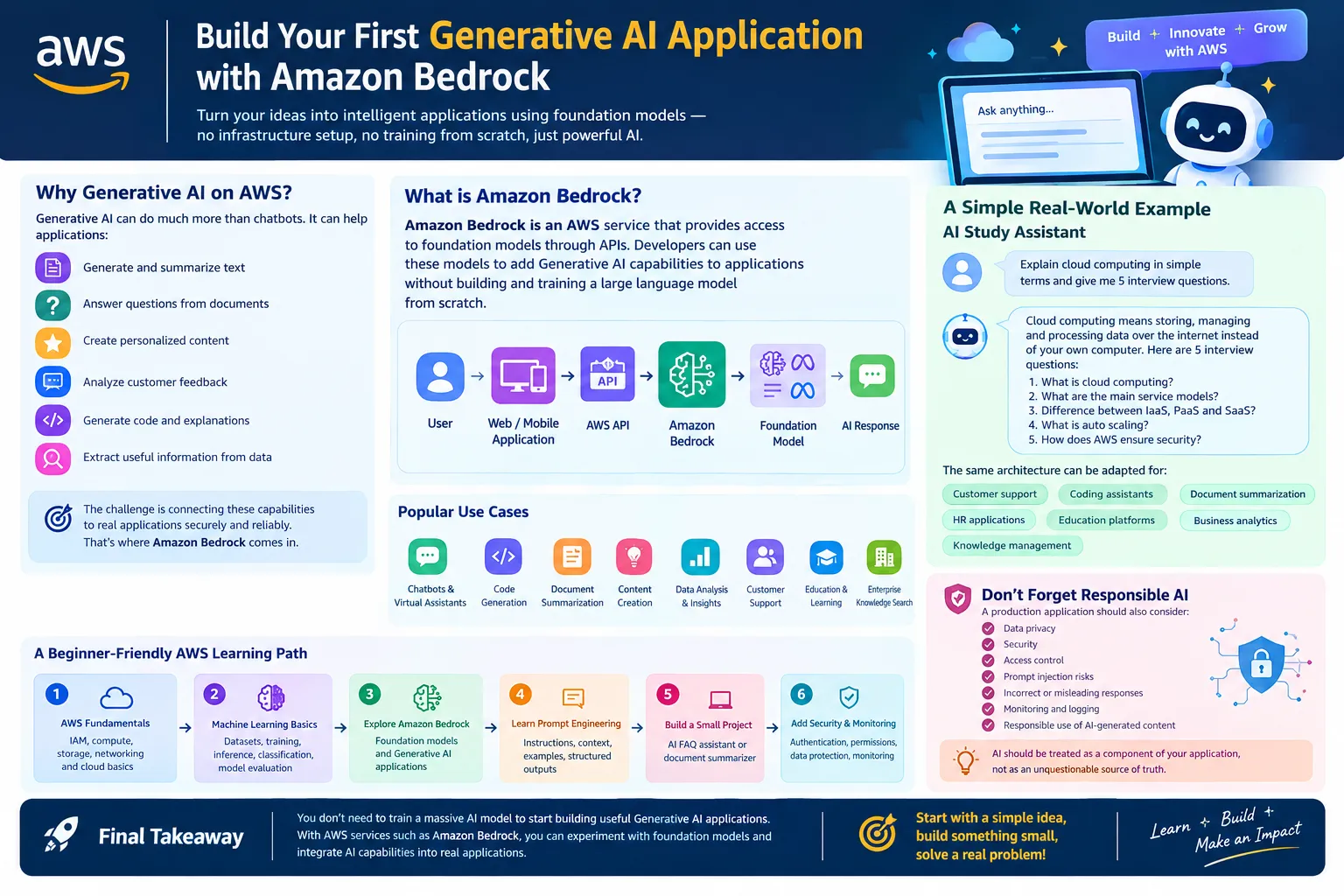
Build Your First Generative AI Application with Amazon Bedrock
A beginner overview of Amazon Bedrock that explains how applications reach foundation models through AWS APIs without managing model infrastructure, and lists common use cases. Covers responsible-AI concerns such as prompt injection and access control, plus a learning path that runs through prompt engineering and a first small project.
Building a Simple RAG Application with Amazon Bedrock
Introduces Retrieval-Augmented Generation and how to build a simple RAG application with Amazon Bedrock: chunk documents, embed them, store vectors for similarity search, and pass retrieved context to an LLM. Suggests Amazon S3 for document storage and IAM for access control, and notes that chunking, embedding model choice, and retrieval strategy drive answer quality.
Exploring Semantic Search on Amazon DynamoDB Vector Search with Amazon Bedrock Embeddings
A proof-of-concept Spring Boot application that ingests an arXiv dataset, generates embeddings for each title and abstract with Amazon Bedrock Titan Embed Text V2, and stores the vectors with metadata in Amazon DynamoDB. Queries are embedded with the same model and ranked by cosine similarity, and the post discusses trade-offs against a managed vector index.

From Prompt to Production: Building a Secure AI Assistant on AWS
Lays out a serverless architecture for an AI assistant in which API Gateway fronts a Lambda function that validates requests, calls Amazon Bedrock, and stores data in DynamoDB. Covers the request flow, IAM-based access control, CloudWatch monitoring, scaling, failure handling, and cost considerations for running it in production.
Automating AI Video Directors with Bedrock & Node.js
Shows how to build a deterministic video-generation pipeline with Amazon Bedrock and Node.js. Instead of free-form text prompts, the backend forces Claude to return a strict JSON schema through a tool configuration, producing consistent motion-graphic blueprints (visuals, camera moves, audio cues, typography timing) for brand intros and event videos.
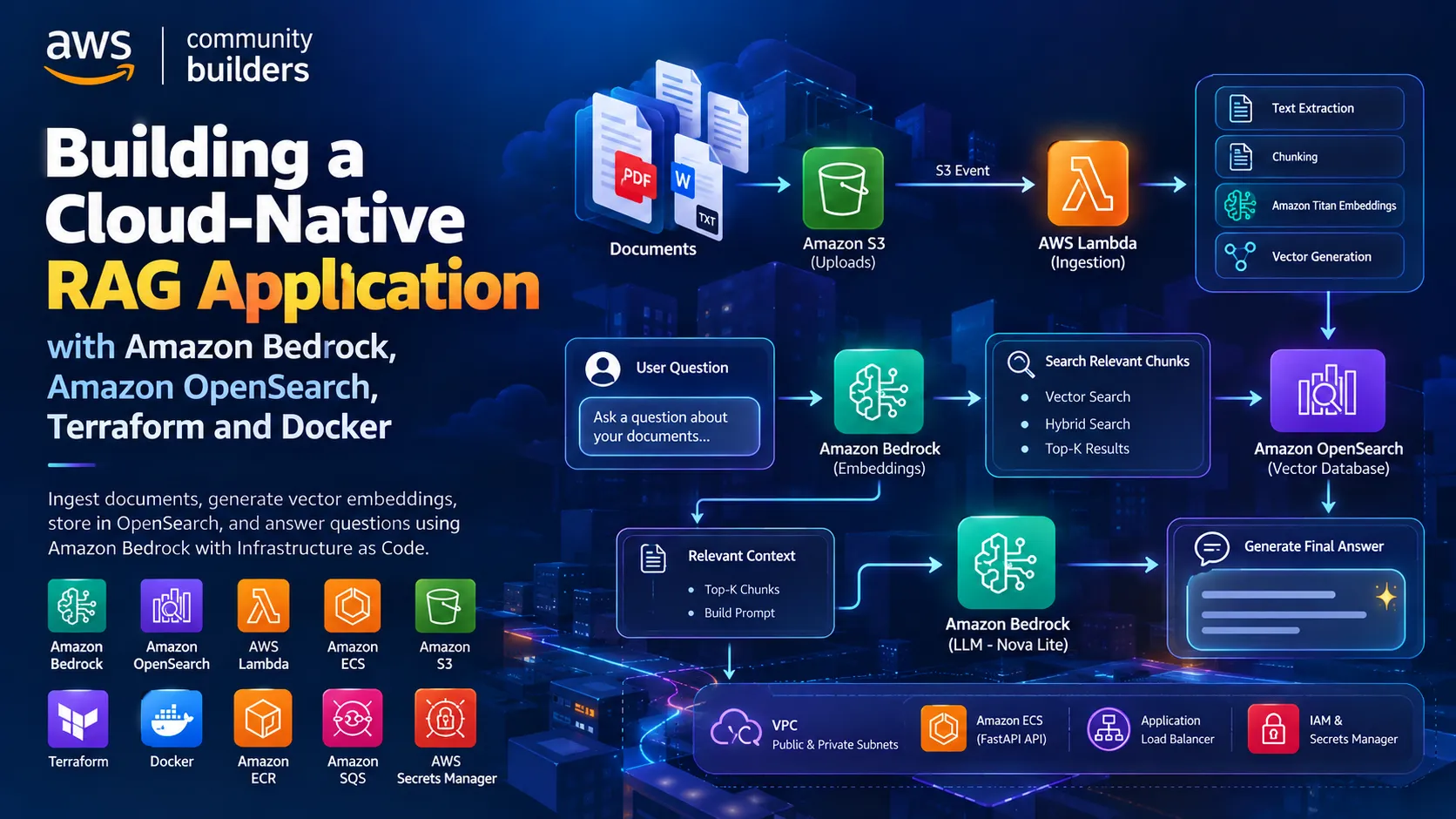
Building a Cloud-Native RAG Application with Amazon Bedrock and OpenSearch
A walkthrough of a RAG application built with Amazon Bedrock and Amazon OpenSearch Service. Documents land in Amazon S3, AWS Lambda chunks them, Amazon Titan Text Embeddings generates vectors stored in an OpenSearch k-NN index, and a FastAPI service on Amazon ECS with Fargate handles vector or hybrid retrieval and answer generation. Terraform provisions the infrastructure.
Designing an Event-Driven AI Knowledge Platform for Campus Documents with AWS
A reference architecture for turning scattered college documents (notes, question papers, placement notices, event files) into a searchable knowledge platform with grounded answers. Uploads to Amazon S3 trigger asynchronous processing through Amazon SQS and AWS Lambda, Amazon Bedrock Knowledge Bases handles retrieval-augmented generation, Amazon DynamoDB stores metadata, and Amazon API Gateway serves queries.
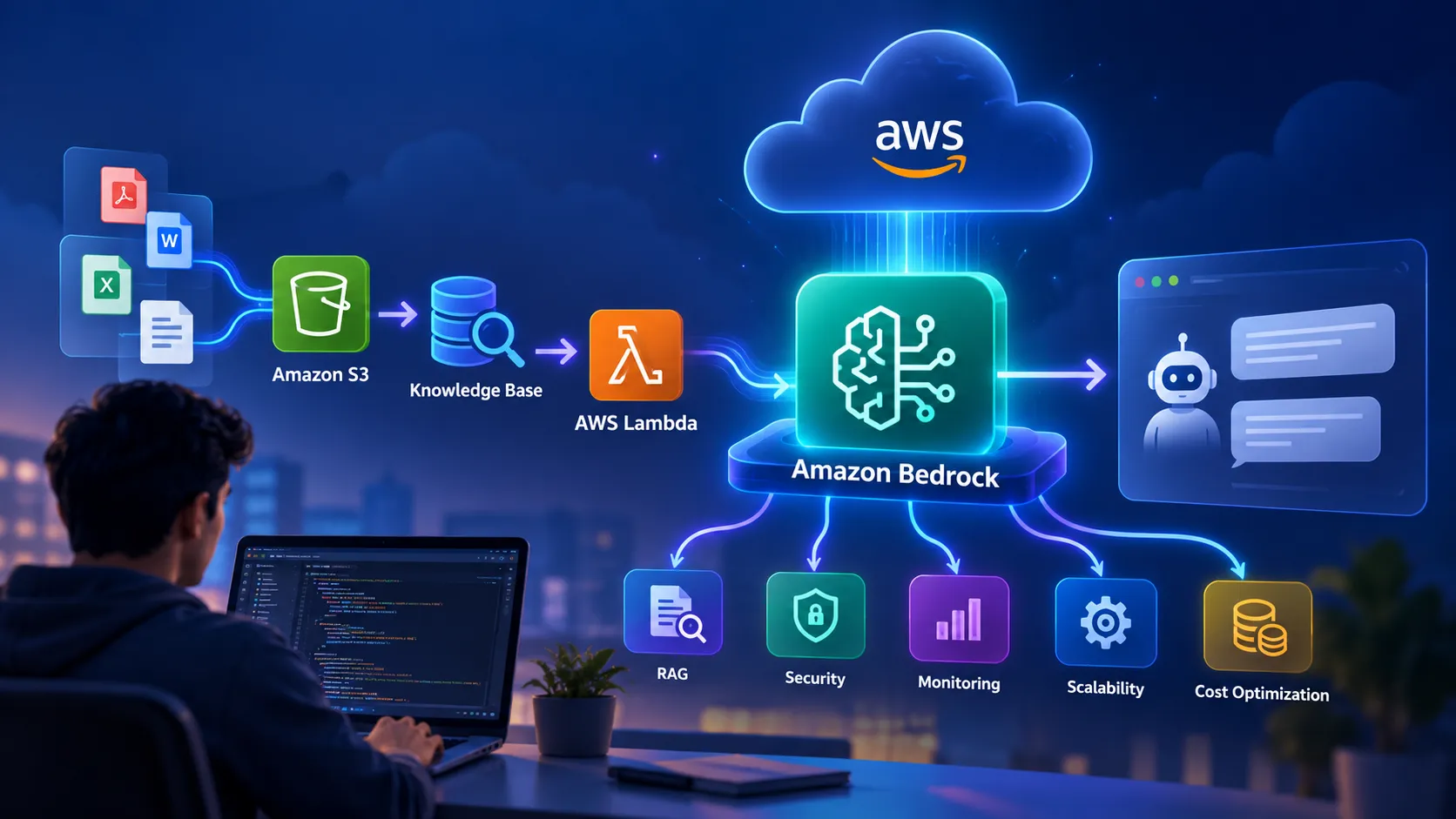
From AI Idea to Production: A Practical Guide to Building Generative AI Applications on AWS
A practical guide to taking a generative AI idea to a production application on AWS. It covers where Amazon Bedrock, Amazon S3, and AWS Lambda fit, when to choose RAG over fine-tuning, and the security, hallucination handling, observability, and cost decisions that separate a demo from a dependable system.

GPT-6 Astra on Amazon Bedrock: What It Means for AI Developers
An overview of OpenAI's GPT-6 Astra, now generally available on Amazon Bedrock, and what it offers developers: deeper reasoning, a context window of up to 1 million input tokens, and computer and browser use. The article describes how the model can drive AI agents that call tools and APIs, with use cases in software investigation, contract and document analysis, and multi-step workflows.
sample-bedrock-quota-checker
A Python collector that runs in AWS CloudShell or locally and builds an offline HTML report of an account's Amazon Bedrock quotas, model availability, inference profiles, and historical usage from CloudWatch metrics. It exports the quota inventory to CSV and JSON and uses only read-only AWS operations, without invoking models or changing resources.
Build an AI-Powered SQL Query Generator with Amazon Bedrock
A hands-on Python tutorial for building a SQL query generator that turns natural-language questions into read-only SQL using Amazon Bedrock and the Converse API. It covers schema-aware prompt construction, validation of generated queries, and safeguards such as Amazon Bedrock Guardrails for prompt-attack detection.

Build Your First AI App on AWS: Lambda + Amazon Bedrock
A beginner overview of a serverless AI app where a frontend sends questions through Amazon API Gateway to AWS Lambda, which calls foundation models on Amazon Bedrock and returns the response. It lists example use cases such as study assistants and document summarizers, plus considerations like least-privilege permissions and cost.
Build Your First AI-Powered Document Q&A App with Amazon Bedrock Knowledge Bases
A beginner introduction to retrieval-augmented generation that walks through building a document question-answering app with Amazon Bedrock Knowledge Bases. It explains embeddings, vector storage, Amazon S3 as a data source, and the difference between the Retrieve and RetrieveAndGenerate operations.
Building a Serverless AI Application on AWS: A Beginner’s Architecture Guide
A beginner architecture guide for a serverless AI application in which Amazon API Gateway routes requests to AWS Lambda, which calls Amazon Bedrock and stores data in DynamoDB, with Amazon S3 holding uploaded documents. It suggests an AI study assistant as a practice project.
Building a Serverless AI Study Assistant with Amazon Bedrock and AWS
An architecture walkthrough for a serverless AI study assistant that uses API Gateway and AWS Lambda for the backend, Amazon Bedrock for generation, DynamoDB for conversation history, and Amazon S3 for study materials. It also covers prompt design, least-privilege IAM, and monitoring.
I Gave an AI Agent a Job: Building a Study Buddy with Amazon Bedrock
The author builds a serverless study buddy that creates learning plans, answers questions from uploaded notes, generates quizzes, and tracks progress. It uses Amazon Bedrock for generation, AWS Lambda and API Gateway for the backend, DynamoDB for progress, S3 for materials, and OpenSearch Serverless for semantic retrieval, with controlled tool actions and structured model outputs.
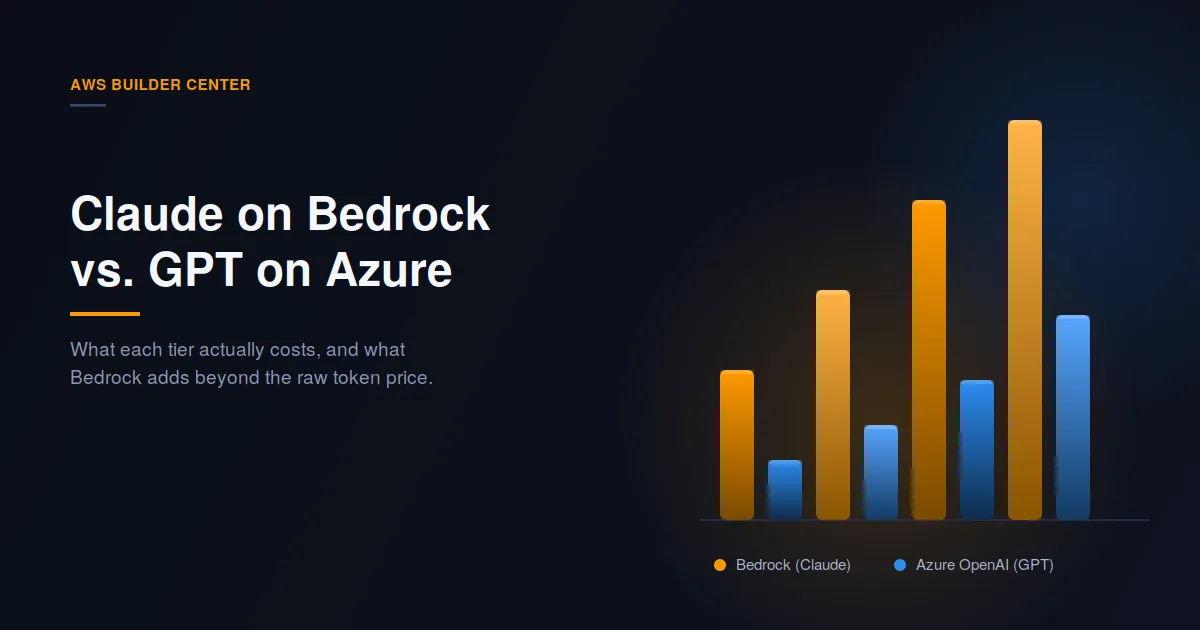
Running Claude on Amazon Bedrock: What It Costs vs. the GPT Alternative on Azure
A guide to choosing a Claude tier on Amazon Bedrock, with per-token pricing for Claude Haiku 4.5, Sonnet 5, and Opus 5 and a worked cost example for a support chatbot. It covers what Bedrock adds beyond the model (Guardrails, Knowledge Bases, IAM access control, one AWS bill), how batch inference and prompt caching lower costs, and how pricing compares with GPT on Azure OpenAI.

Stop Hallucinating: Adding RAG to Amazon Bedrock with Knowledge Bases
A five-step setup for a document-grounded chatbot using Amazon Bedrock Knowledge Bases. Documents in Amazon S3 are embedded with Amazon Titan Text Embeddings v2 into an auto-provisioned Amazon OpenSearch Serverless vector store, and Claude 3.5 Sonnet answers questions with source citations. Includes notes on chunk sizes and cleaning up to avoid idle costs.
Agentic conversational video intelligence built on AWS
A conversational video intelligence solution in which a single Strands Agents SDK agent decides at runtime whether to call Amazon Bedrock, Amazon Rekognition, or Amazon Transcribe to answer natural language questions about uploaded videos. The post covers the architecture, caching of analysis results, security controls, and deployment on Amazon ECS with AWS Fargate.

Build a Serverless AI Chatbot with Amazon Bedrock
A short walkthrough of a serverless chatbot in which API Gateway forwards messages to an AWS Lambda function that calls Amazon Bedrock and stores conversation history in DynamoDB, with IAM controlling access between services.
Building an AI-Powered Document Q&A Application with Amazon Bedrock and Amazon S3
A practical guide to a document Q&A application where users upload files to Amazon S3 and ask natural-language questions answered by foundation models on Amazon Bedrock. It introduces RAG, extends the design with Amazon Bedrock Knowledge Bases, and covers IAM access control and CloudWatch monitoring.
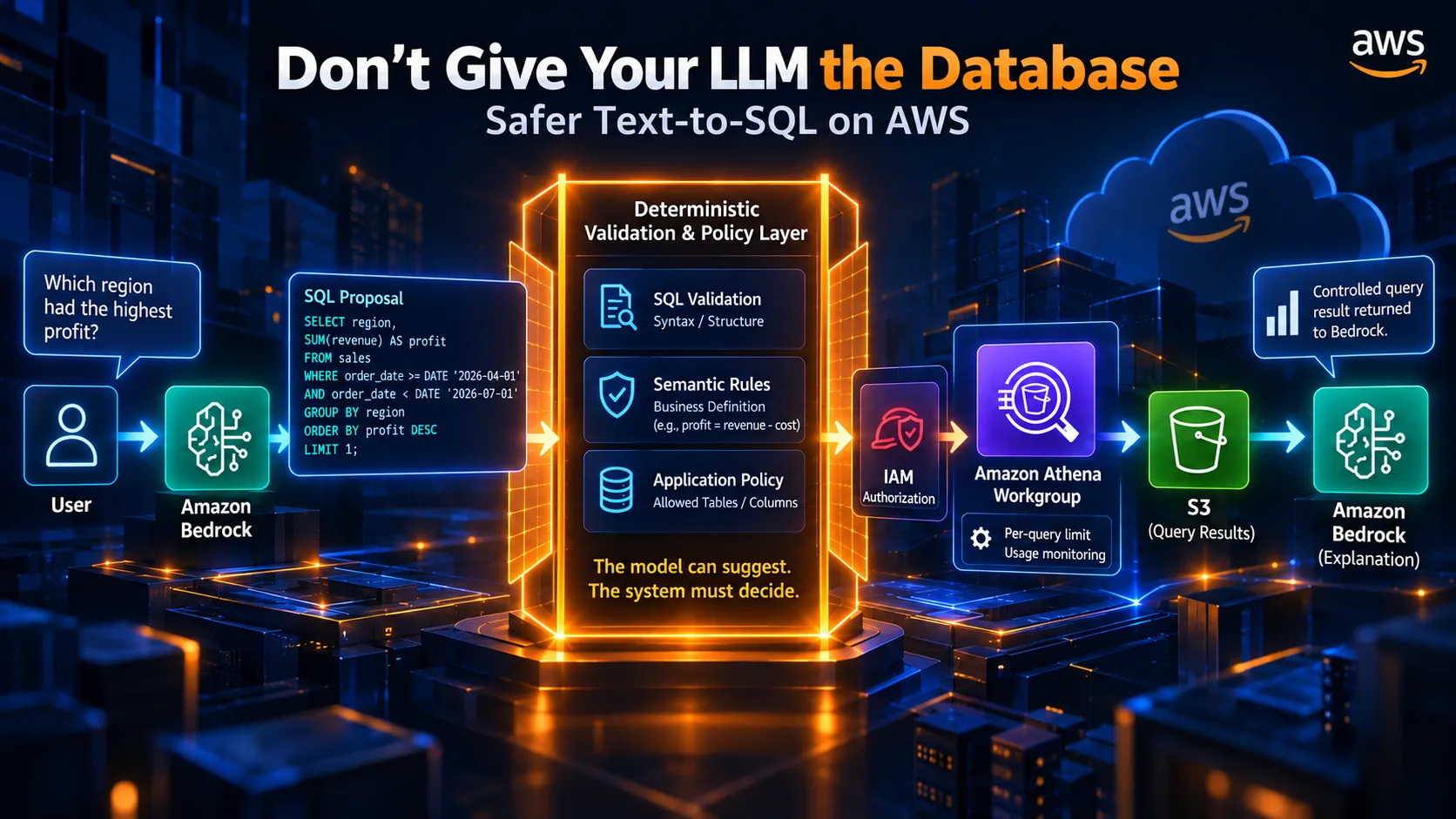
Don't Give Your LLM the Database: Safer Text-to-SQL on AWS
Builds a student-scale text-to-SQL pattern in which Amazon Bedrock proposes SQL through the Converse API with structured output, deterministic validation decides whether the query is allowed, and an Amazon Athena workgroup runs approved queries over Parquet data in Amazon S3. Authorization, scan cost, and semantic limits stay explicit, outside the model.

Exploring Generative AI on AWS: A Student's Intro to Amazon Bedrock
A student preparing for the AWS Certified AI Practitioner exam explains how Amazon Bedrock provides serverless access to foundation models through one API, and covers foundation models, RAG, fine-tuning, and Guardrails for Amazon Bedrock. The post closes with a knowledge assistant pattern that stores documents in Amazon S3, indexes them in Amazon OpenSearch Serverless, and queries Bedrock from AWS Lambda.

From Lakehouse to GenAI: Query Apache Iceberg Data Using Amazon Bedrock and Athena
A reference architecture for a governed natural-language query layer over an Apache Iceberg lakehouse. Amazon Bedrock uses semantic metadata retrieval (RAG) to generate SQL, the SQL is validated, and Amazon Athena executes it. AWS Glue Data Catalog, IAM, Lake Formation, and Amazon CloudWatch handle governance and auditing.
Getting Started with Generative AI Using Amazon Bedrock: A Student Guide
An introductory guide for students that explains what Amazon Bedrock is and lays out a learning path: AWS fundamentals such as IAM, Amazon S3, AWS Lambda, and Amazon CloudWatch, then the Bedrock console, then a small learning-assistant project. It also points to retrieval-augmented generation (RAG) as a next step and covers responsible AI considerations.
Use open weight models as your AI coding agent with Amazon Bedrock
How to pair OpenCode, an open source terminal-native AI coding agent, with open weight models on Amazon Bedrock such as Kimi K3, GPT-OSS 120B, and Nemotron 3 Super 120B through the Converse API. It covers multi-model workflows that match a model to each task, cross-Region inference profiles, and how Ethara.AI runs the setup in production with multi-agent orchestration.
What Actually Happens Inside AWS When You Query a Bedrock Knowledge Base
Walks through each stage of an Amazon Bedrock Knowledge Base, from the ingestion job through chunking strategies, vector store fields, and retrieval with hybrid search and metadata filters, to the RetrieveAndGenerate prompt template placeholders. Each stage comes with AWS CLI commands for inspecting it in your own account.
sample-managed-knowledge-base-patterns
Reference implementations for Amazon Bedrock Managed Knowledge Base, each a self-contained pattern with its own architecture notes, tests, and infrastructure. The first pattern, unified-search, provides enterprise search and chat over a managed knowledge base with document-level access control, so users issuing the same query see only the documents they are allowed to read. Built with React, NestJS, and the AWS CDK.
Amazon Bedrock Managed Knowledge Base now supports Salesforce and Zendesk as native data source connectors
Amazon Bedrock Managed Knowledge Base adds native Salesforce and Zendesk connectors that handle crawling, metadata extraction, and incremental sync of knowledge articles and community posts, removing the need for custom ingestion pipelines.

Amazon Bedrock: Building Generative AI Applications on AWS
A short beginner overview of Amazon Bedrock as a managed service for building generative AI applications on foundation models. It lists use cases such as chatbots, content generation, and question answering, describes how Knowledge Bases connect models to organizational data through RAG, and notes the benefit of model choice.

BedRook | S01E02. maxTokens Decides Whether Your LLM Answers at All: 1,024 vs 16,384 on Amazon Bedrock
A chess benchmark of 65 Amazon Bedrock models, run at output budgets of 1,024 and 16,384 tokens per move. Several reasoning models that finished almost no games at the smaller budget finished nearly all of them at the larger one, while the Claude Opus 4.x models scored about the same either way. The author suggests testing prompts at two budgets and logging stopReason to catch truncated responses.
Beyond Vector Search: Building Zero-Hallucination GraphRAG Applications with Amazon Neptune and Amazon Bedrock
A GraphRAG walkthrough that pairs an Amazon Neptune knowledge graph with Amazon Bedrock. Claude 3.5 Sonnet turns a natural-language question into an openCypher query, Neptune runs the multi-hop traversal, and Bedrock writes a grounded answer from the returned graph paths. Python orchestration code is included.
Bring more intelligence to everyday work with GPT-6 Sol and GPT-6 Luna on Amazon Bedrock
OpenAI's GPT-6 Sol and GPT-6 Luna are generally available on Amazon Bedrock at lower API pricing than their GPT-5.6 predecessors. Sol targets recurring complex work such as coding and multistep tool use, and Luna targets high-volume extraction, summarization, and classification. Both support explicit prompt caching on Bedrock.
Claude Opus 5.5 is now available on AWS
Claude Opus 5.5, Anthropic's most capable Opus model for agentic coding, knowledge work, and long-running tasks, is available on Amazon Bedrock and Claude Platform on AWS. The post covers its improvements over Claude Opus 5, including lower cost per task and always-on adaptive thinking, and shows how to call it with the Invoke, Converse, and Anthropic Messages APIs.