Run a full database modernization assessment with Claude Code
Give this tool the schema and queries of a monolithic relational database. It tells you which queries belong on which AWS purpose-built engine and designs the target schemas.
The input is one collection file. For your own database, you make it with the read-only collection script for your engine (scripts/collect-postgresql.sql, collect-mysql.sql, collect-sqlserver.sql or collect-oracle.sql), run with your own credentials; no row value goes into the file. The bundled WordPress and Discourse samples are synthetic collections. Get started says what the file holds.
Run this command in Claude Code with the repository open. The chat reports each phase, and by default a local UI opens next to it: the chat links the assessment's summary page (the Sankey of queries to engines) at the approval gate and its results page (the headline, the deliverable downloads, the cost, the migration roadmap and the schema designs) at the end.
Get started with Claude Code See a sample report
Demo
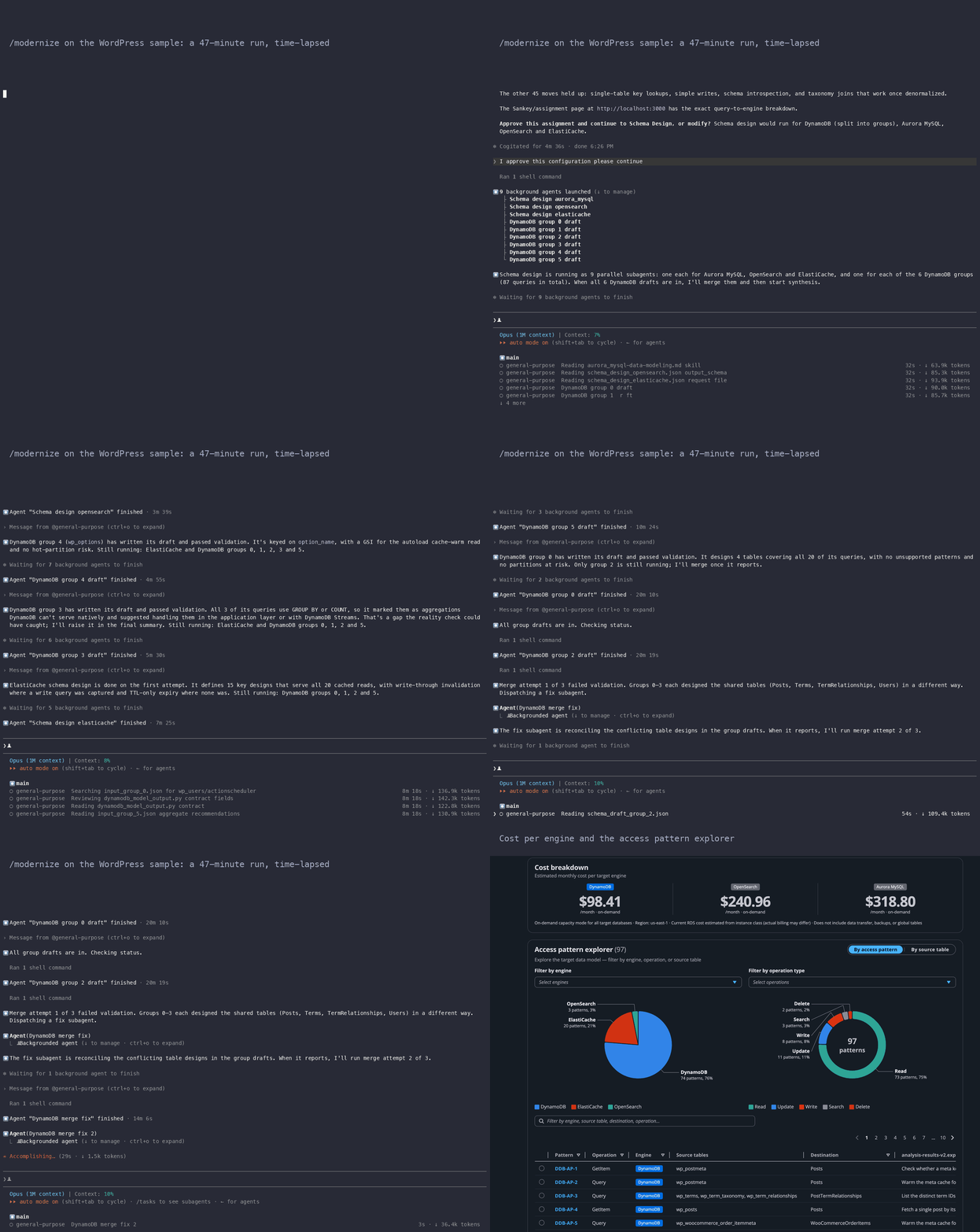
A full /modernize run on the WordPress sample (about 21 minutes, time-lapsed to 76 seconds) with its one approval gate and final summary, then the assessment's results and summary pages in the local UI and four pages of the executive report PDF.
What it answers
- Which queries go where. Every query pattern is scored against every engine that can own it. The assignment is deterministic: the scores decide it, not a model, and all of a table's writes land on one engine, its source of truth.
- What the target schemas look like. DynamoDB tables, DocumentDB collections, OpenSearch mappings and the relational schema that stays, all designed from your workload.
- What it costs and what the risks are. The same run produces TCO projections and a risk register. The migration roadmap shows a suggested step-by-step path in waves, each with the gate to clear before the next, next to the fully decomposed target.
- How to take the first step. For a MySQL or PostgreSQL source,
/test-routinestests the routines the plan carries on a throwaway Aurora test cluster, and/move step-1moves the database into Aurora with AWS DMS, asking before each AWS write. The cutover is your responsibility.
See Understand the results for how to read every deliverable, and After the assessment for the commands that follow it.
Moving off a monolithic relational database raises hard questions. Which queries belong in DynamoDB? Which need a document store? What stays relational? A wrong answer can force a redesign in the middle of the project.
Database Modernizer Assessment answers these questions using your real workload. It scores every query against the AWS purpose-built engines, places each query on its best-fit engine, checks that the resulting architecture holds together, and produces schema designs, a migration roadmap in waves and a cost projection you can implement. The engine placement is deterministic: the scores decide it, not a model, so it comes out the same on every run and can be audited. A model writes the schema designs and the executive summary.
- Sources: PostgreSQL, MySQL, MariaDB, SQL Server and Oracle. A SQL Server or Oracle source moves to whichever Aurora engine scores higher on its workload (Aurora PostgreSQL unless Aurora MySQL scores clearly higher), so wave 1 includes a schema and dialect conversion (the plan says that wave is not yet optimized for heterogeneous migrations).
- Targets: DynamoDB, DocumentDB, Aurora PostgreSQL and Aurora MySQL own queries; ElastiCache can sit in front as a cache, and OpenSearch can serve search as a read model.
- Your data stays yours: the collection scripts are read-only, and no row value goes into the collection. They collect the schema, query shapes and counters; query text can still carry literal values.
Who is this for?
Teams that have decided to refactor their application to use purpose-built databases. It helps you figure out which queries go where and what the target schemas should look like.
Who is this NOT for?
- Lift-and-shift migrations: If you're moving a database as-is to RDS or Aurora without changing the data model, you don't need this tool.
- Tight deadline migrations: This tool guides application refactoring, which takes time. If you need to migrate by next week, use AWS DMS for a straight move.
- Teams that haven't committed to refactoring: If you're still deciding whether to modernize, start with the AWS Migration Evaluator or a Well-Architected review first.
Sample project
This is a sample project intended for educational and evaluation purposes. It requires proper review, testing, and modification before use in production environments. Use at your own risk.