Rede Mater Dei - AI Agents for Healthcare Revenue Cycle
Workload: Workflow agent
Industry: Healthcare | Workload pattern: Event-driven multi-agent | Integration type: EHR system integration
Source
Publication date: See linked source.
Customer context
Rede Mater Dei de Saúde is a major Brazilian hospital network with 45+ years of service and 8+ locations. The organization manages a high volume of healthcare billing operations and is subject to Brazilian healthcare regulatory requirements that demand full auditability of clinical and financial decisions.
Challenge
Claim denials jumped to approximately 16% sector-wide, representing about R$10B in lost revenue across the healthcare sector. Manual, fragmented billing processes at Rede Mater Dei could not keep pace with regulatory complexity and submission volume, creating bottlenecks in authorization, coding, and claim validation.
Solution
Rede Mater Dei chose to deploy 12 specialized AI agents on Amazon Bedrock AgentCore, each focused on a distinct revenue cycle function: claim validation, denial analysis, medical coding checks, authorization requests, and contract verification. Each agent is containerized and runs on AgentCore Runtime, triggered by billing events from hospital EHR systems. Built-in observability captures every execution for audit and continuous improvement.
AgentCore services used
| AgentCore Service | How Rede Mater Dei configured it | Why it mattered |
|---|---|---|
| Runtime | 12 containerized agents, event-driven triggers | Each agent focused on a specific billing task and scaled on demand |
| Observability | Full trace capture of every agent execution | Regulatory compliance and continuous process improvement |
Architecture pattern
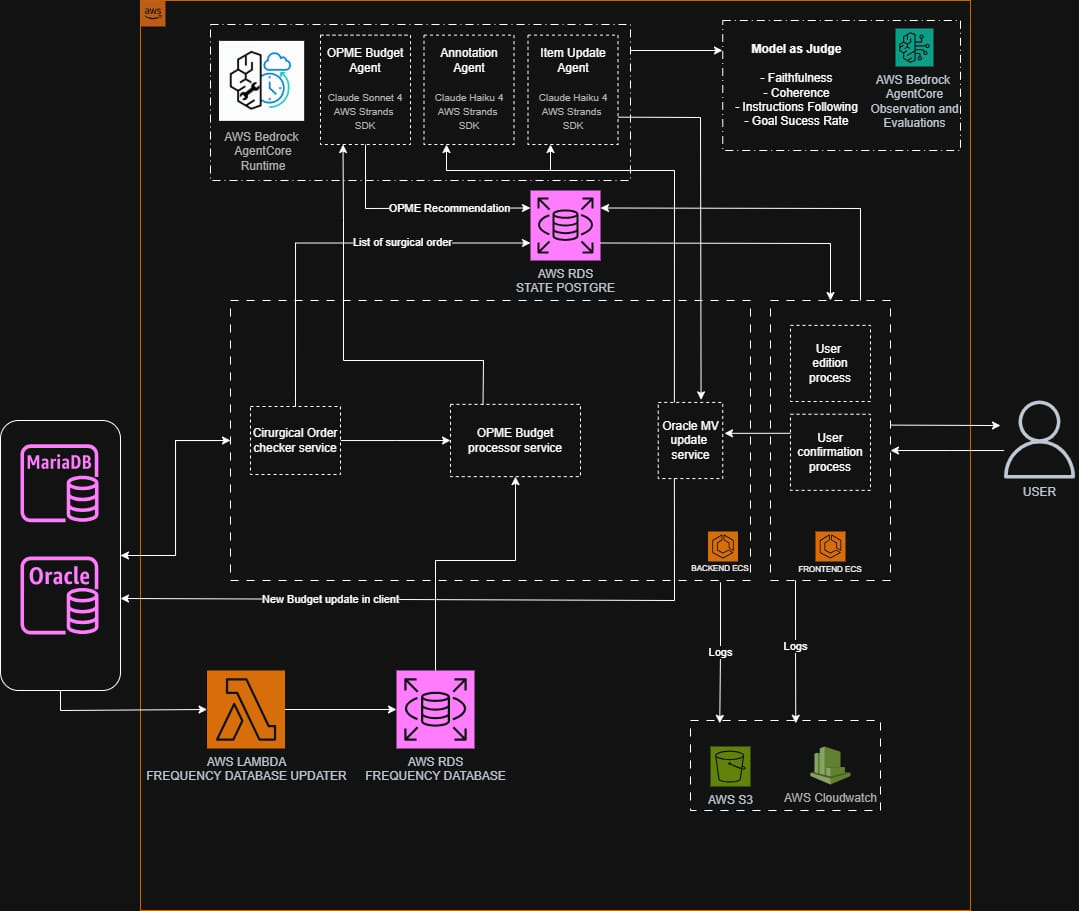
Architecture interpretation by this site based on the public source.
The diagram above shows billing events entering from EHR systems, being routed by an event dispatcher to one of 12 specialized agents, each running independently on AgentCore Runtime, with results written back to claim records and execution traces captured for observability.
Entry point: Billing events from hospital EHR systems. Main flow: Events are routed to the relevant specialized agent, which calls Bedrock models with claim data, then writes the outcome back to the claim record. Key boundary: Each agent has a single bounded responsibility; none spans multiple revenue cycle functions.
Results
Transferable lessons
- Rede Mater Dei chose to decompose the revenue cycle by business function rather than build a monolithic agent. This gave each agent bounded scope and clear responsibilities, simplifying both development and debugging.
- The team prioritized observability from day one given healthcare's regulatory requirements. Every agent execution is traced, which supports compliance reviews and continuous improvement.
- Starting with high-impact, narrowly scoped tasks (authorization validation) before expanding to more complex workflows helped build organizational confidence in the system.
When this is relevant
This pattern fits organizations that need to automate a large family of related but distinct tasks, where each task has its own data sources, validation rules, and failure modes. Healthcare revenue cycle, insurance claims, and financial compliance workflows share this profile. The event-driven trigger model is appropriate when tasks are initiated by external system events rather than user requests.