Quick Agent Assets Deployment
Deploy and migrate Amazon Quick Suite resources — Chat Agents, Action Connectors, and S3 Knowledge Bases — between AWS accounts through a Model Context Protocol (MCP) server hosted on Amazon Bedrock AgentCore Runtime. The server can be driven directly from Amazon Quick (as an action connector) or from any MCP-compatible client.
The deployment is resource-driven: choose a resource type (
agent|connector|knowledge_base) and select resources by id, by name, or all. Spaces are not created or linked. Agents are recreated with their Action Connectors attached (remapped to the target account) but with no Space attachment. Permissions are not hard-coded: the server describes each source resource's permissions and replays the identical actions in the target, remapping principals to a real registered user in the target account.
Problem statement
Promoting Quick resources from one account to another (for example,
dev → prod) by hand is slow and error-prone:
- Each Agent, Action Connector, and Knowledge Base must be recreated individually with the correct configuration.
- Resource permissions must be re-granted, with principals remapped to the target account's registered users.
- Agents must be recreated with their Action Connectors re-attached so the migrated app behaves like the original.
- S3-backed knowledge bases need their bucket, bucket policy, and data source provisioned before the KB can be registered.
Doing this repeatedly across environments is exactly the kind of deterministic, idempotent work that should be automated.
What this solution provides
- A single
migrate_resourcesMCP tool that migrates a selected set of resources (Agents, Action Connectors, or S3 Knowledge Bases) cross-account in one call, and a read-onlypreview_migrationtool for a dry run. - Simple selection — pick a
resource_type(agent|connector|knowledge_base) and choose resources by id, by name, or all. No Spaces are involved in selection or migration. - Idempotency — every resource is created-or-updated, so re-running a migration converges instead of producing duplicates.
- Agents keep their connectors — migrated agents are recreated with their Action Connectors attached (remapped to the target account) but with no Space attachment.
- Permission fidelity — permissions are copied by describing the source and replicating the exact actions, with principals resolved to a real user in the target account.
- Infrastructure as code — CloudFormation templates for the IAM roles, VPC network, and the AgentCore runtime (Cognito JWT auth + VPC network mode).
Architecture
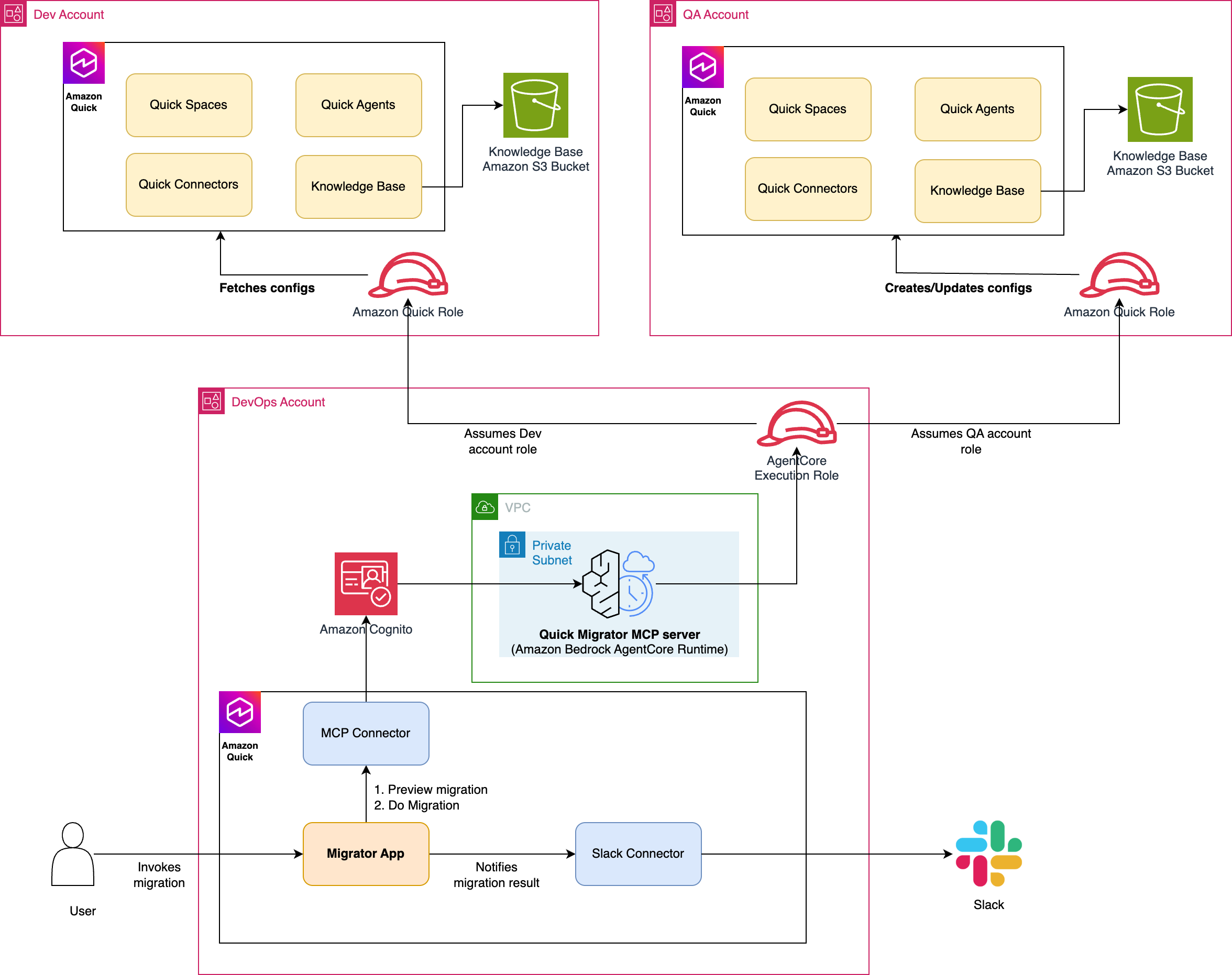
| Component | Account | Responsibility |
|---|---|---|
| AgentCore Runtime (MCP server) | Central (Runner) | Hosts server.py; assumes into source & target; orchestrates the migration. Runs in VPC network mode with a Cognito JWT authorizer. |
| Amazon Cognito | Central (Runner) | User pool + resource server + app client. Issues the OAuth2 JWT (scope invoke) that callers present to AgentCore. |
| Runner execution role | Central (Runner) | AgentCore's execution role: Bedrock InvokeModel, CloudWatch Logs, X-Ray, and sts:AssumeRole into the source & target roles. |
quick-space-migrator-role |
Source | Read-only QuickSight describe/list permissions + KB read. |
quick-space-migrator-role |
Target | Read-write QuickSight create/update permissions + KB and S3 write + ListUsers for principal resolution. |
Migration flow (migrate_resources)
- Resolve resources — from
resource_type+search_by(id|name|all) +value, resolve the concrete resource IDs in the source account. - Migrate the selected type:
- Connectors — recreate each connector; authentication config is sanitized to the create (write) model with placeholder secrets, so connectors must be re-authenticated in the target UI. Copy permissions.
- Knowledge bases — verify the QuickSight service role, create the target
bucket (
knowledge-base-<env>-<account>) + bucket policy + data source + KB, then copy KB permissions. (S3 objects are not copied.) - Agents — recreate each agent with its Action Connectors attached (remapped to the target account) and no Space attachment, then copy agent permissions.
- Report — return a JSON report of the created/updated resources, buckets,
skipped_permissions, and errors.
Data note: the migrator provisions the target KB bucket and registers the knowledge base, but does not copy the S3 objects themselves. Sync the documents (e.g.
aws s3 sync) and trigger a KB ingestion separately. See docs/knowledge-base-iam-setup.md.
Repository layout
quick-space-migrator-mcp/
├── src/
│   └── server.py                     # The MCP server (the only first-party runtime file)
├── infrastructure/                   # CloudFormation templates (deploy in this order)
│   ├── runner-role.yaml              #   1. Central account: AgentCore execution role
│   ├── quick-migrator-role.yaml      #   2. Source & target account cross-account role
│   ├── network.yaml                  #   3. VPC, subnets, NAT, endpoints, security groups
│   └── agentcore-runtime.yaml        #   4. Cognito + AgentCore runtime
├── scripts/                          # Deployment automation (wrappers over the templates)
│   ├── build.sh                      #   Package server.py + deps → build/deployment.zip (ARM64)
│   ├── deploy-roles.sh               #   Deploy runner → source → target roles (ordered)
│   ├── deploy-network.sh             #   Deploy the VPC network stack
│   └── deploy.sh                     #   Build, upload artifact, deploy the runtime
├── examples/                         # Optional helper scripts for testing
│   ├── setup_source.py               #   Seed a source account with sample spaces/agents/KB
│   └── manage_agent_space.py         #   Attach/detach a space from an agent
├── docs/
│   ├── knowledge-base-iam-setup.md   #   KB IAM policy + S3 bucket naming convention
│   └── quick-app-integration.md      #   Build a Quick App on top of the MCP connector
├── images/
│   └── architecture.svg
├── requirements.txt                  # Runtime dependencies (resolved at build time)
├── README.md
├── CONTRIBUTING.md
├── CODE_OF_CONDUCT.md
├── THIRD_PARTY_LICENSES
└── LICENSE
No dependencies are vendored into the repository — scripts/build.sh resolves
them from PyPI at package time into a git-ignored build/ directory.
Prerequisites
Install the following locally:
- AWS CLI v2 — configured with credentials/profiles for each account
- Python 3.14 — the AgentCore runtime targets Python 3.14 on Linux ARM64
- Bash and zip
- Three AWS accounts (or three roles): central/runner, source, target (source and target may be the same account for a smoke test)
ARM64 note: AgentCore Runtime runs on AWS Graviton (Linux
aarch64).scripts/build.shusespip --platform manylinux2014_aarch64 --only-binary=:all:so it produces a correct bundle even when run from an Intel or Apple-Silicon Mac.
Deployment
Deploy the stacks in the order below. All commands assume you are in the repository root.
1. IAM roles (runner → source → target)
The runner execution role is created first so the source/target trust policies can reference its ARN directly (no chicken-and-egg). Account IDs are derived automatically from each CLI profile.
./scripts/deploy-roles.sh \
  --runner-profile central \
  --source-profile source-acct \
  --target-profile target-acct \
  --artifact-bucket my-agentcore-artifacts
2. VPC network
AgentCore only supports specific Availability Zone IDs (in us-east-1:
use1-az1, use1-az2, use1-az4). The script prints the AZ name→ID mapping so
you can confirm before deploying.
./scripts/deploy-network.sh --az1 us-east-1a --az2 us-east-1b
3. Build + deploy the AgentCore runtime
deploy.sh runs build.sh, uploads the artifact to S3, deploys the Cognito +
runtime stack, and prints the token endpoint and client credentials.
./scripts/deploy.sh \
  --artifact-bucket my-agentcore-artifacts \
  --source-role-arn arn:aws:iam::<SOURCE_ACCOUNT_ID>:role/quick-space-migrator-role \
  --target-role-arn arn:aws:iam::<TARGET_ACCOUNT_ID>:role/quick-space-migrator-role \
  --cognito-domain-prefix quick-migrator-<CENTRAL_ACCOUNT_ID> \
  --runner-role-stack quick-space-migrator-runner-role \
  --network-stack quick-migrator-network
On success the script prints the Runtime ARN, token endpoint, app
client ID/secret, and a ready-to-run curl snippet for obtaining a JWT.
Runtime configuration
The runtime needs only two environment variables (plain-string role ARNs, not secrets):
| Variable | Description |
|---|---|
SOURCE_ROLE_ARN |
quick-space-migrator-role ARN in the source account |
TARGET_ROLE_ARN |
quick-space-migrator-role ARN in the target account |
Everything else (accounts, resource selection, envs, QuickSight service role) is passed as a tool input at invocation time.
MCP tools
| Tool | Type | Description |
|---|---|---|
preview_migration |
read-only | Dry run: inventory the agents, connectors, and knowledge bases that would be migrated for the given selection. |
migrate_resources |
read-write | Migrate the selected resources of one type into the target, copy permissions. Agents keep their connectors but get no Space attachment. |
Both tools share the same selection model: resource_type +
search_by (id | name | all) + value.
migrate_resources inputs
| Input | Default | Description |
|---|---|---|
source_account_id |
— | 12-digit source AWS account ID |
target_account_id |
— | 12-digit target AWS account ID |
resource_type |
— | agent, connector, or knowledge_base |
search_by |
"all" |
id, name, or all |
value |
"" |
The id or name to match (required when search_by is id or name) |
region |
"us-east-1" |
AWS region |
source_env |
"dev" |
Env segment of the source KB bucket name |
target_env |
"prod" |
Env segment of the target KB bucket name |
qs_service_role |
aws-quicksight-service-role-v0 |
QuickSight service role for the KB bucket policy (no API exists to look this up) |
preview_migration inputs
| Input | Default | Description |
|---|---|---|
source_account_id |
— | Source AWS account ID |
resource_type |
"all" |
agent, connector, knowledge_base, or all (inventory every type) |
search_by |
"all" |
id, name, or all |
value |
"" |
The id or name to match (required when search_by is id or name) |
region |
"us-east-1" |
AWS region |
migrate_resources returns a JSON report with the created/updated agents,
connectors, knowledge bases, and buckets, plus a skipped_permissions block for
any principals that could not be resolved in the target account.
Integrating with Amazon Quick
Once the runtime is healthy, register it in Amazon Quick as an MCP action connector, then let Quick build an app on top of it. You only need to create two connectors — the migrator MCP connector and (optionally) a Slack connector for notifications; Quick generates the app UI for you from the instructions in docs/quick-app-integration.md.
1. Register the migrator MCP connector
- Type: Action (MCP)
- Endpoint: the AgentCore MCP invocations URL from
deploy.sh:https://bedrock-agentcore.<region>.amazonaws.com/runtimes/<url-encoded-runtime-ARN>/invocations?qualifier=DEFAULT - Network: Public — the AgentCore endpoint is public even in VPC network mode (VPC mode only affects the runtime's outbound traffic).
- Authentication: OAuth2 via the Cognito client ID, client secret,
token endpoint, and scope printed by
deploy.sh. Register these with the connector's OAuth settings. - Exposes two actions:
preview_migrationandmigrate_resources.
2. (Optional) Register a Slack connector
- Type: Action
- Action:
ChatPostMessage— used to post a summary to a channel after a migration completes.
3. Let Quick build the app
Open Amazon Quick, point it at the two connectors, and provide the build specification in docs/quick-app-integration.md. Quick generates the full web app (migration form, preview, confirmation, results view, Slack notification, and history) — no front-end code to write by hand.
MCP connector tips
- Tool
inputSchemamust be JSON Schema Draft 7 (requiredas an array).- MCP operations have a 60-second timeout — keep individual calls fast.
- Connectors migrated by this tool carry placeholder secrets and must be re-authenticated in the target account's UI.
Testing with the example scripts
Seed a source account with two spaces (one with a Slack connector, one with an S3 knowledge base) and their agents:
python3 examples/setup_source.py \
  --account-id <SOURCE_ACCOUNT_ID> \
  --region us-east-1 --env dev \
  --qs-service-role aws-quicksight-service-role-v0
Inspect or adjust an agent's connector attachments:
python3 examples/manage_agent_space.py show \
  --account-id <ACCOUNT_ID> --agent-id analytics-agent
Limitations
- S3 objects are not copied. The migrator provisions the target KB bucket and registers the knowledge base, but you must sync the documents and trigger ingestion yourself.
- Connectors require re-authentication. Secrets are never read from the source; migrated connectors carry placeholders and must be re-authorized in the target UI.
- Principal resolution depends on target registration. Permissions are
granted to a target user only if that identity has been registered in the
target account (i.e. has signed into QuickSight there at least once).
Unresolved principals are reported under
skipped_permissions. - 60-second MCP timeout. Very large migrations (many KBs/agents that sit in a transient state) may approach the MCP socket timeout; the server-side operation still completes.
Security
- No credentials or secrets are stored in this repository. The runtime uses only
two plain-string role ARNs; the Cognito client secret is fetched from the
Cognito API by
deploy.shand never committed. - Cross-account access is least-privilege: the source role is read-only and the target role is scoped to the QuickSight/KB/S3 actions required.
- See How to Contribute for how to report a security issue.
Contributing
See How to Contribute.
License
This library is licensed under the MIT-0 License. See the LICENSE file.