Roll out a SandboxTemplate change with Argo Rollouts
Before you start, review the prerequisites and shared setup
on the home page, and run the hello sandbox
blueprint first so you have a cluster with the runtime classes. This blueprint builds on
warm pool, whose SandboxTemplate,
SandboxWarmPool and SandboxClaim it uses and whose agent-sandbox install (step 1) it
needs. The commands below use files from this repository, so clone it if you have not
already, and run them from this blueprint's folder:
git clone https://github.com/aws-samples/sample-eks-nitro-sandbox.git
cd sample-eks-nitro-sandbox/examples/agent-sandbox/argo-rollouts
It also needs Argo Rollouts on the
cluster, which Step 1 has you install if it is not there already, and these on your machine:
kubectl, jq (1.6 or later), docker (the run below used 25.x) and the aws CLI (v2),
because the step plugin is built in a container and pushed to Amazon ECR in your own
account. You need no Go toolchain: the build runs inside golang:1.26. Beyond the cluster
the only AWS resource is one ECR repository holding a single small image. The pool holds two
warm pods for as long as the blueprint is up, and there is no model or API call anywhere in it.
These pods set no CPU or memory requests, so each guest gets a small default size.
Overview
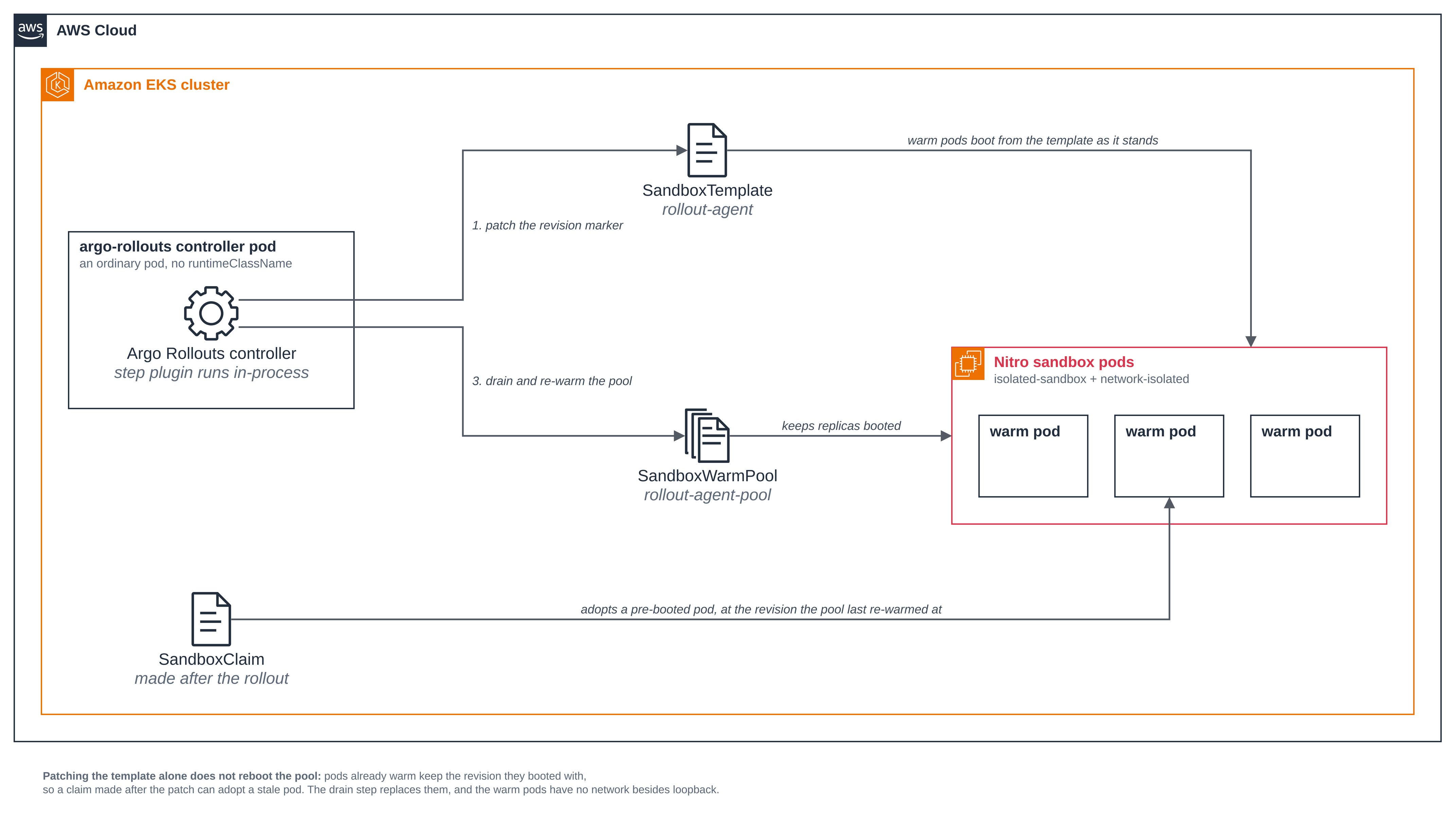
Patching a SandboxTemplate is not a rollout. The agent-sandbox controller uses the
template as it stands at boot time, so a patch changes what the next pod will be built
from and leaves every pod already warm in the pool exactly as it is. A SandboxClaim made
after the patch adopts one of those pre-booted pods, so it gets the old template. That
is the stale-adoption window, and it stays open until something replaces the warm pods.
This blueprint measures that window by value, closes it with a drain, and then drives the same patch-then-drain progression from an Argo Rollouts canary timeline.
- The hazard is read, not inferred. The template carries a revision marker,
TEMPLATE_REVISION, and the container writes it to a file at boot. After a patch with no drain the API template saysrev-2while the claimed pod reportsrev-1, from both the environment variable and the file it wrote when it booted. The page shows the two side by side. - The drain closes it. The drain scales the pool to zero, waits for it to empty
(counting a Terminating pod as still present), scales it back, and waits for the pool to
be ready again with one consistent template hash at the new revision. A claim after that
adopts a pod reporting
rev-2. - There is a witness before anything claims a pod. The agent-sandbox controller stamps
agents.x-k8s.io/sandbox-template-hashon each pool sandbox, so you can read which template the warm pods came from without claiming one or exec'ing into it. - Argo Rollouts runs the drain as a canary step plugin. Two
pluginsteps understrategy.canary.stepspatch the template and then drain the pool, inside the controller process, with the controller's RBAC. If the rollout is aborted or terminated mid-drain, the plugin'sAbortandTerminateput the pool's replica count back, so warm capacity is never stranded at zero. - Only the warm pods are sandboxes. The Argo Rollouts controller and the step plugin are
first-party software the cluster operator installed, so they stay ordinary pods. The warm
pods run with
runtimeClassName: isolated-sandboxand boot withsandbox.amazonaws.com/network-isolated: "true", so they have no network to restrict and the blueprint ships no network policy.
Figure 1: Rolling a SandboxTemplate change through a warm pool with Argo Rollouts. The controller stays an ordinary pod and runs the step plugin in-process; notice that patching the template and draining the pool are two separate steps, because the patch alone leaves the already-warm pods on the old revision.
Versions
| Component | Pin |
|---|---|
| agent-sandbox controller (kubernetes-sigs/agent-sandbox) | v1.0.10, as in Warm pool |
| Argo Rollouts (argoproj/argo-rollouts) | v1.10.1 |
| Step plugin build image | public.ecr.aws/docker/library/golang:1.26 |
| Warm pod and marker container image | public.ecr.aws/docker/library/busybox:1.36 |
The step plugin is built against the Argo Rollouts Go module at the same pin, v1.10.1, and the compiled binary is deliberately not committed: the registration builds it and pushes it to a repository your cluster can pull from.
Files
| File | What it is |
|---|---|
deploy/warm-pool.yaml |
The blueprint's SandboxTemplate at rev-1, carrying the revision marker, and its SandboxWarmPool at two replicas. |
deploy/ordinary-pod.yaml |
The same container with no runtimeClassName, so each sandbox reading has something to be compared against. |
deploy/rollout.yaml |
The Rollout: a marker container to version, and the canary steps that patch the template and drain the pool. |
deploy/step-plugin-config.yaml |
The stepPlugins registration for the controller's argo-rollouts-config ConfigMap. |
deploy/step-plugin-rbac.yaml |
The ClusterRole and ClusterRoleBinding that let the controller act on the agent-sandbox CRDs. |
plugin/main.go |
The go-plugin server and the Argo Rollouts step-plugin handshake. |
plugin/plugin.go |
The StepPlugin itself: the template patch, the drain state machine, and Abort/Terminate. |
plugin/Dockerfile |
Builds the plugin in a container, so the blueprint needs no Go toolchain on your machine. |
scripts/register-step-plugin.sh |
Step 2: build, push and register the plugin on the controller. Defaults to a plan that changes nothing. |
scripts/setup.sh |
Step 3: check the shared installs, create the namespace, apply the template, the pool and the ordinary pod. |
scripts/patch-template.sh |
Step 4: patch the revision marker and nothing else, which opens the window. |
scripts/claim.sh |
Steps 5 and 7: claim a pod and read its revision by value. |
scripts/drain-pool.sh |
Step 6: the drain, as a plain script, with no controller involved. |
scripts/run-rollout.sh |
Steps 10 and 11: drive the same work from a Rollout, and abort mid-drain on purpose. |
scripts/cleanup.sh |
Remove the blueprint's objects, and optionally undo the registration. |
scripts/common.sh |
The names, the pinned context, the readings and the guards the scripts share. |
.env.example |
The local values the blueprint needs, with no values filled in. |
Copy the env file before you start, and set KUBE_CONTEXT to the cluster you mean. Every
script pins --context and --namespace from it, so a run never depends on the machine's
current context:
cp .env.example .env
Prerequisites on the cluster
This blueprint needs two things set up before it will run, and you set up both yourself.
Step 3's setup.sh checks for them and stops without creating anything when either is
missing, and the clean up never undoes either.
| Prerequisite | What it is | Where |
|---|---|---|
| The Argo Rollouts controller, pinned to v1.10.1 | A cluster-wide controller. Another workload on your cluster may already depend on the version and settings it has. | Step 1 |
| The step-plugin registration | The stepPlugins key in the controller's own argo-rollouts-config ConfigMap, an initContainer on its Deployment, a cluster-scoped ClusterRole, and an ECR repository holding the plugin image. |
Step 2 |
Both are cluster-wide changes. The second one in particular changes the Argo Rollouts
controller itself, so it affects every Rollout on the cluster, not just this blueprint's.
Once it is applied, every other workload's Rollouts run with that initContainer on the
controller and with the plugin registered, and the blueprint's clean up does not undo any of
it. On a shared cluster, make sure that is yours to do before you run it, and read
"What stays" under Clean up first so you know what you are leaving behind.
Installing the controller but skipping the registration is the easy mistake to make, and
it does not fail quietly. setup.sh stops with exactly what is missing:
context: sandbox-demo (pinned)   namespace: argo-rollouts-sample
reusing the Argo Rollouts install in namespace argo-rollouts as it is (quay.io/argoproj/argo-rollouts:v1.10.1); this sample was built against Argo Rollouts v1.10.1
error: the Argo Rollouts controller does not have this sample's step plugin registered (missing: eks-nitro-sandbox/sandbox-template-patch eks-nitro-sandbox/sandbox-warmpool-drain).
It currently registers: <none>
The registration is a prerequisite you run yourself, because it changes a controller the
whole cluster shares:
  ./scripts/register-step-plugin.sh          # plan: changes nothing
  ./scripts/register-step-plugin.sh apply
That block comes from a separate run, with the controller installed and the registration absent, rather than from the walkthrough below. Nothing was created by it: the blueprint's namespace did not exist before it and did not exist after.
Step 1: Install Argo Rollouts, or reuse the install that is there
Argo Rollouts is a cluster-wide controller, and another workload on your cluster may already depend on the version and the settings it has. The scripts therefore never install, upgrade or reconfigure it. They check for it and stop with the command when it is missing:
kubectl create namespace argo-rollouts
kubectl -n argo-rollouts apply --server-side -f \
  https://github.com/argoproj/argo-rollouts/releases/download/v1.10.1/install.yaml
kubectl -n argo-rollouts rollout status deploy/argo-rollouts --timeout=180s
If Argo Rollouts already lives somewhere other than argo-rollouts on your cluster, set
ARGO_NAMESPACE in .env instead of installing a second copy. When the install is present
the scripts say so and move on, naming the image they found so you can see what you are
reusing. This line comes from a separate run against the already-installed controller, not
from the walkthrough below:
reusing the Argo Rollouts install in namespace argo-rollouts as it is (quay.io/argoproj/argo-rollouts:v1.10.1); this sample was built against Argo Rollouts v1.10.1
Nothing in this blueprint installs, upgrades or reconfigures Argo Rollouts. It was already installed at v1.10.1 on the cluster these runs used, and was reused exactly as it stood.
Step 2: Register the step plugin on the controller
An Argo Rollouts step plugin is a hashicorp go-plugin
binary that the controller runs as a child process. The controller discovers it from the
stepPlugins key of its own argo-rollouts-config ConfigMap and loads it at start-up, so
registering a step plugin means changing the controller: its ConfigMap, a ClusterRole that
lets it act on the agent-sandbox CRDs, and an initContainer on its Deployment that stages the
binary.
This step changes the Argo Rollouts controller, so it affects every Rollout on the
cluster, not just this blueprint's. The controller loads its step plugins at start-up from
that one ConfigMap, and applying the registration restarts it. There is no per-namespace way
to register a step plugin. That is why this is a prerequisite you run yourself rather than
something setup.sh does: every script here only ever reads the registration and stops
with this command when it is missing, and the clean up never undoes it. Run it on a cluster
whose Argo Rollouts install is yours to change.
It defaults to a plan that changes nothing.
The plan below comes from a separate run, taken against the shared controller before the walkthrough; everything from Step 3 on is from the one fresh walkthrough run.
./scripts/register-step-plugin.sh
context: sandbox-demo (pinned)   namespace: argo-rollouts-sample
reusing the Argo Rollouts install in namespace argo-rollouts as it is (quay.io/argoproj/argo-rollouts:v1.10.1); this sample was built against Argo Rollouts v1.10.1

PLAN. Nothing below has been done; run './scripts/register-step-plugin.sh apply' to do it.

  Argo Rollouts   namespace argo-rollouts, controller pod argo-rollouts-6bf59fc774-f7jpf on node <NODE_NAME> (amd64)
  registered now  <nothing>
  ECR repository  nitro-sample-argo-rollouts-stepplugin in us-west-2 (account <ACCOUNT_ID>), tagged ManagedBy=argo-rollouts
  plugin image    <ACCOUNT_ID>.dkr.ecr.us-west-2.amazonaws.com/nitro-sample-argo-rollouts-stepplugin:v1.10.1

  1. create or adopt the ECR repository above
  2. docker build plugin/ for amd64 and push it
  3. read the built binary's sha256
  4. set data.stepPlugins on configmap argo-rollouts/argo-rollouts-config to register
       eks-nitro-sandbox/sandbox-template-patch
       eks-nitro-sandbox/sandbox-warmpool-drain
     (created when absent; otherwise ONLY this key is merged, other keys are left alone)
  5. apply clusterrole and clusterrolebinding argo-rollouts-sandbox-warmpool
  6. patch deployment argo-rollouts/argo-rollouts with an initContainer that stages the
     binary into an emptyDir at /plugins, and wait for it to roll out

  Steps 4, 5 and 6 CHANGE SHARED STATE: the controller's own ConfigMap, a cluster-scoped
  ClusterRole, and the controller's Deployment. The clean up removes the ClusterRole and
  ClusterRoleBinding; the page's clean up section has the commands to undo the ConfigMap key
  and the Deployment patch, and to remove Argo Rollouts if nothing else on the cluster uses it.
The account ID and the node name are replaced with placeholders above; your run prints your own. Read the plan, then apply it:
./scripts/register-step-plugin.sh apply
This block and the plan above it come from a separate run, taken when the registration was
performed against the shared controller, rather than from the walkthrough that follows.
Everything from Step 3 on comes from one fresh walkthrough run. Two things about it: the
docker build layers were already cached on that machine, so your first build will take
noticeably longer than the 0.3 seconds shown, and the build's long digest and command lines
are abridged here to keep them readable.
$ GOPROXY=direct ./scripts/register-step-plugin.sh apply
context: sandbox-demo (pinned)   namespace: argo-rollouts-sample
reusing the Argo Rollouts install in namespace argo-rollouts as it is (quay.io/argoproj/argo-rollouts:v1.10.1); this sample was built against Argo Rollouts v1.10.1

== 1/6 the ECR repository nitro-sample-argo-rollouts-stepplugin ==
  reusing nitro-sample-argo-rollouts-stepplugin (tagged ManagedBy=argo-rollouts)

== 2/6 build the plugin for amd64 and push it ==
[+] Building 0.3s (14/14) FINISHED                                       docker:default
 => [internal] load build definition from Dockerfile                               0.0s
 => [internal] load metadata for public.ecr.aws/docker/library/golang:1.26         0.2s
 => [internal] load metadata for public.ecr.aws/docker/library/busybox:1.36        0.2s
 => [internal] load .dockerignore                                                  0.0s
 => [build 1/6] FROM public.ecr.aws/docker/library/golang:1.26@sha256:672c944c...   0.0s
 => [stage-1 1/2] FROM public.ecr.aws/docker/library/busybox:1.36@sha256:73aaf0...  0.0s
 => [internal] load build context                                                  0.0s
 => CACHED [build 2/6] WORKDIR /src                                                0.0s
 => CACHED [build 3/6] COPY go.mod go.sum ./                                       0.0s
 => CACHED [build 4/6] RUN go mod download                                         0.0s
 => CACHED [build 5/6] COPY main.go plugin.go ./                                   0.0s
 => CACHED [build 6/6] RUN go build -trimpath -ldflags="-s -w" ...                 0.0s
 => CACHED [stage-1 2/2] COPY --from=build /bin/sandbox-warmpool-stepplugin ...    0.0s
 => exporting to image                                                             0.0s
 => => naming to <ACCOUNT_ID>.dkr.ecr.us-west-2.amazonaws.com/nitro-sample-argo-rollouts-stepplugin:v1.10.1
  pushed <ACCOUNT_ID>.dkr.ecr.us-west-2.amazonaws.com/nitro-sample-argo-rollouts-stepplugin:v1.10.1

== 3/6 the built binary's sha256 ==
  sha256 6dcc356cf0458496fd4093383e807ebad041581720a3694eabf528dcff8033dc

== 4/6 register the plugin in configmap argo-rollouts-config ==
  merged the stepPlugins key into the existing configmap, leaving its other keys alone

== 5/6 the ClusterRole the plugin acts with ==
clusterrole.rbac.authorization.k8s.io/argo-rollouts-sandbox-warmpool created
clusterrolebinding.rbac.authorization.k8s.io/argo-rollouts-sandbox-warmpool created

== 6/6 stage the binary on the controller pod ==
deployment.apps/argo-rollouts patched
Waiting for deployment "argo-rollouts" rollout to finish: 1 old replicas are pending termination...
deployment "argo-rollouts" successfully rolled out

the step plugin is registered and staged at /plugins/sandbox-warmpool-stepplugin on <CONTROLLER_POD>

The step plugin is registered. Drive the rollout:  ./scripts/run-rollout.sh
Step 4/6 is the one to read twice: it says merged, not created. The ConfigMap already
existed on this cluster, so only the stepPlugins key was patched in and every other key in
it was left as it was. Step 1/6 says reusing for the same reason: the ECR repository was
already there carrying this blueprint's ManagedBy tag, so it was adopted rather than recreated.
The sha256 in step 3/6 is the hash the controller verifies before it will load the plugin,
and it is the hash of the binary that was just built from the source in
plugin/. Build it twice and you get the same value.
If your host cannot reach proxy.golang.org, the build fails on a TLS or certificate
error rather than a timeout, because the ,direct in the Dockerfile's default GOPROXY
only falls through on a 404 or 410, not on a proxy that cannot be verified or resolved. Run
the registration with GOPROXY=direct and nothing else:
GOPROXY=direct ./scripts/register-step-plugin.sh apply
The toolchain then fetches each module from its source repository, and every one is still
verified against the committed go.sum. Do not reach for GOSUMDB=off, GOFLAGS=-mod=mod
or GOPRIVATE: those drop the verification rather than route around the proxy, and none of
them is needed.
The registration refuses to write over an install that is not yours. If the ConfigMap
already registers step plugins that are not this blueprint's, or if the Deployment already sets
a different securityContext.fsGroup from the one staging the binary needs, it stops and
says what it found rather than changing a controller other workloads depend on. It merges
only the stepPlugins key, so another key such as trafficRouterPlugins is left alone, and
it patches the Deployment with a strategic merge so another initContainer or volume survives.
Here is the registration the ConfigMap receives. Both step names point at the same binary, because the plugin dispatches on the step name it is called with:
stepPlugins: |
  - name: eks-nitro-sandbox/sandbox-template-patch
    location: "file:///plugins/sandbox-warmpool-stepplugin"
    sha256: "__PLUGIN_SHA256__"
  - name: eks-nitro-sandbox/sandbox-warmpool-drain
    location: "file:///plugins/sandbox-warmpool-stepplugin"
    sha256: "__PLUGIN_SHA256__"
__PLUGIN_SHA256__ is filled in by the registration from the binary it just built, and the
controller verifies that hash before it will load the plugin. The prefix before the slash is
required: Argo Rollouts validates a step-plugin name against
^([a-zA-Z0-9\-]+)/([a-zA-Z0-9_\-.]+)$ and rejects a bare name. It is an opaque string the
controller never resolves, so it is not a Kubernetes namespace and it does not change
when you override NAMESPACE.
The ClusterRole is the other half. The plugin runs inside the controller process, so it
acts with the controller's ServiceAccount, which by default has no access to the
agent-sandbox CRDs at all:
rules:
  - apiGroups: ["extensions.agents.x-k8s.io"]
    resources: ["sandboxwarmpools", "sandboxtemplates"]
    verbs: ["get", "list", "watch", "patch", "update"]
  - apiGroups: ["agents.x-k8s.io"]
    resources: ["sandboxes"]
    verbs: ["get", "list", "watch"]
SandboxWarmPool and SandboxTemplate are in the extensions.agents.x-k8s.io group and the
plugin writes to both, so they carry patch and update. Sandbox objects are in the core
agents.x-k8s.io group and the plugin only counts them and reads their hash label, so there
is no write verb for them.
Step 3: Set up the blueprint
This first checks all four prerequisites, and creates nothing when one of them is missing,
as the refusal above shows. Then it creates the blueprint's own namespace, labelled so the
other scripts can tell it is the blueprint's, and applies the SandboxTemplate at rev-1, the
SandboxWarmPool at two replicas, and the ordinary pod the sandbox readings are compared
against. It changes nothing outside its own namespace.
./scripts/setup.sh
context: sandbox-demo (pinned)   namespace: argo-rollouts-sample
reusing the Argo Rollouts install in namespace argo-rollouts as it is (quay.io/argoproj/argo-rollouts:v1.10.1); this sample was built against Argo Rollouts v1.10.1
the step plugin is registered and staged at /plugins/sandbox-warmpool-stepplugin on argo-rollouts-5c77ffccd4-m42vc

== 1/4 namespace argo-rollouts-sample ==
namespace/argo-rollouts-sample created
namespace/argo-rollouts-sample labeled
created namespace argo-rollouts-sample, labelled app.kubernetes.io/managed-by=argo-rollouts

== 2/4 apply the SandboxTemplate at rev-1 and the SandboxWarmPool ==
sandboxtemplate.extensions.agents.x-k8s.io/rollout-agent created
sandboxwarmpool.extensions.agents.x-k8s.io/rollout-agent-pool created

== 3/4 apply the ordinary pod the sandbox readings are compared with ==
pod/ordinary-pod created

== 4/4 wait for the pool to be warm at one template revision ==
  readyReplicas=0/2  distinct template hashes=1
NAME                 READY   DESIRED   AGE
rollout-agent-pool   2       2         16s

the SandboxTemplate says TEMPLATE_REVISION=rev-1
the pool's sandboxes carry agents.x-k8s.io/sandbox-template-hash:
  1f41be27
The first two lines are the prerequisite checks passing: the controller is reused as it
stands, and the step plugin is found already registered and staged. Then the pool comes up
warm at rev-1, with its two sandboxes agreeing on one template hash, cbed2ff8.
Here is the part of deploy/warm-pool.yaml that matters, the
revision marker and the two annotations:
spec:
  podTemplate:
    metadata:
      annotations:
        sandbox.amazonaws.com/network-isolated: "true"
        karpenter.sh/do-not-disrupt: "true"
    spec:
      runtimeClassName: isolated-sandbox
      automountServiceAccountToken: false
      containers:
        - name: agent
          image: public.ecr.aws/docker/library/busybox:1.36
          env:
            - name: TEMPLATE_REVISION
              value: "rev-1"
          command:
            - sh
            - -c
            - |
              printf %s "$TEMPLATE_REVISION" > /tmp/template-revision
              echo "booted TEMPLATE_REVISION=$TEMPLATE_REVISION"
              exec sleep infinity
The marker is written to a file once, at boot. That is what makes it provenance rather than
a current reading: the file records the value this pod started with, and no later patch to
the template can change it. karpenter.sh/do-not-disrupt is there because a warm pod sits
Ready and idle; nothing would reschedule it if consolidation removed the node under it, and
the pool's revisions would then change for reasons that have nothing to do with the rollout.
The pool asks for two replicas, not one, so "every pool pod carries the same template hash"
is a reading that could actually fail.
Step 4: Patch the template, and watch nothing happen to the pool
This is the deploy on its own. It changes the revision marker on the SandboxTemplate and
touches nothing else.
./scripts/patch-template.sh rev-2
context: sandbox-demo (pinned)   namespace: argo-rollouts-sample
sandboxtemplate/rollout-agent: TEMPLATE_REVISION rev-1 -> rev-2

The pool has NOT been rebooted. Its sandboxes still carry:
  booted at rev-1
  template hash 1f41be27

Claim a pod now and it adopts one of those:  ./scripts/claim.sh stale
The template now says rev-2, and the script reads the pool straight back: its sandboxes
booted at rev-1 and carry template hash cbed2ff8. The patch moved the template and left
the warm pods alone. This is the stale-adoption window, and it is open right now. Note that you can see it without claiming anything or exec'ing into
anything: the hash label on the pool's sandboxes is a Kubernetes-observable witness.
Step 5: Claim a pod, and read the stale revision by value
./scripts/claim.sh stale
context: sandbox-demo (pinned)   namespace: argo-rollouts-sample

  the SandboxTemplate now says          : TEMPLATE_REVISION=rev-2
  the claim adopted pod                 : rollout-agent-pool-bqlhh
  that pod's TEMPLATE_REVISION (env)    : rev-1
  /tmp/template-revision (at boot)      : rev-1
  agents.x-k8s.io/launch-type           : warm

STALE: the template says rev-2, and the adopted pod booted from rev-1.
A claim made now still gets a pod from the old template, because patching a
SandboxTemplate does not reboot the pool. ./scripts/drain-pool.sh closes this.
There is the hazard, by value and side by side. The API template says rev-2. The pod the
claim adopted reports rev-1 twice: once from the live environment variable, and once from
the file it wrote when it booted. launch-type: warm says it was adopted from the pool
rather than cold-started for this claim, which is why it carries the old template at all.
The script reads both in-guest values and requires them to be present and equal to each other before it compares either with the template, so an exec that failed can never make a stale pod look fresh.
Step 6: Drain the pool to close the window
The drain is what a template patch does not do. It reads the pool's spec.replicas, patches
it to zero, waits until no sandbox matches the pool's selector, patches the count back, and
waits until the pool is ready again with one consistent template hash at the revision the
template now holds.
./scripts/drain-pool.sh
context: sandbox-demo (pinned)   namespace: argo-rollouts-sample
[drain] the SandboxTemplate says TEMPLATE_REVISION=rev-2
[drain] the pool selects sandboxes with agents.x-k8s.io/warm-pool-sandbox=fc450e7f
[drain] the pool's sandboxes booted at: rev-1, rev-2 (want rev-2), so a drain is needed
[drain] pre-drain template hashes: 1f41be27, c461a7c0
[drain] spec.replicas=2 (will scale to 0, then back to 2)
[drain] patched spec.replicas=0; waiting for the pool to empty (timeout 300s)
[drain] the pool is empty: 0 sandboxes match the pool selector
[drain] patched spec.replicas=2; waiting for the pool to re-warm at rev-2 (timeout 600s)
  readyReplicas=0/2  distinct hashes=1  revisions=rev-2
[drain] the pool has re-warmed: readyReplicas=2, all sandboxes at TEMPLATE_REVISION=rev-2
[drain] template hash: 1f41be27, c461a7c0 -> c461a7c0
Look at the third line. By the time the drain ran, the pool held both revisions:
rev-1 and rev-2. That is the claim in Step 5 refilling the pool. The claim took a
rev-1 pod out, and the pool booted its replacement from the template as it stood then,
which was already rev-2. So a pool in the stale window does not serve uniformly stale
pods, it serves a mixture, and which one a given claim gets depends on which pod the
controller hands it. That is worse than a clean failure, because it is intermittent.
That is the whole progression Steps 4 to 6 just walked through, in one picture:
Figure 2: The same rollout as a progression over time. Notice the third state: inside the stale window the pool holds one pod of each revision, so staleness here is intermittent rather than total, which is harder to notice.
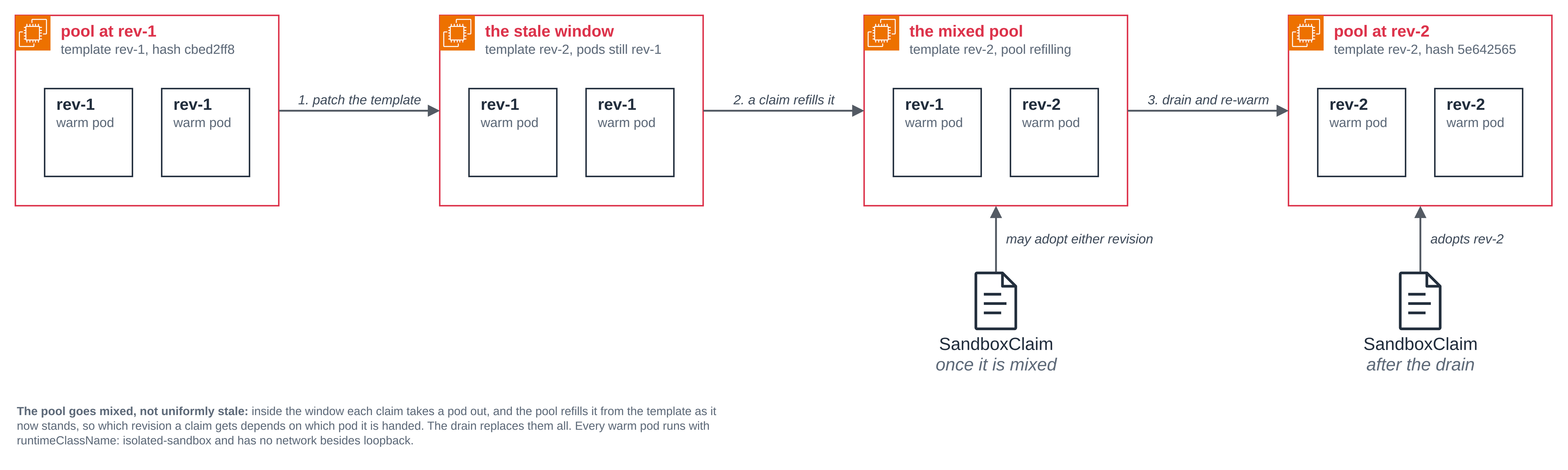
After the drain the pool is at one hash, 5e642565, and every sandbox reports rev-2. The
witness reads the same way straight from the API:
kubectl -n argo-rollouts-sample get sandbox -l agents.x-k8s.io/warm-pool-sandbox=fc450e7f \
  -L agents.x-k8s.io/sandbox-template-hash
NAME                       READY   REASON              AGE   SANDBOX-TEMPLATE-HASH
rollout-agent-pool-p8ll2   True    DependenciesReady   13s   5e642565
rollout-agent-pool-xhwjg   True    DependenciesReady   13s   5e642565
The selector hash fc450e7f is the pool's own, from its status.selector. Read it from
there rather than assuming it is the pool name: the scripts do, and an unreadable selector
is treated as "not ready" and never as "matches nothing", because an empty selector passed
to kubectl get -l would match every sandbox in the namespace and an empty result would
then read as a drained pool.
The drain waits on the revision as well as the hash. Waiting on readyReplicas alone would
pass while a replacement was still coming up, and waiting on one consistent hash alone would
be satisfied by a pool that is uniformly on the old template, which is the state the drain
exists to leave behind.
Step 7: Claim again, and read the new revision
./scripts/claim.sh fresh
context: sandbox-demo (pinned)   namespace: argo-rollouts-sample

  the SandboxTemplate now says          : TEMPLATE_REVISION=rev-2
  the claim adopted pod                 : rollout-agent-pool-flpzf
  that pod's TEMPLATE_REVISION (env)    : rev-2
  /tmp/template-revision (at boot)      : rev-2
  agents.x-k8s.io/launch-type           : warm

CURRENT: the adopted pod booted from the revision the template now holds (rev-2).
Still launch-type: warm, so this claim was still adopted from the pool and still got the
sub-second path. It is the same mechanism as Step 5, with the window closed.
Step 8: The drain is a safe no-op when the pool is already current
Running the drain again must not throw away warm capacity for nothing. It checks the pool before it scales anything, by reading the revision each pool sandbox actually booted with rather than comparing hashes it would have to have remembered:
./scripts/drain-pool.sh
context: sandbox-demo (pinned)   namespace: argo-rollouts-sample
[drain] the SandboxTemplate says TEMPLATE_REVISION=rev-2
[drain] the pool selects sandboxes with agents.x-k8s.io/warm-pool-sandbox=fc450e7f
[drain] every pool sandbox already booted at TEMPLATE_REVISION=rev-2; nothing to drain
  template hash: c461a7c0
That is the same action proved both ways: Step 6 ran it on a pool that needed draining and it drained, and Step 8 ran it on a pool that did not and it changed nothing. A pool with no sandboxes at all counts as not current, because the re-warm half of the drain still has work to do.
Step 9: The claimed pod really ran in a Nitro sandbox
The pool's pods are the only part of this blueprint in a sandbox, so it is worth reading that
off the running pod rather than trusting the manifest. Each reading is next to the same
reading from deploy/ordinary-pod.yaml, which is the same
container with the single line runtimeClassName: isolated-sandbox left out.
kubectl -n argo-rollouts-sample exec rollout-agent-pool-p8ll2 -- sh -c \
  'uname -rv; cat /proc/uptime; ls /sys/block; cat /sys/class/dmi/id/product_name'
kubectl -n argo-rollouts-sample exec ordinary-pod -- sh -c \
  'uname -rv; cat /proc/uptime; ls /sys/block; cat /sys/class/dmi/id/product_name'
| Reading | Claimed sandbox pod | Ordinary pod on the same cluster |
|---|---|---|
uname -rv |
6.18.54 #1 SMP PREEMPT_DYNAMIC Thu Oct 22 17:38:11 UTC 2026 |
6.18.56 #2 SMP PREEMPT_DYNAMIC Fri Oct 30 22:32:37 UTC 2026 |
cat /proc/uptime |
48.34 45.22 |
21033.03 40928.37 |
ls /sys/block |
dm-0 vda vdb vdc |
dm-0 loop0 loop1 loop2 loop3 loop4 loop5 loop6 loop7 nvme0n1 nvme1n1 zram0 |
cat /sys/class/dmi/id/product_name |
r8a.enclave |
r8a.large |
The kernel version is the same, 6.18.54, which is exactly why uname -r on its own is
not evidence. The build is not: #1 built at 17:38 against #2 built at 00:16. The
block devices are virtio disks, vda through vdc, where the ordinary pod sees the
instance's NVMe devices. And the DMI product name reads the VM in the sandbox rather than
the EC2 instance type the ordinary pod reads.
The uptime is the reading that needs its own evidence, because "36 seconds" only means something next to when the pod started:
kubectl -n argo-rollouts-sample get pod rollout-agent-pool-p8ll2 ordinary-pod \
  -o custom-columns='NAME:.metadata.name,RUNTIMECLASS:.spec.runtimeClassName,START:.status.startTime'
NAME                       RUNTIMECLASS       START
rollout-agent-pool-flpzf   isolated-sandbox   2026-11-07T03:53:10Z
ordinary-pod               <none>             2026-11-07T03:51:54Z
The readings above were taken at about 03:53:58. The sandboxed pod started at 03:53:10, so its 48 seconds of uptime is its own age: the VM booted with the pod. The ordinary pod started 76 seconds earlier but reports 21033 seconds, because it is reading the node's uptime, not its own. The two pods also sit on different instance types here, which is why the product names are not a matched pair: what matters is that one reads a VM and the other reads the instance it runs on.
No network to restrict
The warm pods boot with one annotation:
metadata:
  annotations:
    sandbox.amazonaws.com/network-isolated: "true"
The guest then comes up with only loopback: no route out and no DNS. This blueprint ships no network policy, because a pod with no network interface gives a policy nothing to allow or deny. For a sandbox that does have a network, and how to restrict where it can reach, see the network policy blueprint.
Rather than assert the isolation, here it is read from the claimed pod, with the ordinary pod beside it:
kubectl -n argo-rollouts-sample exec rollout-agent-pool-p8ll2 -- sh -c 'ip -o addr; ip route'
kubectl -n argo-rollouts-sample exec rollout-agent-pool-p8ll2 -- nslookup example.com
1: lo    inet 127.0.0.1/8 scope host lo\       valid_lft forever preferred_lft forever
1: lo    inet6 ::1/128 scope host noprefixroute \       valid_lft forever preferred_lft forever

nslookup: can't connect to remote host (8.8.8.8): Network is unreachable
command terminated with exit code 1
ip -o addr lists only lo, ip route prints nothing at all, and a lookup fails with
"Network is unreachable". The ordinary pod, for contrast, has an eth0 with a VPC address
and a default route:
1: lo    inet 127.0.0.1/8 scope host lo\       valid_lft forever preferred_lft forever
3: eth0    inet <POD_IP>/32 scope global eth0\       valid_lft forever preferred_lft forever

default via 169.254.1.1 dev eth0
169.254.1.1 dev eth0 scope link
kubectl exec, cp and logs keep working on the network-isolated pod throughout, because
they use the guest's internal control channel rather than the network. That is how every
in-guest reading on this page was taken.
Step 10: Drive the same work from a Rollout
Everything above used plain scripts, so you could see the mechanism without a controller in
the way. This step runs the same two operations as canary steps of an Argo Rollouts
Rollout.
./scripts/run-rollout.sh rev-3
context: sandbox-demo (pinned)   namespace: argo-rollouts-sample
reusing the Argo Rollouts install in namespace argo-rollouts as it is (quay.io/argoproj/argo-rollouts:v1.10.1); this sample was built against Argo Rollouts v1.10.1
the step plugin is registered and staged at /plugins/sandbox-warmpool-stepplugin on argo-rollouts-5c77ffccd4-m42vc

before the rollout: the template says TEMPLATE_REVISION=rev-2, the pool wants 2 replicas

== seed the Rollout at rev-2, the revision the template already holds ==
Argo Rollouts skips the canary steps on a Rollout's first creation, so the first
apply is made at the current revision: the skip then changes nothing, and the bump
below is a real update whose steps do run.
rollout.argoproj.io/template-bump created
  seeded and Healthy at rev-2

== apply the Rollout at rev-3 ==
rollout.argoproj.io/template-bump configured

== watch the canary steps ==
  step=1 phase=Paused  template=rev-3  poolReplicas=2  revisions=rev-2,
  step=2 phase=Progressing  template=rev-3  poolReplicas=0  revisions=
  step=2 phase=Progressing  template=rev-3  poolReplicas=2  revisions=rev-3,
  step=4 phase=Healthy  template=rev-3  poolReplicas=2  revisions=rev-3,

== what the rollout left behind ==
  the template says TEMPLATE_REVISION=rev-3
  the pool's sandboxes booted at: rev-3
  template hashes: 8c9184c5
  readyReplicas=2/2

  PASS  the patch step put TEMPLATE_REVISION=rev-3 on the SandboxTemplate (read: rev-3)
  PASS  the drain step left every pool sandbox booted at rev-3 (read: rev-3)
  PASS  the pool is warm again at 2 replicas (read: 2)

3/3 checks passed: the Rollout drove the template patch and the pool drain
Those four progress lines are the whole blueprint in miniature, so read them in order:
| Line | What it says |
|---|---|
step=1 phase=Paused template=rev-3 poolReplicas=2 revisions=rev-2 |
The patch step has run and the pause is holding. This is the hazard, mid-rollout: the template already says rev-3 while the pool's two warm pods still report rev-2. A claim landing here adopts a stale pod. |
step=2 ... poolReplicas=0 revisions= |
The drain step has scaled the pool to zero. No warm capacity at all for the length of one pod boot. |
step=2 ... poolReplicas=2 revisions=rev-3 |
The pool is back at two, and the replacements booted from the patched template. |
step=4 phase=Healthy ... revisions=rev-3 |
setWeight: 100 has finished the canary, and the template hash has moved to 0ea1ee76. |
Here are the canary steps from deploy/rollout.yaml:
  strategy:
    canary:
      steps:
        - plugin:
            name: eks-nitro-sandbox/sandbox-template-patch
            config:
              namespace: __NAMESPACE__
              template: rollout-agent
              revision: __REVISION__
        - pause:
            duration: 30s
        - plugin:
            name: eks-nitro-sandbox/sandbox-warmpool-drain
            config:
              namespace: __NAMESPACE__
              pool: rollout-agent-pool
              waitForNewTemplateHash: true
              timeoutSeconds: 600
        - setWeight: 100
| Step | What it does |
|---|---|
sandbox-template-patch |
Writes the new revision onto the SandboxTemplate. On its own this is the hazard: it opens exactly the window Step 4 opened by hand. |
pause: 30s |
Holds, so the window is long enough to observe rather than being passed through too fast to read. |
sandbox-warmpool-drain |
Drains and re-warms the pool. waitForNewTemplateHash: true makes it wait for the pool's sandboxes to carry the hash of the patched template, not merely for readyReplicas to come back. |
setWeight: 100 |
Finishes the canary. It moves the marker Deployment's own pods and nothing else. |
The drain step is written as a non-blocking state machine rather than a long blocking call.
Each invocation advances one phase and returns Running with a requeue, so the controller's
RPC is never held open for the length of a pool reboot, and the phase and the replica count
to restore are persisted in the step's own status between calls.
What the Argo Rollouts documentation does not cover
Three things on this page are this blueprint's own design, not something the Argo Rollouts documentation describes, and it is worth being explicit about which:
- Step plugins driving agent-sandbox CRDs. The plugin interface is documented; using it
to patch a
SandboxTemplateand drive aSandboxWarmPoolis not. TheClusterRolein Step 2 exists only because of it. - The marker-container bridge. A
Rolloutprogresses a Deployment-shaped workload. It does not watch aSandboxTemplateor aSandboxWarmPooland has no concept of warm capacity. So this blueprint'sRolloutruns one small marker container whoseTEMPLATE_REVISIONis the value a CI system bumps, purely to give Argo Rollouts something to version, and the plugin steps do the real work. The marker pod holds no warm capacity and nothing claims it. setWeightdoes not apply to a warm pool. Progressive traffic weighting assumes two versions running side by side with traffic split between them. A warm pool has one active template, so there is nothing to split. This blueprint claims no progressive weighting: the progression it shows is patch, then drain.
One more behaviour worth knowing, because it decides how the script drives the rollout: Argo
Rollouts skips the canary steps the first time a Rollout is created, because there is
no previous revision to progress away from. So run-rollout.sh seeds the Rollout at the
revision the template already holds, which makes that skip a no-op, and only then bumps it.
Without the seed the plugin steps would never run at all.
Step 11: Abort mid-drain, and keep the warm capacity
A drain scales the pool to zero on its way. If a rollout is aborted in that window, the
worst outcome is not a stale pool, it is a pool stuck at zero replicas, which serves no
claims at all. The plugin's Abort and Terminate exist for that, and this step aborts a
rollout on purpose to show it.
./scripts/run-rollout.sh rev-4 --abort-during-drain
context: sandbox-demo (pinned)   namespace: argo-rollouts-sample
reusing the Argo Rollouts install in namespace argo-rollouts as it is (quay.io/argoproj/argo-rollouts:v1.10.1); this sample was built against Argo Rollouts v1.10.1
the step plugin is registered and staged at /plugins/sandbox-warmpool-stepplugin on argo-rollouts-5c77ffccd4-m42vc

before the rollout: the template says TEMPLATE_REVISION=rev-3, the pool wants 2 replicas
rollout/template-bump already exists, with its marker at rev-3

== apply the Rollout at rev-4 ==
rollout.argoproj.io/template-bump configured

== wait for the drain step to scale the pool to 0, then abort ==
  pool spec.replicas=2, rollout step=1
  pool spec.replicas=2, rollout step=1
  pool spec.replicas=2, rollout step=1
  pool spec.replicas=2, rollout step=1
  pool spec.replicas=2, rollout step=1
  pool spec.replicas=2, rollout step=1
  pool spec.replicas=2, rollout step=1
  pool spec.replicas=2, rollout step=1
  pool spec.replicas=2, rollout step=1
  the drain has scaled the pool to spec.replicas=0 (rollout step 2); aborting now
  aborted rollout/template-bump

== the pool's replica count after the abort ==

  PASS  the plugin's Abort restored the pool to spec.replicas=2 (read: 2)
  rollout phase: Degraded

warm capacity was not left stranded at zero. The pool re-warms at whichever
revision the template holds; read it with: ./scripts/claim.sh after-abort

1/1 checks passed: abort mid-drain restores the pool's replica count
The pool is caught at spec.replicas=0 on the tenth poll, just after the rollout moves to
step 2, and the abort lands there. The replica count comes back to 2 without the drain ever
finishing, which is the plugin's Abort doing it: the step was interrupted between its
scale-to-zero and its scale-back, and the count it had recorded is what gets restored. The
rollout itself ends Degraded, which is the correct outcome for an aborted rollout, and the
pool re-warms at whatever the template now holds.
The script polls the pool's spec.replicas and aborts only once it has actually observed
zero, so the abort really does land inside the window rather than before or after it. If the
drain finishes faster than the poll, the script says so and stops rather than reporting a
test it did not run.
The plugin covers the other way a drain can stop, too. A step that fails does not get
Abort or Terminate called on it, so a drain that times out restores the replica count
itself before returning failure.
Good to know
- A template patch is not a rollout, and the pool is not a Deployment. A
SandboxWarmPoolhas no surge, nomaxUnavailableand no rolling update. The only way to move warm pods to a new template is to replace them, which means a window with less warm capacity than usual. The drain takes the pool to zero for the length of one pod boot; if that matters for your workload, drain in batches rather than all at once. - The stale window serves a mixture, not a uniformly old pool. As Step 6 showed, each claim during the window takes a pod out and the pool refills from the current template, so the pool drifts to a mix of revisions. Intermittent staleness is harder to notice than total staleness, which is the argument for closing the window rather than tolerating it.
- The template hash moves with the whole blueprint. The agent-sandbox controller computes
agents.x-k8s.io/sandbox-template-hashover the template'sSandboxBlueprint, of whichpodTemplateis one field, so any change to the template moves it, not only a change to the revision marker. Do not read a hash change as "the marker changed". - The hash label is readable only before a claim adopts the pod. When a
SandboxClaimadopts a sandbox, the controller takes the pool's labels off it, bothwarm-pool-sandboxandsandbox-template-hash, and adds a claim reference instead. So read the hash witness from the pool, which is what Step 4 and Step 6 do, and read the in-guest marker from the claimed pod. - The plugin runs with the controller's permissions, not the pod's. A step plugin is
loaded into the Argo Rollouts controller process, so it acts with the controller's
ServiceAccount cluster-wide. That is a real grant: the
ClusterRolein Step 2 lets the controller patchSandboxTemplateandSandboxWarmPoolobjects in every namespace, not just this blueprint's. Scope it to a Role in one namespace if that is too broad for you. - The warm pods hold no API credential. The template sets
automountServiceAccountToken: false. A pod built from aSandboxTemplatehas that defaulted to false already, so the line says out loud what the pod relies on rather than changing it: a warm pod runs untrusted code and has no reason to hold a token for the cluster it runs on. - A warm pod costs whatever it reserves, for as long as it is booted. These pods set no requests, so each guest gets a small default size, but a real template sizes its pods for the workload and a sandbox reserves its full memory request up front.
- The compiled plugin binary is not in this repository. It is built in a container and pushed to your own ECR repository, so the binary the controller loads is one you built and whose hash you registered.
Clean up
Set the variables again if you are in a new shell. The clean up removes the blueprint's own
namespace and everything in it, and nothing else. It takes no arguments: there is
deliberately no flag that undoes the prerequisites, because the controller and the
registration are shared with every Rollout on the cluster and a reader set them up before
the blueprint ran.
cp .env.example .env    # if you have not already; set KUBE_CONTEXT and NAMESPACE
./scripts/cleanup.sh
context: sandbox-demo (pinned)   namespace: argo-rollouts-sample

== 1/1 the sample's namespace argo-rollouts-sample ==
  deleting the warm pool first, so it stops booting replacements
sandboxwarmpool.extensions.agents.x-k8s.io "rollout-agent-pool" deleted from argo-rollouts-sample namespace
  deleting the namespace and everything in it
namespace "argo-rollouts-sample" deleted
  deleted namespace argo-rollouts-sample

Left in place, because a reader sets these up as prerequisites and the whole
cluster shares them:
  - the Argo Rollouts install in namespace argo-rollouts
  - the step-plugin registration: the stepPlugins key in configmap
    argo-rollouts/argo-rollouts-config, the initContainer on deployment
    argo-rollouts/argo-rollouts, and clusterrole/clusterrolebinding
    argo-rollouts-sandbox-warmpool
  - the ECR repository nitro-sample-argo-rollouts-stepplugin, which holds the plugin image
  - the agent-sandbox controller
The page's "What stays" section has the commands to remove them, and what to
check first.

clean up complete: the sample's namespace and everything in it are gone.
The clean up checks the namespace carries the blueprint's label before it deletes anything inside it, and deletes the pool first so it stops booting replacements. Inside a namespace it has confirmed is the blueprint's, the namespace label is the mark, so it does not re-check each object. A lookup that fails means "could not determine", which it reports as a failure rather than as "gone", and the script exits non-zero when it skipped something, so an incomplete clean up is never reported as done.
What stays. Everything you set up as a prerequisite, because the whole cluster shares it:
- The step-plugin registration. Remove it only if nothing else on the cluster uses a step plugin. The order matters: take the staging off the controller before deleting the image it pulls, or the controller cannot start the next time it restarts, which would break it for every workload rather than just this blueprint.
kubectl -n argo-rollouts patch deployment argo-rollouts --type=strategic -p '
spec:
  template:
    spec:
      securityContext:
        fsGroup: null
      initContainers:
        - name: copy-sandbox-warmpool-plugin
          $patch: delete
      volumes:
        - name: plugins
          $patch: delete
      containers:
        - name: argo-rollouts
          volumeMounts:
            - mountPath: /plugins
              $patch: delete'
kubectl -n argo-rollouts rollout status deploy/argo-rollouts --timeout=180s
kubectl -n argo-rollouts patch configmap argo-rollouts-config \
  --type=json -p '[{"op":"remove","path":"/data/stepPlugins"}]'
kubectl delete clusterrolebinding argo-rollouts-sandbox-warmpool
kubectl delete clusterrole argo-rollouts-sandbox-warmpool
aws ecr delete-repository --repository-name nitro-sample-argo-rollouts-stepplugin \
  --region "$AWS_REGION" --force
Check the ConfigMap first: if stepPlugins holds entries that are not this blueprint's two,
remove only this blueprint's rather than the whole key, and leave the rest alone.
- Argo Rollouts. Remove it only if nothing else uses it. Check first, across the whole
cluster, and only then uninstall:
kubectl get rollout,analysisrun,experiment -A
# all empty? then:
kubectl -n argo-rollouts delete -f \
  https://github.com/argoproj/argo-rollouts/releases/download/v1.10.1/install.yaml
kubectl delete namespace argo-rollouts
Anything listed there is another workload's, so leave Argo Rollouts where it is. - The agent-sandbox controller, shared with the warm pool blueprint and the other agent-sandbox blueprints. To remove it, follow the warm pool clean up.
If this is the only blueprint you ran, follow the hello sandbox clean up to remove the namespace and the cluster.