Trust an image by its signer, not its digest
A software provider ships you a container image and keeps shipping new versions of it. You run it in your own cluster, in a confidential sandbox, and you want each new release to start without you doing anything first. That is what this page buys you: configure the provider's signing profile once, and every release they sign afterwards runs under the policy you already have. No policy regenerated, no annotation edited, no digest looked up.
What you give up for it, and what you keep, is set out below, because the trade is real and narrow rather than free.
Everything here about the image pin and the signer option is a property of
confidential-sandbox and the Cedar policy generator, so it applies to any confidential
pod. The workload below is deliberately dull: it exists only to make the mechanism visible,
and this page is the Confidential section's reference for the mechanism itself.
Before you start, review the prerequisites and shared setup on the home page and the Confidential section page, which covers the trust boundary these blueprints share. Two blueprints lead into this one:
- cedar-policy generates a Cedar policy for a
confidential-sandboxpod and shows the guest enforce it. - hello sandbox introduces the readings that show a pod ran in a sandbox.
The commands below use files from this repository, so clone it if you have not already:
git clone https://github.com/aws-samples/sample-eks-nitro-sandbox.git
cd sample-eks-nitro-sandbox/examples/confidential/signer-policy
cp .env.example .env    # then fill in CLUSTER_NAME, AWS_REGION and the two releases
On your own machine the scripts need the AWS CLI signed in to the account that holds the
cluster, kubectl, jq, gzip, base64, Docker,
the Notation CLI with the AWS Signer plugin
installed (AWS Signer container workflow),
and the Cedar policy generator the Amazon EKS User Guide names
eks-nitro-sandbox-genpolicy. The scripts take the generator from a GENPOLICY variable,
so pass the name your copy has if it differs. The scripts run against your current
kubectl context; set KUBE_CONTEXT=<your cluster's context> and they pass --context on
every call and never change your current context.
A run stores two small images and two signatures in Amazon ECR, billed as ECR storage, and runs one sandboxed pod while the blueprint is up. There is no additional charge for AWS Signer used with Amazon ECR.
The choice confidential mode gives you
A confidential pod is pinned to one exact image, by default. Generate a policy for a
pod with runtimeClassName: confidential-sandbox and the policy names the digest the image
resolved to. The guest will create that container and no other. Nothing asks for this: the
Amazon EKS User Guide describes the generator's built-in confidential profile as pinning
all container admission fields, image digests among them (Cedar policies). It is a
narrower constraint on the image than anything else on this page, and it is what you get
without choosing anything.
This blueprint generates from the Confidential section's shared profile rather than that built-in one, for a reason that has nothing to do with the image: step 3 says which, and names the two fields it leaves unpinned. The image pin is the same in both.
Figure 1: The default pin, and what it costs. The generated policy names release 1.0.0's exact digest, so when the pod is pointed at release 1.1.0 the guest refuses to create the container.
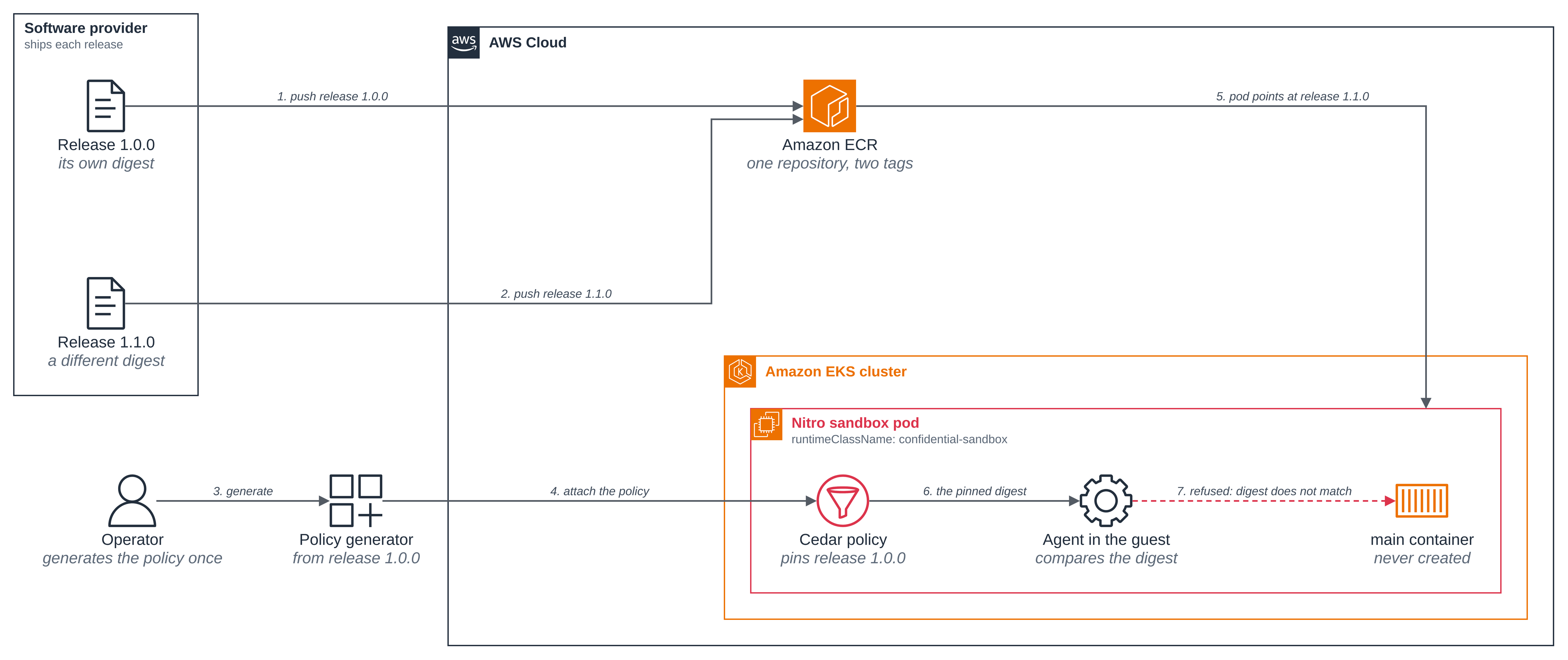
It is also the posture that costs you something, and here is where that bites. Picture two companies: one writes the software, the other runs it on its own EKS cluster. The provider would rather the operator could not read its image; the operator would rather the provider could not read its data. A confidential sandbox suits them both. But every release the provider cuts is a new digest, so under the default every release means the operator regenerating the policy and editing the pod before anything can start. The provider ships; the operator re-pins. That is the treadmill.
Confidential mode gives you one documented way off it, and only one: instead of naming a digest, the policy can say run any image signed by a signer I trust.
Figure 2: Trust by signer instead of by digest. One policy names the signing profile rather than a digest, so release 1.1.0 starts under the policy generated for release 1.0.0 and nothing on the operator's side is regenerated.
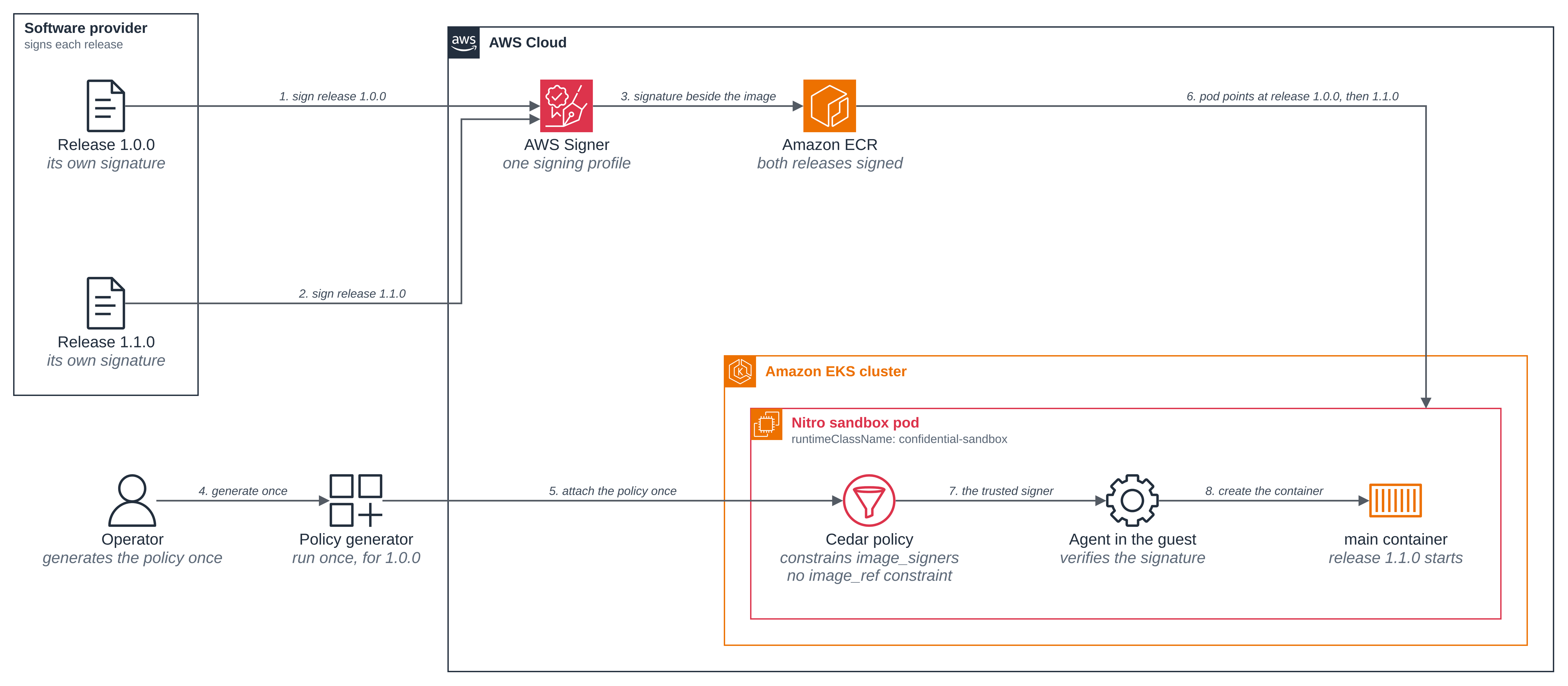
For this, use the profile-level signing ARN rather than a version ARN. A profile-level ARN,
arn:aws:signer:REGION:ACCOUNT:/signing-profiles/NAME, matches any version of the signing
profile, because the guest's agent presents both profile-level and version-level ARNs to
the policy. So the provider can rotate its signing certificate and the operator's policy
keeps working. A full version ARN pins one certificate rotation, which is a legitimate
thing to want if that is what you mean, and is the wrong default here: it stops working at
the next rotation, which is the kind of breakage nobody tells the operator about in advance.
The walkthrough below shows both halves of the choice on one cluster: the signer-based policy admitting release one and then release two, a different image under a new tag, with nothing regenerated; and the default digest-pinned policy refusing that same release two.
The provider and the operator are two roles here, not two accounts. One reader runs both halves of this walkthrough in one AWS account, signing as the provider and running the pod as the operator. Nothing on this page is evidence about a cross-account setup.
The flags that change image trust
These are the generator's own descriptions, from eks-nitro-sandbox-genpolicy --help.
| Flag | What the generator says it does |
|---|---|
--require-signatures |
"Require verified image signatures". The matching --no-require-signatures is "Do not require image signatures". |
--require-any-signer <ARN> |
"Require a verified image signature from any of the given AWS Signer signing profile ARNs (repeatable, OR logic). The image must be signed by at least one of these profiles. Use the profile-level ARN (without version suffix) [...] The agent presents both profile-level and version-level ARNs in the Cedar context, so profile-level ARNs match any version". |
--require-all-signers <ARN> |
"Require verified image signatures from all of the given AWS Signer signing profile ARNs (repeatable, AND logic). The image must be signed by every listed profile. Use the profile-level ARN (without version suffix) to match any version, or the full version ARN to pin to a specific certificate rotation". This is how you require co-signing. |
--skip-image-ref-container <NAME> |
"Omit the image_ref constraint for the named container (repeatable). Use when image trust is established via [a signer flag] instead of pinning to a specific image reference". |
--no-pin-image |
"Do not pin the container image ref", for every container rather than a named one. The matching --pin-image is "Pin the container image ref". |
Four things about them change what you should write, and each was measured against the generator rather than assumed.
--require-signatureson its own is refused. It needs at least one signer flag:error: require_signatures is enabled but no --require-any-signer or --require-all-signers provided.- A signer flag on its own does not drop the digest pin. Passing
--require-any-signeralone produces a policy that requires both the pinned digest and the signature. That is a tighter policy, and a reasonable one, but it still has to be regenerated for every release. Dropping the pin is what--skip-image-ref-containeror--no-pin-imageis for. --skip-image-ref-containerwrites its own warning into the policy, which--no-pin-imagedoes not: the generated Cedar carries the comment// WARNING: image_ref not checked; any image signed by the trusted signers will be allowed. The two have the same effect on a single-container pod, and this blueprint uses--skip-image-ref-containerso that the policy a reader reads says what was traded away.- The help for
--skip-image-ref-containernames a flag that does not exist. Where it says image trust is established "via" a signer flag, it gives a flag name the generator does not have, so the quotation in the table is edited at exactly that point and nowhere else. The two real flags are--require-any-signerand--require-all-signers.
Versions
| Component | This run |
|---|---|
eks-nitro-sandbox-genpolicy |
Reports no version string of its own. What it pinned is in the generated policy, which step 3 reads back. |
| Notation CLI (notaryproject/notation) | 1.3.1 |
| AWS Signer plugin for Notation | 1.0.2292 |
| AWS Signer signing platform | Notation-OCI-SHA384-ECDSA |
| Docker | 25.0.14 |
| Base image for the provider's releases | public.ecr.aws/amazonlinux/amazonlinux:minimal, by tag rather than digest, so an unrelated rebuild of the base changes the releases' digests too |
The AWS Signer plugin is published as a latest artifact rather than a fixed version
string, so the version above is what it resolved to at run time, read with
notation plugin ls.
Files
| File | What it is |
|---|---|
Dockerfile |
The provider's application image, built once per release with a RELEASE build argument |
deploy/pod.yaml |
The pod: confidential-sandbox, and as little else as the mechanism allows |
deploy/namespace.yaml, deploy/service-account.yaml |
The namespace, labelled as this blueprint's, and the pod's ServiceAccount |
iam/signer-verify-policy.json |
The pod's whole AWS permission: read this signing profile, check revocation status |
iam/pod-identity-trust.json |
The Pod Identity trust policy, scoped to this cluster, namespace and ServiceAccount |
scripts/setup.sh |
The operator's setup and the provider's first release: signing profile, repository, build, sign, role, both policies, start the pod |
scripts/new-version.sh |
The provider's next release, and the pod restarted on it with the policy untouched |
scripts/pinned-arm.sh |
The digest-pinned policy refusing that same release |
scripts/clean.sh |
Delete what the blueprint created, and verify it is gone |
scripts/lib.sh |
The helpers the four scripts share |
../_shared/confidential-profile.yaml |
The generator profile the Confidential blueprints share |
Step 1: The pod. It is as plain as the mechanism allows, because the subject is what the
policy admits, not what the workload does. Here is the container, from
deploy/pod.yaml:
spec:
runtimeClassName: confidential-sandbox
serviceAccountName: signer-policy-pod
hostname: signer-policy-demo
containers:
- name: app
image: <IMAGE_URI>
imagePullPolicy: Always
env:
- name: AWS_REGION
value: <AWS_REGION>
- name: AWS_DEFAULT_REGION
value: <AWS_REGION>
Trimmed: the file also sets the security context, the resource requests and the start-up
command that prints the release and the guest's own kernel. Four details are load-bearing,
and the file says why beside each. imagePullPolicy: Always makes the guest prepare and
verify the image on every start, which is the thing being shown. The hostname is set
explicitly because the generated policy pins it, and the digest-pinned arm later needs a
pod that differs from this one in the image and nothing else. Both AWS_REGION and
AWS_DEFAULT_REGION are declared because a policy generated with --with-pod-identity
expects both in the pinned environment, and the webhook injects the second only when the
first is already there. The pod does set CPU and memory requests, which most blueprints here
avoid: the guest unpacks every image layer inside the sandbox before the container starts,
and the smallest default sandbox has nowhere to put them.
There is no network-isolated annotation, and there cannot be: signature verification
needs to reach the AWS Signer endpoint, and a pod that sets that annotation "cannot use
image signature verification, because Pod Identity credentials and the Signer endpoint are
both unreachable" (Amazon EKS User Guide, Cedar policies).
Step 2: The operator sets up once. scripts/setup.sh creates the AWS Signer signing
profile and the ECR repository, has the provider build, push and sign release one, gives
the pod its role, generates both policies, and starts the pod under the signer-based one.
Every AWS resource it creates is tagged ManagedBy, and it reuses only a resource carrying
that tag, so it cannot touch another demo's resources in a shared account.
Signature verification is the one reason this pod needs AWS credentials at all. The guest
calls AWS Signer to check revocation before it admits a container, using the pod's own
role: the Amazon EKS User Guide requires signer:GetSigningProfile and
signer:GetRevocationStatus on it, and states that if either call fails or returns a
permission error, verification fails closed and the agent denies container creation
(Cedar policies). The guide lists the actions and does not say how to scope them. Scoping
them as narrowly as this is this blueprint's own choice, in
iam/signer-verify-policy.json:
{
"Version": "2012-10-17",
"Statement": [
{
"Sid": "ReadOnlyThisSamplesSigningProfile",
"Effect": "Allow",
"Action": "signer:GetSigningProfile",
"Resource": "arn:aws:signer:<AWS_REGION>:<ACCOUNT_ID>:/signing-profiles/<SIGNING_PROFILE>"
},
{
"Sid": "CheckRevocationStatus",
"Effect": "Allow",
"Action": "signer:GetRevocationStatus",
"Resource": "*"
}
]
}
GetRevocationStatus takes no resource type, which is why it is on *. The role holds
nothing else: no ECR, no KMS, no write anywhere. setup.sh checks that, failing if the role
carries any other inline or attached policy, so a role adopted from an earlier run cannot
quietly bring extra permissions with it.
cp .env.example .env # then edit CLUSTER_NAME, AWS_REGION and the two releases
./scripts/setup.sh
Abridged: the Docker build and layer-push lines are left out.
== 1/7 check the cluster and read the identity ==
kube context: <KUBE_CONTEXT>
account <ACCOUNT_ID>, region us-west-2, cluster <CLUSTER_NAME>
== 2/7 ensure the AWS Signer signing profile ==
created signing profile nitro_sample_trusted_release (Notation-OCI-SHA384-ECDSA)
== 3/7 ensure the ECR repository ==
created ECR repository nitro-sample-signer-policy (IMMUTABLE tags)
== 4/7 the provider builds, pushes and signs release 1.0.0 ==
AWS Signer plugin version: 1.0.2292
1.0.0: digest: sha256:ff38cb18774c9a86c9eafe7ea0b8d4631233f09bfec1fc74da65c6e432a6f991 size: 736
Successfully signed <ACCOUNT_ID>.dkr.ecr.us-west-2.amazonaws.com/nitro-sample-signer-policy@sha256:ff38cb18774c9a86c9eafe7ea0b8d4631233f09bfec1fc74da65c6e432a6f991
pushed and signed nitro-sample-signer-policy:1.0.0
digest: sha256:ff38cb18774c9a86c9eafe7ea0b8d4631233f09bfec1fc74da65c6e432a6f991
== 5/7 give the pod a role that can only check this profile's revocation status ==
created IAM role nitro-sample-signer-policy-verify
namespace/signer-policy-sample created
serviceaccount/signer-policy-pod created
created the Pod Identity association for signer-policy-pod
== 6/7 generate the two policies from the same pod spec ==
info: fetching image configs from the registry to resolve pin_image, pin_working_dir, pin_identity, pin_args, pin_env (pulling layers for pin_identity)
info: fetching image config for <ACCOUNT_ID>.dkr.ecr.us-west-2.amazonaws.com/nitro-sample-signer-policy:1.0.0
signer policy: .../tmp/signer-policy/policy.signer.yaml
digest-pinned policy: .../tmp/signer-policy/policy.pinned.yaml (pins sha256:ff38cb18774c9a86c9eafe7ea0b8d4631233f09bfec1fc74da65c6e432a6f991)
== 7/7 start the pod under the signer policy ==
pod/signer-policy-demo created
the running pod carries the generated policy, sha256 0adb0ab275bb90b3b5b94c0098b575bd88566ed46bc90deaebd8231c9508ed75
signer-policy-demo is Ready on release 1.0.0, under a policy that requires this signer.
That last hash is the annotation read back off the running pod, not off the file the script applied. It is the baseline step 5 compares the next release against.
Step 3: Read the two policies. setup.sh generates both from the same pod spec and
decodes each into readable Cedar under the repository's tmp/. The annotation itself is a
gzipped, base64 string, so it is not readable by eye.
Both are generated from
../_shared/confidential-profile.yaml, the profile
the Confidential blueprints share, and that profile is what makes this page's mechanism
possible: it pins each of the container admission fields it lists, the image among them,
which is why there is an image pin here to relax in the first place; it allows log reading,
which is how the steps below read the container's own output, given that it denies exec; and
it deliberately does not pin everything the generator can pin. It sets
pin_oci_hardening: false and omits the ephemeral-layer assertion, because the preview
guest's policy schema does not define those fields and the guest rejects a whole policy that
mentions one. Read the profile for the exact list rather than assuming "confidential" means
every field. --with-pod-identity
adds the projected volume the Pod Identity webhook injects to the mount set the policy
expects, which is what lets the credentials the verification uses reach the pod at all.
The signer-based policy is generated like this, with the profile-level signing ARN:
eks-nitro-sandbox-genpolicy \
--profile ../_shared/confidential-profile.yaml --with-pod-identity \
--require-signatures \
--require-any-signer "arn:aws:signer:<AWS_REGION>:<ACCOUNT_ID>:/signing-profiles/<SIGNING_PROFILE>" \
--skip-image-ref-container app \
pod.json
There is no --image-architecture here, which is worth a word because it is easy to reach
for: that flag narrows a multi-arch image index to one architecture, and the provider's
image is built for a single platform, so it is one manifest rather than an index. Passing
it makes the generator stop with user requested specific architecture amd64 for a
non-index image.
The two policies differ in exactly one way, and the diff between them is the point of the
blueprint. The substitution appears twice because the image is named in two permits,
PrepareImage and CreateContainer: the digest-pinned policy requires the exact
image_ref in both, and the signer-based one requires a verified signer in both instead.
$ diff tmp/signer-policy/policy.pinned.yaml tmp/signer-policy/policy.signer.yaml
10c10,11
< context.image_ref == "<ACCOUNT_ID>.dkr.ecr.us-west-2.amazonaws.com/nitro-sample-signer-policy@sha256:ff38cb18774c9a86c9eafe7ea0b8d4631233f09bfec1fc74da65c6e432a6f991" &&
---
> // WARNING: image_ref not checked; any image signed by the trusted signers will be allowed
> context.image_signers.contains("arn:aws:signer:us-west-2:<ACCOUNT_ID>:/signing-profiles/nitro_sample_trusted_release") &&
122c123,124
< context.image_ref == "<ACCOUNT_ID>.dkr.ecr.us-west-2.amazonaws.com/nitro-sample-signer-policy@sha256:ff38cb18774c9a86c9eafe7ea0b8d4631233f09bfec1fc74da65c6e432a6f991"
---
> // WARNING: image_ref not checked; any image signed by the trusted signers will be allowed
> context.image_signers.contains("arn:aws:signer:us-west-2:<ACCOUNT_ID>:/signing-profiles/nitro_sample_trusted_release")
Here is the whole PrepareImage permit from the signer-based policy, which is what the
guest evaluated before it prepared each release:
// PrepareImage: <ACCOUNT_ID>.dkr.ecr.us-west-2.amazonaws.com/nitro-sample-signer-policy@sha256:ff38cb18774c9a86c9eafe7ea0b8d4631233f09bfec1fc74da65c6e432a6f991
permit(
principal,
action == Agent::Action::"PrepareImage",
resource
)
when {
// WARNING: image_ref not checked; any image signed by the trusted signers will be
  allowed
context.image_signers.contains("arn:aws:signer:us-west-2:<ACCOUNT_ID>:/signing-profiles/nitro_sample_trusted_release")
};
The digest on that first line is a comment, not a constraint. The generator records the
image the policy was generated from above each permit, so release one's digest is still
written in a policy that no longer checks it. Read the when block for what is enforced;
setup.sh checks for image_ref == rather than searching for the digest for this reason.
Step 4: The pod is running on release one. The confidential profile denies exec, so the
container prints its evidence at start-up and kubectl logs reads it, which the policy
permits. The release it reports comes from a file in the image, so it is the image talking
and not the manifest:
kubectl -n signer-policy-sample logs signer-policy-demo
kubectl -n signer-policy-sample get pod signer-policy-demo \
  -o custom-columns=NAME:.metadata.name,RC:.spec.runtimeClassName,IMAGE:.spec.containers[0].image
release: 1.0.0
kernel:  6.18.54 #1 SMP PREEMPT_DYNAMIC Thu Oct 22 17:38:11 UTC 2026
uptime:  33.56s
disks:   dm-0 dm-1 dm-2 loop0 loop1 loop2 loop3 loop4 loop5 loop6 loop7 vda vdb vdc
signer-policy-ready

NAME                 RC                     IMAGE
signer-policy-demo   confidential-sandbox   <ACCOUNT_ID>.dkr.ecr.us-west-2.amazonaws.com/nitro-sample-signer-policy:1.0.0
The kernel build, the uptime and the disk list are what show it ran in a sandbox rather than as an ordinary pod. Running the same three readings in an ordinary pod on the same cluster, from the same image, gives a different answer to each of them:
kernel:  6.18.54 #2 SMP PREEMPT_DYNAMIC Thu Oct 22 00:16:59 UTC 2026
uptime:  126783.84s
disks:   dm-0 nvme0n1 nvme1n1 nvme2n1 zram0
The kernel version is the same, 6.18.54, which is why it is not evidence on its own.
The build is not: #1 built at 17:38 in the sandbox against #2 built at 00:16 on the
node. The sandboxed pod's uptime of 33 seconds is its own VM's, booted with the pod, where
the ordinary pod reports the node's 126,783 seconds. And the sandbox's disks are the
guest's virtio devices, vda, vdb and vdc, where the ordinary pod sees the instance's
nvme devices.
Step 5: The provider ships the next release. scripts/new-version.sh builds a different
image, pushes it under the second release's tag, signs it with the same profile, and
restarts the pod on that tag carrying the same policy annotation. It refuses to go on if
the annotation is not the exact string setup.sh generated, and once the pod is up it reads
the annotation back off the running pod and compares it with the one setup.sh read off the
release-one pod, so both ends of "the same policy" are observed on the cluster rather than
taken from the files the script applied. It also compares the two pods' specs and stops
unless the image tag is the only difference. That comparison is of the Kubernetes spec, which
is what the policy was generated from, rather than of the generated Cedar itself.
./scripts/new-version.sh
Abridged in the same way: the build and layer-push lines are left out.
== 1/4 the provider builds, pushes and signs release 1.1.0 ==
1.1.0: digest: sha256:db32b50088a6138bc7dab2d78837044f97d09062129581ab3983e261ef20b54e size: 736
Successfully signed <ACCOUNT_ID>.dkr.ecr.us-west-2.amazonaws.com/nitro-sample-signer-policy@sha256:db32b50088a6138bc7dab2d78837044f97d09062129581ab3983e261ef20b54e
  release 1.0.0 was sha256:ff38cb18774c9a86c9eafe7ea0b8d4631233f09bfec1fc74da65c6e432a6f991
  release 1.1.0 is  sha256:db32b50088a6138bc7dab2d78837044f97d09062129581ab3983e261ef20b54e

== 2/4 point the pod at the new tag, with the policy untouched ==
  policy annotation sha256: 0adb0ab275bb90b3b5b94c0098b575bd88566ed46bc90deaebd8231c9508ed75 (unchanged since setup.sh)
  the spec differs from the approved pod in the image tag and nothing else

== 3/4 restart the pod on the new release ==
pod/signer-policy-demo created

== 4/4 read back what is running ==
NAME                 READY   IMAGE                              IMAGEID
signer-policy-demo   true    .../nitro-sample-signer-policy:1.1.0   ...@sha256:db32b50088a6138bc7dab2d78837044f97d09062129581ab3983e261ef20b54e
  read back from the API: the running pod carries that same policy, sha256 0adb0ab275bb90b3b5b94c0098b575bd88566ed46bc90deaebd8231c9508ed75

signer-policy-demo is Ready on release 1.1.0, under the policy generated for release 1.0.0.
Nothing was regenerated: the annotation is the same string, sha256 0adb0ab275bb90b3b5b94c0098b575bd88566ed46bc90deaebd8231c9508ed75.
That is the same hash step 2 printed for the release 1.0.0 pod, read back off the API both times. So one policy, unchanged and observed on the cluster, admitted both releases.
The IMAGE and IMAGEID columns are abridged to their last part so the table fits; the
registry prefix is the same as everywhere else on this page.
Two digests, two tags, one policy. The IMAGEID is read from the running pod rather than
from the registry, so it is the digest the guest actually prepared.
Step 6: The digest pin refuses the same release. Without this a reader could not tell a
signer-based policy from no policy at all. scripts/pinned-arm.sh starts a second pod with
release two's image under the default policy setup.sh generated for release one, the
one that pins release one's digest. Everything the policy pins is identical to the approved
pod apart from the image, so a refusal is a refusal of the image:
./scripts/pinned-arm.sh
== 1/3 confirm the pinned policy pins release 1.0.0, not release 1.1.0 ==
  it pins sha256:ff38cb18774c9a86c9eafe7ea0b8d4631233f09bfec1fc74da65c6e432a6f991 and does not mention sha256:db32b50088a6138bc7dab2d78837044f97d09062129581ab3983e261ef20b54e

== 2/3 start the pinned pod on release 1.1.0's image ==
  the spec differs from the approved pod in the image tag and the policy only
pod/signer-policy-pinned created

== 3/3 wait for the guest to refuse it ==
NAME                   READY   STATUS              RESTARTS   AGE
signer-policy-pinned   0/1     RunContainerError   0          36s

failed to create containerd task: failed to create shim task: Others("Other: prepare_image: rpc status: Status { code: PERMISSION_DENIED, message: \"policy denied Agent::Action::\\\"PrepareImage\\\" for image \\\"<ACCOUNT_ID>.dkr.ecr.us-west-2.amazonaws.com/nitro-sample-signer-policy@sha256:db32b50088a6138bc7dab2d78837044f97d09062129581ab3983e261ef20b54e\\\" reasons=[] errors=[]\", details: [], special_fields: SpecialFields { unknown_fields: UnknownFields { fields: None }, cached_size: CachedSize { size: 0 } } }")

The digest-pinned policy refused release 1.1.0, which it had never seen.
policy denied Agent::Action::"PrepareImage" is the guest naming the action its policy
refused, and the digest in the message is release 1.1.0's. So the image never reached a
container: the refusal came at the point the guest prepares the image, which is the same
permit the signer-based policy admitted both releases under.
The script fails if that pod becomes Ready. It also fails if the pod merely did not start: the message has to be the guest naming its own policy as the refusal, and it has to name release 1.1.0's digest, because a pull failure, a throttle or an expired credential all look like "not Ready" too, and a refusal aimed at some other field the policy pins would not be about the image. Delete it when you have read it:
./scripts/pinned-arm.sh --delete
What the signer policy still constrains
Dropping image_ref drops one constraint, not the policy. Under the shared confidential
profile the generated policy still pins the process arguments, the environment, the working
directory, the hostname, the mount set, the user and group IDs, the capabilities, the
security settings, the masked and read-only paths, the seccomp default action, the AppArmor
profile, the namespace configuration and the sysctls, and it still denies exec and stdin.
Its SetupSandbox permit also pins how the sandbox itself is brought up, down to
context.deny_all_egress == false, so a sandbox set up differently from the one the policy
was generated for does not match it. So the trade is narrower than "the policy stops
checking the image":
- What the provider gains is the freedom to change the image's content without the operator doing anything.
- What the provider does not gain is the freedom to change the container's
configuration. A release whose image set a different
WORKDIR, or a different environment variable, would be refused by this policy even though it is signed, becausepin_working_dirandpin_envfix those from the release the policy was generated for. That is worth agreeing with a provider up front, and it is why this blueprint's two releases differ in their content and in nothing else. The image's ownUSERis not an example of this, and deliberately so: this pod setsrunAsUserandrunAsGroupnumerically in its spec, which overrides whatever the image declares, so a release that changed itsUSERwould change nothing the policy compares. - What the operator gives up is certainty about which bytes run. A digest pin tells you exactly one image may start. A signer constraint tells you the image came from a signer you trust, and the provider decides what is in it.
A signer constraint establishes provenance, not safety. Configuring it says "I accept releases from this provider", not "I have checked this build". If what you need is certainty about exact bytes, the digest pin is the right choice and the cost is regenerating the policy for every release. Both are legitimate; which one fits is a judgement about how much you trust the provider's release process, and only you can make it.
Good to know
- What the Cedar policy governs. Container admission, the runtime operations such as exec and log reading, and the IMDS surrogate (Amazon EKS User Guide, Cedar policies). The Amazon Time Sync Service and the EKS Pod Identity Agent are not policy-controlled: the sandbox always reaches them directly (same page), which is how the credentials the verification uses arrive without the policy granting them. This blueprint ships no network policy. To restrict where this pod can connect, see the network policy blueprint.
- What this run establishes, and what it does not. It shows that the signer-based policy
admitted a release it had never seen, and that the digest-pinned policy refused that same
release. It does not include an unsigned or wrong-signer image, so it does not by
itself demonstrate that the signature is what the guest required: that rests on the policy
text in step 3, where
image_signersis the only constraint left on the image's identity, the working directory and environment it derives from the image being pinned still, and on the Amazon EKS User Guide, which states that the agent verifies the signature inside the sandbox before allowing the container to start and denies container creation if verification fails or the image is unsigned (Cedar policies). If you want that arm, add an unsigned release and point the pod at it; this page keeps to one refusal so that the comparison stays about the pin. - A canceled signing profile still verifies. AWS Signer treats
CancelSigningProfileas administrative retirement rather than trust withdrawal, so signatures from a canceled profile are still accepted;RevokeSigningProfileis what withdraws trust (Amazon EKS User Guide, Cedar policies). Worth knowing, because the clean up cancels the profile. - A policy is mandatory in confidential mode. The runtime class enforces a strict
default-deny posture, so a pod with no
sandbox.amazonaws.com/policyannotation does not start. There is no "no policy" option to compare against, which is the other reason the digest-pinned arm is what the signer policy is measured against. - The policy is measured into PCR17, and the measurement does not change here. Because the policy is never regenerated, its measurement stays the same across both releases. If you gate a KMS key on it, as the encrypted image blueprint does, that gate keeps working through a release the policy has never seen, which is the same benefit in another place.
- An encrypted image can carry a signature too. Keeping the provider's image unreadable to the operator is the other half of the arrangement this page describes, and the encrypted image blueprint shows that mechanism, with the layer key released only to an attested sandbox. A policy can require both. This blueprint stays on the signature so that it is the only thing moving.
- The repository has
IMMUTABLEtags, so a release tag cannot be overwritten. To run the blueprint again without deleting the repository, set two release names it does not already hold.
Clean up
Set the variables again in a new shell if needed (the scripts read .env). Remove the
pinned arm's pod first if you ran it, then the rest:
./scripts/pinned-arm.sh --delete
./scripts/clean.sh                          # the pods, the namespace, the Pod Identity association
./scripts/clean.sh --delete-aws-resources   # also the ECR repository, the IAM role, and CANCEL the signing profile
$ ./scripts/pinned-arm.sh --delete
pod "signer-policy-pinned" deleted from signer-policy-sample namespace

$ ./scripts/clean.sh

== 1/5 the pods and the namespace ==
  deleted pod signer-policy-demo (if it was there)
  deleted pod signer-policy-pinned (if it was there)
  deleted namespace signer-policy-sample

== 2/5 the Pod Identity association ==
  deleted Pod Identity association <ASSOCIATION_ID>

== 3/5 AWS resources kept ==
  the ECR repository, the IAM role and the signing profile are still there.
  Remove them with: ./scripts/clean.sh --delete-aws-resources

Clean up complete.
AWS resources kept; see --delete-aws-resources above.

$ ./scripts/clean.sh --delete-aws-resources

== 1/5 the pods and the namespace ==
  namespace signer-policy-sample is already gone

== 2/5 the Pod Identity association ==
  no Pod Identity association for signer-policy-sample/signer-policy-pod

== 3/5 the IAM role ==
  deleted IAM role nitro-sample-signer-policy-verify

== 4/5 the ECR repository ==
  deleted ECR repository nitro-sample-signer-policy and the images and signatures in it

== 5/5 the signing profile ==
  canceled signing profile nitro_sample_trusted_release (the name stays taken; set a new SIGNING_PROFILE in .env to run again)

Clean up complete.
clean.sh deletes only what carries this blueprint's mark: it checks the namespace label
before it removes anything inside the namespace, and each AWS resource for its ManagedBy
tag. A lookup it cannot complete counts as "could not determine", which is a failure and
never "gone", so it reports what it could not do and exits non-zero.
AWS Signer has no hard delete, so --delete-aws-resources cancels the signing profile and
confirms the status reads Canceled. A canceled profile lingers until its signatures expire
(about 141 months by default) and AWS Signer refuses to reuse the name, so to set the blueprint
up again afterwards, set a new SIGNING_PROFILE in .env first; setup.sh stops with that
instruction if the old name is still there. To remove the namespace and the cluster, follow
the hello sandbox clean up.