Build an Ubuntu AMI for EKS Pod Isolation
Not ready to merge to main as an available blueprint
This blueprint is not ready to be merged to main and marked available until the
maintainers make one decision. The runtime binaries and guest image ship as one
operator-supplied preview archive that a reader obtains from their AWS account team. Its
exact name and every SHA-256 are pinned below, and it has no public download. Whether that
meets the Issue #10 criterion that every required input is available to an external
reader is waiting on the maintainers
(Issue #10 comment).
The archive's license and redistribution terms are recorded with that decision.
Until that decision, this blueprint stays a draft and is not marked (available now).
Status: live-validated on the GA bundle
Run 20261030t025526z407c, an independent walk of this page from a fresh clone, built
the AMI from the Nitro sandbox GA node-build bundle dated 2026-10-28, verified it on a
second, fresh instance, joined the dedicated node group, passed every ./test.sh check
(52 passed, 0 failed), and was then cleaned up completely, its AMI and snapshot included.
Every output block under Evidence comes from that run. Every clusterless
check is proven both ways (see Clusterless checks).
Build a custom Ubuntu 24.04 node AMI for Amazon EKS Pod Isolation, add one dedicated, tainted managed node group to an existing cluster, and run an isolated pod on that node. Ubuntu is the node operating system; application containers can use their own distributions.
This blueprint serves readers who manage their own node OS and cannot rely on the managed AMI that Getting started depends on (EKS Auto Mode provisions sandbox-capable nodes for you, with no AMI build). It adds one new, tainted node group; the cluster's existing node groups and workloads are untouched, and this blueprint never replaces or reconfigures an existing node group.
Stops on a documented prerequisite
The Nitro sandbox runtime archive (nitro-sandbox-binaries-2026-10-28.zip: the
containerd shim and CRI proxy, Firecracker and its jailer, the guest boot image and root
disk, the policy generator and the key provider) is an operator-supplied preview
archive, checksum-pinned, with no public download. Every other input is public, pinned
and checksum-verified, including the
host-kernel change, which is AWS's public kernel commit on GitHub. Until you place the
archive where config.env says, ./setup.sh --prepare stops cleanly at that
prerequisite rather than substituting an internal or private artifact. See
The runtime archive.
flowchart TB
  A["Ubuntu 24.04 EKS base AMI"] --> B["Build host: kernel + erofs-utils + runtime"]
  B --> C["Fresh instance verification"]
  C --> D["Dedicated Ubuntu managed node group"]
  D --> E["Isolated pod in a Nitro guest"]
Allow about two hours for a fresh full ./setup.sh. In the validation run it took 1 h 49 min:
about 25 minutes for the kernel stage on the m8i.4xlarge build host, and about an hour
waiting for the 120 GiB AMI to become available.
Figure 1: The ubuntu-ami architecture, from pinned public inputs to the isolated sandbox pod. Pinned public inputs feed the build host; the user-supplied runtime archive installs once present. The build host bakes the AMI, a fresh instance verifies it, then the verified AMI joins the dedicated, tainted managed node group, leaving the cluster's existing node groups untouched.
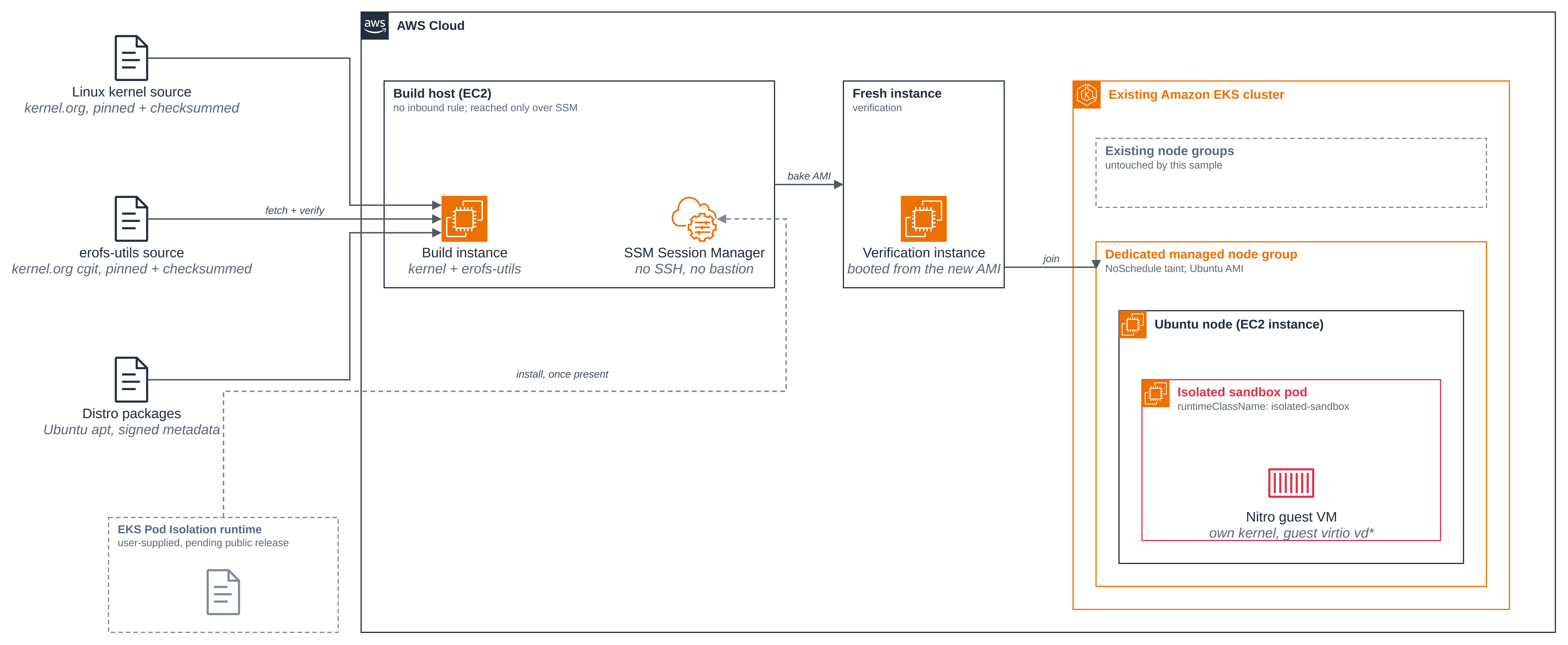
How this differs from Getting started
Getting started > Hello sandbox needs no AMI: EKS Auto Mode already runs a sandbox-capable managed AMI, and the runtime classes are there on day one. This blueprint is for the opposite case: a cluster that manages its own node OS, where the sandbox-capable AMI does not exist yet and someone has to build it.
- One dedicated, tainted managed node group. The build produces a launch template and
a managed node group with a
NoScheduletaint, so only a pod that explicitly tolerates it lands there. No existing node group is modified, relaunched or drained. - Starts from Getting started. Run hello-sandbox
first so you have a cluster with the
isolated-sandboxRuntimeClass; this blueprint adds compute to that cluster, it does not create one. - A build, not just a deploy. The other blueprints apply manifests to compute that
already exists. This one also builds the node image: resolve the base AMI, build a
kernel, build
erofs-utils, install the runtime, bake and verify a fresh instance, then join it.
Prerequisites
- A cluster that has finished Getting started > Hello sandbox:
EKS 1.36 or later with the
isolated-sandboxRuntimeClass present. The blueprint reuses that RuntimeClass as it is and never creates or changes it; it checks that every label the RuntimeClass selects (eks.amazonaws.com/nitro-sandbox=true) is one the blueprint's node registers with, and stops if not. - The managed
vpc-cniadd-on. A managed node group node gets its pod network from this add-on'saws-nodeDaemonSet; EKS Auto Mode nodes do not need it, so a cluster that only ran Getting started can lack it, and then the blueprint's node never becomesReady. Its network policy setting can be on or off: the blueprint ships no network policy, and its validation sandbox boots with no network. This is a cluster-wide install, so you install it yourself, at a version you pin; the blueprint only checks that it isACTIVE(scripts/00c-check-cluster.sh) and stops with this command when it is missing:
aws eks describe-addon-versions --region <AWS_REGION> --addon-name vpc-cni \
  --kubernetes-version 1.36 --query 'addons[0].addonVersions[].addonVersion'
aws eks create-addon --region <AWS_REGION> --cluster-name <CLUSTER_NAME> \
  --addon-name vpc-cni --addon-version <VPC_CNI_ADDON_VERSION> \
  --resolve-conflicts NONE
--resolve-conflicts NONE makes the create fail only when the add-on would have to
overwrite a value that is already set; it does not leave an existing amazon-vpc-cni
ConfigMap alone. If the cluster already has that
ConfigMap and nothing owns it, as the cluster this blueprint was validated on did, the add-on
adopts it: it adds its chart's default keys and its Helm labels, and keeps
enable-network-policy-controller as it was. Record the version you chose as
VPC_CNI_ADDON_VERSION in config.env; each run records the version it found.
If some of the cluster's nodes run another CNI, keep aws-node off them with the add-on's
affinity configuration value. Keep the chart's default requirements and append a NotIn
requirement for those nodes' label to the same term's matchExpressions: the requirements in
one term must all hold, while separate nodeSelectorTerms are alternatives, so a term of its
own would not keep aws-node off those nodes. This is the value the validation cluster's
add-on used, with its node label key shown as <OTHER_CNI_NODE_LABEL> (that install also
set enableNetworkPolicy, which this blueprint does not need). Save it to a file and add
--configuration-values file://<file> to the create-addon command:
{
  "affinity": {
    "nodeAffinity": {
      "requiredDuringSchedulingIgnoredDuringExecution": {
        "nodeSelectorTerms": [
          {
            "matchExpressions": [
              {"key": "kubernetes.io/os", "operator": "In", "values": ["linux"]},
              {"key": "kubernetes.io/arch", "operator": "In", "values": ["amd64", "arm64"]},
              {"key": "eks.amazonaws.com/compute-type", "operator": "NotIn", "values": ["fargate", "hybrid", "auto"]},
              {"key": "<OTHER_CNI_NODE_LABEL>", "operator": "NotIn", "values": ["true"]}
            ]
          }
        ]
      }
    }
  }
}
- A kubectl context for the same cluster, named in
KUBE_CONTEXT. Everykubectlcall the scripts make passes--context "$KUBE_CONTEXT"; there is no fallback to the current context, and nothing runskubectl config use-context. Before the first change,./setup.sh,./test.shand./clean.shcompare that context's server URL with the API endpointaws eks describe-clusterreports forCLUSTER_NAME, and stop on a mismatch or an unreadable context, so the kubectl side and the AWS side are always the same cluster. - Private subnets in the cluster's VPC with egress to Ubuntu's
aptmirrors, kernel.org, git.kernel.org, github.com, Amazon S3, and the EKS, EC2 and SSM APIs. This blueprint creates no network infrastructure. awsCLI v2,kubectl, Python 3,curlandtar. Optional: the AWS Session Manager plugin, for an interactive shell on the build host while you debug;./setup.shwarns when it is missing.- Operator IAM permissions to create and remove EC2 instances, images, snapshots, a
security group, a launch template, IAM roles, inline role policies and instance profiles,
an S3 bucket (create, tag, Block Public Access, default encryption, bucket policy, put and
delete objects, delete), and an EKS managed node group; to list and delete the cluster's
access entries (the clean up removes the one EKS creates for the node role); to read the
cluster, its add-ons and the Canonical SSM parameter; plus SSM Run Command access to the build and
verification instances. These are the credentials you run
./setup.shwith; the blueprint then creates two scoped roles of its own (below). - The two scoped roles the blueprint creates for the resources it launches.
scripts/00a-iam.sh(run for you by./setup.sh) creates: - a build-host instance role with
AmazonSSMManagedInstanceCore(SSM, no inbound rule) and nothing else standing. For the few minutes the build host downloads its staged files,./setup.shaddsdeploy/iam-build-host-policy.json, rendered for this run:s3:GetObjecton<staging-bucket>/<run-id>/*ands3:ListBucketlimited to that prefix (the Systems Manager documentAWS-RunRemoteScriptthat downloads the objects needs both), then deletes it again; - an EKS node role with the standard worker policies
(
deploy/iam-node-trust-policy.json's trust plusAmazonEKSWorkerNodePolicy,AmazonEC2ContainerRegistryReadOnly,AmazonEKS_CNI_PolicyandAmazonSSMManagedInstanceCore).
Both are named for the run (<RESOURCE_PREFIX>-<RUN_ID>-build and -node) and tagged
ManagedBy=<RESOURCE_PREFIX> and RunId=<RUN_ID>, so ./clean.sh --delete-aws-resources
removes them and nothing else. A same-named role is reused only when it carries both tags,
the trust policy above, exactly the managed policies above and no inline policy; anything
else stops the run. Neither is an admin role.
- IMDSv2 only, hop limit 1, on every instance the blueprint launches. The build host, the
verification instance and the node group's nodes (through the launch template) all require
IMDSv2 tokens with a response hop limit of 1. That stops an ordinary pod, one that does not
use the host's network, from getting a token, so it cannot read the node role's credentials
through the metadata service. It is not a boundary for a pod that runs with
hostNetwork: true, or for a privileged pod, which can enter the host's network: such a pod
reaches the metadata service as the node does. The VPC CNI's own aws-node pods run on the
host network and use the node role, which is why that role carries AmazonEKS_CNI_Policy.
Any other pod that needs AWS access should use EKS Pod Identity, not the node's role. Each
launch spec is rendered, checked
(scripts/lib/launch_spec.py) and sent to EC2 as that same
file.
- SSM-based build-host access, no inbound rule. The build security group opens no
inbound port (./setup.sh checks it has none); you reach the build and verification
instances over SSM, which needs no bastion, no SSH key and no open port.
- A build instance type with room for the kernel compile. The default build host is
m8i.4xlarge, the type the GA bundle's kernel build was validated on; on m8i.xlarge
the compile takes about four times as long. Nitro Enclaves must be enabled on it (the
script does that) and Secure Boot off (Canonical's EKS AMI boots with it off; the build
checks).
Public inputs, pinned and checksum-verified
Every input in this list is public, and the build verifies each one against the pin
below before using it; a mismatch aborts the build with no override flag. The lock file,
packages/sources.lock, is the one tracked place all of these
pins live, with a note on how each was obtained and verified. The plain-text
packages/SOURCES.txt gives the same provenance in prose.
| Input | Pin | SHA-256 | Source |
|---|---|---|---|
| Ubuntu 24.04 EKS base AMI | Kubernetes 1.36 | n/a (signed AMI) | Canonical's public EKS AMI SSM parameter path, resolved per Region at build time |
| Linux kernel source | 6.18.56 |
4633bbda2ab95eaf2a7af4041236451d6759c72e6946265531af4b3aacefbf89 |
linux-6.18.56.tar.xz on kernel.org |
| Host-kernel patch | commit 1e66c960b982c94bda76ebd0129eaecf0a68b46e |
051ede9dff52d24fb7ff47dd783a9eb2f6b18c742dbf151926cb48304d72924b |
amazonlinux/linux 1e66c960 as a patch on GitHub |
| erofs-utils source | 1.8.10 |
05eb4edebe11decce6ecb34e98d2f80c8cd283c2f2967d8ba7efd58418570514 |
kernel.org cgit snapshot erofs-utils-1.8.10.tar.gz |
| Distro packages | capability-asserted, versions recorded from the run | verified by apt's signed repository metadata |
Ubuntu apt repositories |
How each pin was checked:
- Kernel. The SHA-256 is the
linux-6.18.56.tar.xzline of kernel.org'ssha256sums.asc, whose signature verifies with the Kernel.org checksum autosigner key (B8868C80BA62A1FFFAF5FDA9632D3A06589DA6B1, from kernel.org'spgpkeysrepository); the tarball also verifies against its stable-release signaturelinux-6.18.56.tar.sign(647F28654894E3BD457199BE38DBBDC86092693E). - Host-kernel patch. One squashed public commit on Amazon Linux's kernel tree,
nitro_enclaves: Amazon Nitro Enclaves extension (port onto 6.18.48), which applies cleanly to kernel.org 6.18.56. GitHub serves any commit as a patch at its commit URL plus.patch;packages/fetch-kernel-patch.shchecks the SHA-256 and the commit id in the patch's first line before the file takes its final name, and the kernel build applies it withgit amand checks it landed as exactly one commit with that subject. - erofs-utils. A cgit snapshot of a tag has no upstream-published checksum, so the SHA-256 is pinned by this blueprint itself (confirmed identical across independent fetches).
- Base AMI. No SHA-256 to pin: it is a signed image resolved from a Parameter Store value Canonical's own AWS account owns. Canonical republishes it under new serials (the image name ends in the serial), so the build records the image ID, name and serial it resolved rather than hard-coding a Region-specific AMI ID, and checks that image's containerd before it builds anything.
No bare latest or moving tag is used anywhere in the build. A version bump re-records the
pin and SHA-256 here, in the lock file and in packages/SOURCES.txt, and the build
re-asserts the kernel config and re-runs the live checks. Checking a version string alone is
not sufficient.
To produce one offline-consumable archive of the pinned public file inputs (kernel,
host-kernel patch, erofs-utils) with its SBOM, license summary and provenance record, run
packages/make-bundle.sh build; consume a pre-built bundle on
a restricted-network host with packages/make-bundle.sh consume <bundle-dir>. The runtime
archive is never bundled.
The runtime archive
The runtime ships as one flat zip, nitro-sandbox-binaries-2026-10-28.zip, with a
SHA256SUMS inside that covers all eight files. It is an operator-supplied preview archive, checksum-pinned, with no public download: ask your AWS account team for it. Never commit it, and never put
it in this blueprint folder.
| File | SHA-256 | Installed on the node as |
|---|---|---|
nitro-sandbox-binaries-2026-10-28.zip (the archive) |
6830dc8d0acb356b06753fed609ebb9f03a182e340eaa27cd9ed171f7667ba40 |
not installed; verified, unpacked, then removed before baking |
containerd-shim-nitro-sandbox-v2 |
991a3786577d19ec3ee5005c90530cc1b2464c052af0218b1064f54c3c2aa7c9 |
/usr/sbin/containerd-shim-nitro-sandbox-v2, mode 0755 (also the CRI proxy) |
firecracker |
13a369b76af5f87039944f52dd6c4ef292cfdfc818a9b6e87d174b86920f5a31 |
/usr/bin/firecracker, mode 0755 |
jailer |
b7067964a02a0f6a35244a54a763f8bc420dac8c5ff4d471b2102845357293a3 |
/usr/bin/jailer, mode 0755 (it unpacks as 0644) |
eks-nitro-sandbox-genpolicy |
8bb076d5f4c631f9a0a91c58f249876f49d1c4f794b7241fbbbb2398da3fbad2 |
/usr/local/bin/eks-nitro-sandbox-genpolicy, mode 0755 |
nitro-sandbox-keyprovider |
57407a2f47e56ee46736bcdce73d48a6a10af25c613dfa08370cd0c081814c3f |
/usr/local/bin/nitro-sandbox-keyprovider, mode 0755 |
latest.eif |
31f21cf805e193710295a1dbee2e98847c4d8a0cc040597cb6abc39d3aad5105 |
/var/lib/nitro-sandbox-images/latest.eif, mode 0644 (guest boot image, guest kernel 6.18.54) |
latest-disk.img |
932a251aab211785c10620ab17ac314f5c09da3c2b61f7917acdf2208b6c3eb7 |
/var/lib/nitro-sandbox-images/latest-disk.img, mode 0644, with rootfs.ext4 linked to it |
nitro-sandbox-agent |
df85d0ea5b5021004110b2322283e2bd35b01c668ffd838573bc8f28bc8b6b8c |
not installed on the host: the copy inside latest-disk.img runs in the guest |
Place the archive in RUNTIME_ARTIFACTS_DIR, which defaults to the repository's gitignored
tmp/issue10/run/runtime (all of this blueprint's local state lives under tmp/issue10/run, in
logs/, out/ and runtime/). packages/fetch-runtime-artifacts.sh
checks the archive's SHA-256, refuses any member that is not a plain file with a flat name,
unpacks it, and then fails closed unless SHA256SUMS lists every unpacked file exactly once,
every hash matches, and every file matches its pin in packages/sources.lock, so a
re-packed archive whose SHA256SUMS was edited to match is still refused.
Build
git clone https://github.com/aws-samples/sample-eks-nitro-sandbox.git
cd sample-eks-nitro-sandbox/examples/setup/ubuntu-ami
cp config.env.example config.env
# Set KUBE_CONTEXT (the kubectl context of CLUSTER_NAME), BUILD_SUBNET_ID, NODE_SUBNET_IDS and
# VPC_CNI_ADDON_VERSION. Your usual CLUSTER_NAME, AWS_REGION and AWS_PROFILE remain in effect.
# The scripts pass --context "$KUBE_CONTEXT" to every kubectl call and never change the
# current context.
$EDITOR config.env

./setup.sh --prepare   # local only: verify every pinned input and the runtime archive
./setup.sh             # check the cluster, build, bake, verify, join, and run the pods
# or in two stages:
#   ./setup.sh --ami-only              # build, verify and tag the AMI; no cluster needed
#   RUN_ID=<id> ./setup.sh --join      # later: join that run's AMI and run the pods
./test.sh              # read live node and guest evidence again
./clean.sh --dry-run   # preview what a full clean up would remove
The blueprint uses its own namespace, ubuntu-ami-sample (NAMESPACE in config.env), not the
home page's nitro-sandboxes-demo: ./clean.sh deletes the namespace the run created, so it
must be one no other blueprint uses.
flowchart TB
  P["Verify pinned inputs + runtime archive locally"] --> Q["Check vpc-cni add-on + RuntimeClass (read only)"]
  Q --> Z["Create scoped IAM roles + build-host instance profile"]
  Z --> A["Resolve base AMI via SSM; record serial"]
  A --> S["Per-run S3 staging bucket; upload scripts + runtime archive"]
  S --> B["Build host downloads + verifies; containerd 2.1 to 2.3 gate"]
  B --> C["Kernel 6.18.56 + public patch; assert .config after olddefconfig"]
  C --> D["erofs-utils 1.8.10 with zstd"]
  D --> G["Install runtime; wire containerd + kubelet; load AppArmor profile"]
  G --> H["Bake; verify a fresh instance; tag BtfValidated=true"]
  H --> I["Join tainted node group; wait for nitro-sandbox capacity; apply pods"]
Every run has its own id. ./setup.sh picks a run id (a UTC timestamp plus four random hex
digits, such as 20261028t221500z3f9a, or the RUN_ID you pass to resume a run), reserves the
run's folder so no other start can share it, and records the id as the current run in
tmp/issue10/run/out/run-state.env just before its first AWS change, so a run that stops on a
read-only check leaves the previous run as the current one; the run's private evidence goes under
tmp/issue10/run/out/runs/<run-id>/evidence/. Every name the run creates is derived from it
(<RESOURCE_PREFIX>-<RUN_ID>-build for the build role and instance profile, -node for the
node role, -build-sg, -lt, -ng, -verify, -stage-read for the staging policy, and
<RESOURCE_PREFIX>-stage-<RUN_ID>-<6 hex> for the bucket), checked against the IAM, EKS and
S3 name limits, and every AWS resource it creates carries both ManagedBy=<RESOURCE_PREFIX>
and RunId=<RUN_ID>, including the verification instance and, through the launch template,
every node instance and volume. A resource with the run's name is reused only when it carries
both tags; a mismatch or a failed lookup stops the run. The namespace carries
app.kubernetes.io/part-of=<RESOURCE_PREFIX> and app.kubernetes.io/instance=<RUN_ID>. The
run's record (tmp/issue10/run/out/runs/<run-id>/run-state.env) also names the
CLUSTER_NAME and AWS_REGION it started with: a resume, --join, ./test.sh or
./clean.sh of that run with another cluster or Region stops before any call. Within one
checkout, one process at a time acts on a run: ./setup.sh, ./test.sh and ./clean.sh each
take the run's lock (a file in the run's folder) first, and refuse the run while another holds
it. The lock cannot be seen from another checkout or another machine, so it does not stop two
checkouts acting on the same run; see A lost run id under Clean up.
./clean.sh --list-runs needs no run and no lock.
Build the AMI now, join it later. ./setup.sh --ami-only checks the inputs, runs steps 2
to 7 below through the BtfValidated=true tag, records the AMI ID in the run's
tmp/issue10/run/out/runs/<run-id>/run-state.env, and stops. It never reads or changes the
cluster, so it needs no KUBE_CONTEXT, no vpc-cni add-on and no NODE_SUBNET_IDS; set
CLUSTER_NAME to the cluster you will join, because the run's record keeps it. The
cilium-ubuntu blueprint (issue #11) needs only this AMI. RUN_ID=<id> ./setup.sh --join does
step 8 for that run: before it changes anything, it checks that the run's AMI carries
ManagedBy, the run's RunId and BtfValidated=true, that KUBE_CONTEXT is
CLUSTER_NAME, and that the cluster prerequisites in step 1 hold; then it joins the node group
and applies the pods. It never builds an AMI. Without either flag, ./setup.sh does both in
one run and checks the cluster first, before anything is created.
Every wait has a deadline. The AWS CLI waiters give up after about 100 seconds for an SSM
command and 600 seconds for an AMI, which is less than the kernel build and a large snapshot
can take, so scripts/lib/aws-wait.sh polls instead. An SSM
command is read about every 15 seconds until it ends, for up to its own executionTimeout
plus 300 seconds, and Failed, Cancelled, TimedOut, Undeliverable or Terminated
stops the run. A new AMI is read until it is available, for up to AMI_WAIT_SECONDS
(default 7200, in config.env; this blueprint's 120 GiB AMI took about 55 minutes); failed,
error or the deadline stops the run and names the
AMI. After the reboot onto the new kernel, the build host must answer with a new boot ID and
uname -r equal to 6.18.56-nitro-ga within REBOOT_WAIT_SECONDS (default 1200) before the
next stage runs, and the run's evidence records both boot IDs. A read that keeps failing ends
in "could not determine", which stops the run.
1. Check the inputs and the cluster. ./setup.sh --prepare verifies every pinned input
and the runtime archive on your workstation and creates nothing. A full ./setup.sh then
reads two cluster-wide prerequisites before it creates anything: the vpc-cni add-on is
ACTIVE, and the shared isolated-sandbox RuntimeClass selects only labels the blueprint's
node will carry. It stops with the command to run if either is not so.
2. Resolve the base AMI. The build resolves the Canonical EKS Ubuntu 24.04 AMI for
Kubernetes 1.36 from the public SSM parameter path for your Region at run time, and records
the image ID, name and serial it got in the run's private evidence (under
tmp/issue10/run/out/runs/<run-id>/evidence/), not on the image. It never hard-codes an AMI
ID or serial.
3. Stage the files through a private, per-run S3 bucket. The runtime archive is about
150 MB and its guest disk unpacks to 2 GiB, so nothing large is pushed through an SSM shell.
scripts/00b-stage-bucket.sh creates a bucket for this run,
tagged ManagedBy=<RESOURCE_PREFIX> and RunId=<run-id>, with S3 Block Public Access on,
default encryption (SSE-S3) and the TLS-only policy in
deploy/s3-stage-bucket-policy.json; it uploads the
blueprint's scripts and the archive with their SHA-256 (S3 checks it on receipt) and grants the
build-host role read on this run's prefix only. The build host downloads them with its
instance profile and checks each SHA-256 against the value ./setup.sh sends over SSM, not
one read from the bucket. If any staging step fails after the bucket exists, the helper removes
what it created before it stops. Then the staged objects and the build role's read are deleted,
but only after the bucket and the role are confirmed to carry this run's two tags and the role's
staging policy is confirmed to be exactly this run's read; the revocation then confirms both
are gone: if either is still there, it records what is left in the run's state and the run
stops. The empty bucket stays until
./clean.sh --delete-aws-resources removes it.
4. Check containerd, then build the host kernel. The build host's first preflight reads
the booted base image's containerd: the GA shim runs on containerd 2.1.x, 2.2.x and 2.3.x,
and the build stops before anything is compiled on 2.4 or later, or anything older than 2.1
(a new Canonical serial can ship a newer containerd). scripts/10-kernel.sh
then fetches and verifies kernel.org linux-6.18.56.tar.xz and the public patch, applies the
patch in a throwaway git repository and checks it is the expected single commit, and starts
.config from the running node's own config. It asserts on the result of olddefconfig,
because olddefconfig silently drops a symbol whose menu gate is off:
CONFIG_NITRO_ENCLAVES=y, built in and never a module: thenitro_enclaves.mempool=boot argument reserves the enclave memory pool early in boot, and does nothing when the driver is a module;CONFIG_CMA=y,CONFIG_DEBUG_INFO_BTF=yandCONFIG_DEBUG_INFO_BTF_MODULES=y(kernel and module BTF for eBPF, which Cilium's datapath needs);CONFIG_VHOST_VSOCK,CONFIG_EROFS_FSandCONFIG_TUN, built in or modules;- the menu gates
CONFIG_VIRT_DRIVERS,CONFIG_VSOCKETSandCONFIG_VHOST_MENU; CONFIG_EXT4_FS, built in or a module. The build sets it built in (y), which needs no module at boot; ifolddefconfigleaves it a module, the build requiresext4.koin the new initramfs.
It installs dwarves (pahole, which builds BTF from DWARF), gawk (Ubuntu ships mawk,
and the link step needs gawk) and libdw-dev (Canonical's config sets
CONFIG_GENDWARFKSYMS=y), compiles with DWARF 4, installs the modules with
INSTALL_MOD_STRIP=1 (their DWARF is stripped, their BTF stays), checks the kernel release
is 6.18.56-nitro-ga, adds the nitro_enclaves.mempool and nitro_enclaves.ne_cpus boot
arguments, and pins the new kernel as the GRUB default (the stock kernel sorts newer).
The assertion is the one scripts/10-kernel.sh --assert-config <file> runs on a file: the
build applies it to .config right after make olddefconfig, prints one ok: line per
symbol, and stops before anything is compiled if a required symbol is missing or has the wrong
value. SSM Run Command returns only the first 24,000 characters of a command's output, and
the kernel stage prints far more than that, so those ok: lines do not reach the run's
evidence. Run 20261030t025526z407c passed that gate: its build went on to compile the kernel
and rebooted the build host onto 6.18.56-nitro-ga. Once the runtime was installed,
verify-image.py checked on the build host, running that kernel, what those symbols provide:
  [build]   "checks": {
  [build]     "host_kernel": {
  [build]       "ok": true,
  [build]       "detail": "6.18.56-nitro-ga"
  [build]     },
  [build]     "nitro_enclaves_device": {
  [build]       "ok": true,
  [build]       "detail": "/dev/nitro_enclaves"
  [build]     },
  [build]     "btf": {
  [build]       "ok": true,
  [build]       "detail": "/sys/kernel/btf/vmlinux 6817803 bytes"
  [build]     },
  [build]     "cma": {
  [build]       "ok": true,
  [build]       "detail": "CmaTotal 61526016 kB"
  [build]     },
  [build]     "vsock": {
  [build]       "ok": true,
  [build]       "detail": "/dev/vhost-vsock"
  [build]     },
  [build]     "tun": {
  [build]       "ok": true,
  [build]       "detail": "/dev/net/tun"
  [build]     },
  [build]     "erofs": {
  [build]       "ok": true,
  [build]       "detail": "erofs in /proc/filesystems"
  [build]     },
  [build]     "apparmor": {
  [build]       "ok": true,
  [build]       "detail": "enabled; ubuntu-ami-sample-profile loaded in enforce mode"
  [build]     },
  [build]     "containerd_version": {
  [build]       "ok": true,
  [build]       "detail": "containerd 2.2.1 (2.2.1): supported by the GA shim (2.1.x to 2.3.x)"
  [build]     },
  [build]     "runtime_wiring": {
  [build]       "ok": true,
  [build]       "detail": "template, dump, bootstrap endpoint, shim config, drop-in and cri-proxy unit parsed and correct"
  [build]     },
  [build]     "guest_image": {
  [build]       "ok": true,
  [build]       "detail": "/var/lib/nitro-sandbox-images: latest.eif, latest-disk.img, rootfs.ext4 -> latest-disk.img"
  [build]     },
  [build]     "mkfs_erofs": {
  [build]       "ok": true,
  [build]       "detail": "mkfs.erofs (erofs-utils) 1.8.10; zstd ok as a systemd service"
  [build]     },
  [build]     "runtime_payloads": {
  [build]       "ok": true,
  [build]       "detail": "7 installed files match SHA256SUMS and sources.lock, with their modes"
  [build]     },
  [build]     "package_holds": {
  [build]       "ok": true,
  [build]       "detail": "held and blacklisted for unattended upgrades: containerd linux-aws linux-headers-aws linux-image-aws"
  [build]     }
  [build]   }
  [build] image_configuration: PASS (14 checks)
Abridged: ./setup.sh step 7, the end of the build host's verify-image.py result from run
20261030t025526z407c: its checks map and its summary line, whole. The JSON's first three
lines and its closing brace are left out. Each line keeps the [build] prefix ./setup.sh
puts on the build host's output; no value was replaced. Step 9 repeats the same 14 checks on a
second, fresh instance before BtfValidated=true is tagged (that block is under
Evidence).
On the node that joined from the AMI, ./test.sh section 2/7 reads the same host requirements
again, each device and feature probe next to the same probe of something that does not exist
(the _bogus lines):
  node> KERNEL=6.18.56-nitro-ga
  node> btf=present
  node> btf_bogus=absent
  node> ne=present
  node> ne_bogus=absent
  node> vsock=present
  node> vsock_bogus=absent
  node> tun=present
  node> tun_bogus=absent
  node> cma=14456832
  node> cma_bogus=
  node> erofs=present
  node> erofs_bogus=absent
  node> handler=present
  node> handler_bogus=absent
  node> containerd_gate=ok
  node> containerd_version=containerd github.com/containerd/containerd/v2 2.2.1
Abridged: the node's readings from ./test.sh section 2/7 of run 20261030t025526z407c,
the 17 lines after the section's header line; the AppArmor readings that follow are shown
under Evidence, and the section's PASS lines are left out. No value was
replaced.
5. Build erofs-utils with zstd. The containerd shim builds each container's EROFS
filesystem with zstd and has no fallback, and Ubuntu 24.04's erofs-utils 1.7.1 has no zstd.
The build fetches the 1.8.10 snapshot, verifies it, builds it with
--enable-lz4 --with-libzstd into /usr/local, purges Ubuntu's package, and checks that
mkfs.erofs reports 1.8.10 and compresses with zstd when run as a systemd service, which is
how containerd runs it.
6. Install and wire the runtime. scripts/30-runtime-install.sh
re-verifies the archive, installs each file at the path and mode in the table above, links
rootfs.ext4, writes /etc/containerd/nitro-sandbox.toml with debug = false (the
production setting; SHIM_DEBUG=true gives debug-mode enclaves for troubleshooting only), and
installs and enables, but does not start, cri-proxy.service.
scripts/31-wire-containerd.sh adds the isolated-sandbox
and confidential-sandbox handlers to Canonical's containerd template
/usr/local/share/eks/containerd-config.toml (config version 2, with
discard_unpacked_layers = false inside its existing cri containerd table) and checks
containerd's own config migrate and config dump show both, points kubelet's endpoint at
unix:///run/nitro-sandbox/cri-proxy.sock in /usr/local/share/eks/bootstrap.sh, and adds
the snap.kubelet-eks.daemon.service.d/50-cri-proxy.conf ordering drop-in. Both files are
templates because Canonical's bootstrap regenerates the live ones at join.
scripts/35-apparmor.sh loads the blueprint's scoped AppArmor profile
and stops unless the kernel reports it in enforce mode and its load service is enabled
(systemctl enable and is-enabled both checked).
scripts/36-hold-packages.sh finds the package that owns the
containerd binary with dpkg -S and holds what it finds (on Canonical's serial 20261027
that was containerd), together with the installed Ubuntu kernel meta-packages, with
apt-mark hold and in Unattended-Upgrade::Package-Blacklist, so an
unattended upgrade can neither move containerd past the GA shim's range nor pull a stock
kernel that GRUB could boot instead of 6.18.56-nitro-ga. Everything else keeps the base
AMI's update policy: package-list refresh and unattended security upgrades stay on.
Trade-off: held packages get updates only through a new AMI build. containerd and the held kernel meta-packages receive no security fix on a running node. Rebuild the AMI to pick them up, and replace the node group's nodes with it.
Observe: a completed ./setup.sh writes a plain-text manifest on the image,
/etc/ubuntu-ami-sample-manifest, recording the kernel release and the SHA-256 of its
tarball and patch, the erofs-utils version and installed binary hash, each installed runtime
file's path, mode and SHA-256, the observed containerd version and the shim's debug setting,
so a later reader can audit the image without the build host.
7. Verify a fresh instance, then tag the AMI BtfValidated=true. Before baking,
scripts/50-bake-prep.sh removes the kernel tree, the downloaded
kernel tarball and patch, the archives, the staged downloads, the build toolchain, SSH host
keys and the machine ID, and refuses to continue if any of them is still there, or if its scan
for them fails ("could not determine" is a failure, never a pass). It does not change the
base AMI's apt update policy. After the AMI
is registered, ./setup.sh launches a SECOND, fresh instance from it
(scripts/verify-fresh-instance.sh) and runs
scripts/verify-image.py and 40-smoke.sh on that instance, never
on the build host's own run. verify-image.py checks the kernel release
6.18.56-nitro-ga, /dev/nitro_enclaves, BTF, a CMA reservation, vsock, TUN, EROFS,
AppArmor with the scoped profile loaded, containerd 2.1.x to 2.3.x, both handlers, the kubelet
endpoint, mkfs.erofs 1.8.10 with zstd as a service sees it, and every installed runtime file
against SHA256SUMS and its pin, the AppArmor profile in enforce mode, and the package
holds. Each check raises its own failure (no Python assert, which python3 -O would
remove). Only once both checks pass does the script tag the AMI
BtfValidated=true (scripts/lib/btf-tag.sh), alongside the
ManagedBy=<RESOURCE_PREFIX> ownership tag, the pinned kernel and erofs-utils versions and
the verification run's id. If verification fails, the AMI never receives BtfValidated=true,
and the tagging step refuses any AMI that does not already carry both of this run's tags
(ManagedBy and RunId). The verification instance is terminated however the script ends. This tag is the contract the cilium-ubuntu blueprint's (issue #11) AMI preflight checks:
BtfValidated=true means "a fresh instance booted from this AMI passed this blueprint's
host-readiness and BTF checks," never "an AMI was merely created."
8. Join the dedicated node group, then wait for sandbox capacity.
scripts/join-nodegroup.sh creates the launch template and the
tainted managed node group. With a custom AMI, EKS does not merge its own user data and
applies the node group's labels and taints only after the node registers, so the node sets
them itself through Canonical's bootstrap.sh --kubelet-extra-args:
--node-labels=eks.amazonaws.com/nodegroup=<NODEGROUP_NAME>,eks.amazonaws.com/nitro-sandbox=true,sandbox.preview/nitro=true
and --register-with-taints=sandbox.preview/ubuntu-ami=true:NoSchedule, checked in the
rendered user data before the launch template is created: with comments and blank lines
stripped, the script must hold exactly one /etc/eks/bootstrap.sh command for this cluster,
with nothing after it and the cluster name as its last argument, after every option (the
script's usage is bootstrap.sh [options] <cluster-name>), and the labels and taint are read
from that command's own --kubelet-extra-args. The launch template data (IMDSv2 required, hop limit 1, enclaves on,
both run tags on every node instance and volume) is checked the same way, and the template
and the node group are named and tagged for the run. Before any pod is applied,
scripts/wait-node-ready.sh waits until the node is Ready
and advertises allocatable eks.amazonaws.com/nitro-sandbox greater than zero (the extended
resource the RuntimeClass's overhead requests), and stops with a clear message if it does not.
containerd is a gate, not an install. The build checks that the base image's containerd is one the GA shim runs on; it never upgrades or downgrades the containerd already on the base AMI.
Evidence
Every block on this page is from one fresh run,
20261030t025526z407c: an independent walk of this page from a fresh clone, which ran a full./setup.sh(with the fresh-instance verification) and then./test.sh(52 passed, 0 failed). Lines are copied whole and in order. Values from the test account are shown as placeholders, and the note under each block says which ones, and whether lines were left out.
Node vs guest kernel, and host vs guest block devices. The same shape Getting started
uses: the ordinary pod shares the node's kernel, 6.18.56-nitro-ga, and sees the
instance's nvme* disks; the isolated-sandbox pod reports its own guest kernel, 6.18.54
(the kernel inside latest.eif), and sees only virtio vd* disks, no nvme*.
== 5/7 guest boundary: kernel and block devices, ordinary pod vs isolated-sandbox pod =====
  ordinary pod kernel:         6.18.56-nitro-ga
  ordinary pod /sys/block:     loop0 loop1 loop2 loop3 loop4 loop5 loop6 loop7 loop8 nvme0n1
  isolated-sandbox kernel:     6.18.54
  isolated-sandbox /sys/block: dm-0 vda vdb vdc
  PASS  the ordinary pod shares the host kernel 6.18.56-nitro-ga
  PASS  the sandbox pod runs the guest kernel 6.18.54, not the host's
  PASS  the ordinary pod sees the host's nvme* devices
  PASS  the sandbox pod sees virtio vd* devices and no nvme*
./test.sh section 5/7, whole. No value was replaced; the trailing space at the end of the
two /sys/block lines was removed.
Boot uptime matches the pod's age, because the VM boots with the pod, while the ordinary pod reads the host's much longer uptime:
== 6/7 guest boundary: boot uptime matches the sandbox pod's age, not the host's =========
  host uptime (ordinary pod): 696 s
  sandbox guest uptime:       567 s
  sandbox pod age:            573 s (started 2026-10-30T04:44:15Z)
  PASS  the sandbox guest booted with its pod (uptime <= pod age + 120 s)
  PASS  the sandbox guest booted after the host (guest uptime < host uptime)
./test.sh section 6/7, whole. No value was replaced.
Host-requirement accept/reject controls. Each control below is proven both ways: one input that has the requirement and passes, one that is missing it and is refused, per this repository's rule that a check proven only on good input cannot be told apart from one that accepts everything.
| Control | Accepts | Refuses |
|---|---|---|
| Kernel config assertion | every required symbol present after olddefconfig |
CONFIG_NITRO_ENCLAVES=m, BTF off or missing, module BTF off, CMA off, VHOST_VSOCK or TUN dropped, the VIRT_DRIVERS gate off |
| Root filesystem at boot | CONFIG_EXT4_FS=y with or without ext4.ko; =m with ext4.ko (plain or compressed) in the initramfs |
=m with no ext4.ko, a file that only starts with ext4.ko, EXT4 not set |
| Host kernel | the node reports 6.18.56-nitro-ga |
any other release |
| BTF presence | /sys/kernel/btf/vmlinux present and non-empty |
the same probe on a path that does not exist |
| Nitro Enclaves device | /dev/nitro_enclaves present after reboot |
the same probe on a device that does not exist |
| CMA pool | a non-zero CmaTotal |
the same probe on a key that does not exist |
vsock and TUN |
/dev/vhost-vsock and /dev/net/tun present |
the same probes on devices that do not exist |
| EROFS + zstd | mkfs.erofs 1.8.10 builds a zstd image as a systemd service |
erofs-utils without zstd |
| containerd | 2.1.x, 2.2.x, 2.3.x | 2.4.0 and later, 2.0.x and earlier, unreadable versions |
| Runtime archive | the pinned archive, every payload listed once and matching | a wrong archive hash, a tampered payload, a payload missing from SHA256SUMS, an unlisted extra file, a duplicate entry, a re-packed payload |
| Runtime wiring | both handlers in containerd's migrated config dump, the endpoint at the CRI proxy | a handler name that is not registered |
| Node labels and taint | one active bootstrap.sh command for this cluster, its name last after every option, whose --kubelet-extra-args carry all three labels and the taint |
any one missing, the strings only in a comment, an exit before the command, two commands, a command for another cluster, the cluster name first or before an option |
| Launch specs | IMDSv2 required, hop limit 1, enclaves on, ManagedBy and RunId on instance and volume |
IMDSv1 allowed, hop limit 2, no metadata options, IMDS off, enclaves off, a volume without RunId, another run's RunId |
| Kube context | the context's server is CLUSTER_NAME's API endpoint |
another cluster's server, an unknown context, no KUBE_CONTEXT |
| AppArmor stage | the profile loaded in enforce mode, its service enabled | complain mode, a failed systemctl enable, a service that is not enabled |
| AppArmor profile rules | signal (receive) from runc and unconfined, signal (send,receive) with itself, audit deny /etc/shadow* w,, no plain deny |
a signal rule missing or only in a comment, a plain deny, no /etc/shadow rule, another profile name |
| Package holds | the containerd owner and the kernel meta-packages held and blacklisted | a hold missing from apt-mark showhold or from the blacklist |
| Bake residue | no build residue left | residue present, or a scan that fails |
| Sandbox capacity | the node advertises eks.amazonaws.com/nitro-sandbox > 0 |
zero, absent, or a node that is not Ready |
| No network in the validation sandbox | the network-isolated annotation read back; only loopback has an address; no route; every interface but lo down (a dummy0 that is down passes); the connect fails with Network is unreachable while the ordinary pod's connects |
an extra IPv4 or IPv6 address, a route, an interface other than lo that is up, a refused or timed-out connect, an unreadable file or an incomplete read |
BtfValidated=true applied only after fresh-instance verification passes. The AMI tag
cilium-ubuntu's (issue #11) AMI preflight requires before it will use an AMI from this
blueprint. Written by scripts/verify-fresh-instance.sh via scripts/lib/btf-tag.sh, never at
create-image time, and never when verification fails or the AMI is not this run's own
(ManagedBy=<RESOURCE_PREFIX> and RunId=<RUN_ID> checked first).
[2026-10-30T04:29:26Z] Step 9/10: fresh-instance verification on a SECOND instance, then tag BtfValidated=true on success (scripts/verify-fresh-instance.sh)
[2026-10-30T04:29:26Z] launching fresh verification instance ubuntu-ami-sample-20261030t025526z407c-verify from <AMI_ID>
LAUNCH SPEC OK: <repository>/tmp/issue10/run/out/runs/20261030t025526z407c/verify-instance-launch.json
[2026-10-30T04:29:29Z] instance: <INSTANCE_ID>
[2026-10-30T04:32:33Z] running: verify-image.py
Success
{
  "image_configuration": "PASS",
  "failed": [],
  "checks": {
    "host_kernel": {
      "ok": true,
      "detail": "6.18.56-nitro-ga"
    },
    "nitro_enclaves_device": {
      "ok": true,
      "detail": "/dev/nitro_enclaves"
    },
    "btf": {
      "ok": true,
      "detail": "/sys/kernel/btf/vmlinux 6817803 bytes"
    },
    "cma": {
      "ok": true,
      "detail": "CmaTotal 14456832 kB"
    },
    "vsock": {
      "ok": true,
      "detail": "/dev/vhost-vsock"
    },
    "tun": {
      "ok": true,
      "detail": "/dev/net/tun"
    },
    "erofs": {
      "ok": true,
      "detail": "erofs in /proc/filesystems"
    },
    "apparmor": {
      "ok": true,
      "detail": "enabled; ubuntu-ami-sample-profile loaded in enforce mode"
    },
    "containerd_version": {
      "ok": true,
      "detail": "containerd 2.2.1 (2.2.1): supported by the GA shim (2.1.x to 2.3.x)"
    },
    "runtime_wiring": {
      "ok": true,
      "detail": "template, dump, bootstrap endpoint, shim config, drop-in and cri-proxy unit parsed and correct"
    },
    "guest_image": {
      "ok": true,
      "detail": "/var/lib/nitro-sandbox-images: latest.eif, latest-disk.img, rootfs.ext4 -> latest-disk.img"
    },
    "mkfs_erofs": {
      "ok": true,
      "detail": "mkfs.erofs (erofs-utils) 1.8.10; zstd ok as a systemd service"
    },
    "runtime_payloads": {
      "ok": true,
      "detail": "7 installed files match SHA256SUMS and sources.lock, with their modes"
    },
    "package_holds": {
      "ok": true,
      "detail": "held and blacklisted for unattended upgrades: containerd linux-aws linux-headers-aws linux-image-aws"
    }
  }
}
image_configuration: PASS (14 checks)

[2026-10-30T04:40:05Z] running: 40-smoke.sh
Success
crw-rw---- 1 root root  10, 260 Oct 30 04:30 /dev/nitro_enclaves
-rwxr-xr-x 1 root root  4763448 Oct 30 03:27 /usr/bin/firecracker
-rw-r--r-- 1 root root 13004876 Oct 30 03:27 /var/lib/nitro-sandbox-images/latest.eif
lrwxrwxrwx 1 root root       15 Oct 30 03:27 /var/lib/nitro-sandbox-images/rootfs.ext4 -> latest-disk.img
PUT /machine-config -> 204
PUT /boot-source -> 204
PUT /drives/rootfs -> 204
PUT /drives/overlay -> 204
PUT /vsock -> 204
PUT /network-interfaces/eth0 -> 204
PUT /enclave -> 204
PUT /actions -> 204
vsock handshake reply: 'OK 1073741824'
--- process alive: yes; agent reachable: 1 after 3s
smoke 2026-10-30T04:40:11Z: PASS; debug_mode=false

[2026-10-30T04:40:23Z] terminating verification instance <INSTANCE_ID>
[2026-10-30T04:40:56Z] fresh-instance verification PASS
[2026-10-30T04:40:58Z] tagged <AMI_ID> BtfValidated=true (fresh-instance verification passed; ManagedBy=ubuntu-ami-sample preserved)
./setup.sh step 9, from the step line to the BtfValidated=true tag line, whole. This run
was a full ./setup.sh, which goes on to step 10 and joins the node group; a
./setup.sh --ami-only run stops after this tag instead. The AMI id, the verification
instance's id and the repository's absolute path are shown as <AMI_ID>, <INSTANCE_ID>
and <repository>; the trailing space at the end of the eight PUT lines was removed. The
tag is written 2 s after the PASS line, never before it.
AppArmor. AppArmor stays enabled on the host, and the node loads one scoped profile,
manifests/ubuntu-ami-sample-profile, installed onto
the AMI by scripts/35-apparmor.sh. The profile refuses writes to
/etc/shadow and a few other paths inside the confined container with audit deny rules, so
each refusal is logged; the pod mounts no host filesystem, so these are the container's own
files, not the node's. It lets runc, crun and the host signal the container, as containerd's
own default container profile
does (containerd contrib/apparmor/template.go): without those signal rules, a pod under
the profile could never be stopped. ./test.sh shows four things on the blueprint's node, each
next to its control.
1. AppArmor is on and enforcing on the host. The kernel reports AppArmor enabled, the scoped profile is loaded in enforce mode, and the node's copy of the profile is this blueprint's file (same sha256). The same probe reads absent for a profile the node never loaded.
  node> apparmor_enabled=Y
  node> apparmor_profile=loaded
  node> apparmor_profile_bogus=absent
  node> apparmor_profile_mode=enforce
  node> apparmor_profile_sha256=b285f498d97bdc427d0303b96d6c68eb86a8caf83a8d9d2b0570e3ba6381548f
  -- 8a: AppArmor is on and enforcing on the host
  PASS  AppArmor is enabled host-wide on the node (enabled=Y)
  PASS  ACCEPT: the scoped profile ubuntu-ami-sample-profile is loaded on the node in enforce mode (mode=enforce)
  PASS  REJECT: the same probe reads absent for a profile the node never loaded
  PASS  the profile on the node is this sample's manifests/ubuntu-ami-sample-profile (sha256 b285f498d97bdc427d0303b96d6c68eb86a8caf83a8d9d2b0570e3ba6381548f)
Abridged: the five AppArmor readings ./test.sh takes on the node in section 2/7, then the
8a lines of section 3/7. No value was replaced.
2. The scoped profile working, on an ordinary pod.
deploy/pod-apparmor-scoped.yaml is an ordinary (runc)
pod on the same node that selects the profile with securityContext.appArmorProfile
(type: Localhost). ./test.sh checks that its process runs under
ubuntu-ami-sample-profile (enforce) (/proc/self/attr/current), while the ordinary pod's
label does not name the profile. It checks that the pod's write to /etc/shadow is refused
with Permission denied and the node's kernel logs the profile's DENIED line for it, read
from the node's clock just before the write, while the same pod's write to another file in
/etc succeeds. Then it deletes the pod by its exact name and checks that the pod is gone
within its 15 s grace period, with no DENIED signal logged under the profile. A profile
the node never loaded has no DENIED lines, as the control for both counts.
  -- 8b: the scoped profile works on an ordinary pod on the same node (apparmor-scoped-pod)
  scoped pod: node=<NODE_NAME> type=Localhost profile=ubuntu-ami-sample-profile phase=Running
  PASS  the scoped pod requests Localhost ubuntu-ami-sample-profile and runs on the sandbox node (phase=Running)
  scoped attr/current: 'ubuntu-ami-sample-profile (enforce)'  ordinary attr/current: 'cri-containerd.apparmor.d (enforce)'
  PASS  ACCEPT: the scoped pod's process is confined by 'ubuntu-ami-sample-profile (enforce)' (attr/current)
  PASS  REJECT: the same label read on the ordinary pod, which requests no profile, does not name ubuntu-ami-sample-profile
  scoped pod: write to /etc/shadow: sh: line 1: /etc/shadow: Permission denied WRITE-FAILED
  scoped pod: write to /etc/ubuntu-ami-sample-write-control: WRITTEN
  PASS  ACCEPT: the scoped pod's write to /etc/shadow is refused with EACCES (Permission denied)
  PASS  REJECT: the same pod's write to a path the profile does not deny succeeds (so the refusal is the profile's)
  node DENIED lines since T0=1793335994 for that write: ubuntu-ami-sample-profile 3, profile-that-does-not-exist 0
  PASS  ACCEPT: the node's kernel logged the profile's DENIED line for that write since T0
  PASS  REJECT: the same count for a profile the node never loaded is 0
  scoped pod deleted by its exact name: gone=yes after 1 s (grace 15 s); signal DENIED lines since T0: ubuntu-ami-sample-profile 0, profile-that-does-not-exist 0
  PASS  ACCEPT: deleted by its exact name, the scoped pod is gone within its grace period (1 s <= 15 s)
  PASS  ACCEPT: the node logged no DENIED signal under ubuntu-ami-sample-profile since T0 (the profile lets runc stop the pod)
  PASS  REJECT: the same signal count for a profile the node never loaded is 0
./test.sh section 3/7, the 8b lines, whole. The node's host name is shown as <NODE_NAME>.
Why the profile has signal rules and audit deny. The first version of the profile had
neither, and a validation run of this blueprint on its own AMI showed what that costs. On Ubuntu
24.04, runc runs under its own AppArmor profile, runc, so the stop signals a pod receives
come from the peer runc. With no signal rule, AppArmor refused them: a pod under the
profile could not be stopped, and kubelet kept logging
runc did not terminate successfully: exit status 1: unable to signal init: permission denied
(the end of the message). And a plain deny rule refuses without logging, so the refused
/etc/shadow write left no DENIED line. The profile now has the signal rules of
containerd's default container profile, and every deny rule is audit deny. The block above
shows both on this run: the pod was gone 1 s into its 15 s grace period with 0 signal denials,
and the refused write left the profile's DENIED lines.
3. A pod naming a profile the node never loaded is refused. The reject control,
deploy/pod-apparmor-reject.yaml, is an ordinary pod on
the same node that asks for profile-that-does-not-exist. ./test.sh checks that it is
scheduled on the blueprint's node, is not running, and waits with reason CreateContainerError
and containerd's message for a missing profile, matched whole:
failed to get container spec opts: failed to generate apparmor spec opts: apparmor profile not found profile-that-does-not-exist.
  -- 8c: a pod naming a profile the node never loaded is refused
  reject control: node=<NODE_NAME> phase=Pending reason=CreateContainerError message: failed to get container spec opts: failed to generate apparmor spec opts: apparmor profile not found profile-that-does-not-exist
  PASS  REJECT: a pod naming an unloaded AppArmor profile is refused on the sandbox node: CreateContainerError 'failed to get container spec opts: failed to generate apparmor spec opts: apparmor profile not found profile-that-does-not-exist'
./test.sh section 3/7, the 8c lines, whole. The node's host name is shown as <NODE_NAME>.
4. Why the sandbox pod runs Unconfined. The isolated-sandbox pod,
deploy/pod-isolated-sandbox.yaml, sets
appArmorProfile type: Unconfined. A sandbox pod's profile is not applied on the host: the
shim passes it into the guest microVM, where runc applies it. The runtime's Ubuntu build notes
(UBUNTU.md in the GA node-build bundle) say that on an AppArmor host "every sandbox pod
needs Unconfined, or kubelet requests the RuntimeDefault profile, the shim forwards it
into the guest, and runc fails with apparmor failed to apply profile". A validation run of
this blueprint on its own AMI showed exactly that. With type: Localhost and the scoped
profile, the sandbox pod stopped in StartError with
apparmor failed to apply profile: write fsmount:fscontext:proc/thread-self/attr/exec: invalid argument
(the end of the message), because the guest runs SELinux and has no AppArmor: its process
label is system_u:system_r:runtime_t:s0:c0.c1023. The microVM is the sandbox pod's boundary.
./test.sh prints the sandbox's own label and checks that the pod runs with Unconfined.
  -- why the sandbox pod runs Unconfined
  sandbox pod: appArmorProfile type=Unconfined phase=Running attr/current (the guest's own label): 'system_u:system_r:runtime_t:s0:c0.c1023'
  PASS  the sandbox pod runs with appArmorProfile Unconfined, as the GA build notes require (phase=Running)
./test.sh section 3/7, its last three lines, whole. No value was replaced.
The validation sandbox has no network
The isolated-sandbox pod is booted with no network. It needs none: it runs sleep infinity,
and every check ./test.sh makes reaches it through kubectl exec. One annotation in
deploy/pod-isolated-sandbox.yaml does it, the same one
Getting started uses. Here is the part of the
manifest that matters:
metadata:
  annotations:
    sandbox.amazonaws.com/network-isolated: "true"   # <-- boot the VM with no network besides loopback
./test.sh section 7/7 reads the annotation back from the API, then reads what the guest
itself reports: only loopback has an address, the sandbox has no route, and every interface
other than lo is down. The guest also has a dummy0 interface, from its image, which is
down and has no address. A TCP connect from the sandbox to the cluster's kubernetes Service on port
443 fails with Network is unreachable, while the same connect from the ordinary pod on the
same node succeeds, so the failure is the sandbox's and not the Service's. The API still
reports a podIP for the sandbox pod: the host side allocates it, and no interface in the
guest carries it.
== 7/7 the validation sandbox has no network ============================================
  sandbox pod annotation sandbox.amazonaws.com/network-isolated: true
  PASS  the sandbox pod carries sandbox.amazonaws.com/network-isolated="true" (read back from the API)
  sandbox interfaces (/sys/class/net, operstate): dummy0 down, lo unknown
  sandbox IPv4 local addresses (/proc/net/fib_trie): 127.0.0.1
  sandbox IPv6 addresses (/proc/net/if_inet6): ::1 on lo
  sandbox IPv4 routes (/proc/net/route): none (header line only)
  PASS  only loopback has an address in the sandbox (IPv4: 127.0.0.1; IPv6: ::1 on lo)
  PASS  the sandbox has no route (/proc/net/route: none (header line only))
  PASS  every sandbox interface other than lo is down (dummy0 down, lo unknown)
  kubernetes Service ClusterIP (read from the API): <API_SERVICE_IP>
  sandbox TCP connect to that ClusterIP on 443: errno=ENETUNREACH (Network is unreachable)
  PASS  the sandbox's TCP connect to the API Service fails with Network is unreachable (ENETUNREACH)
  ordinary pod TCP connect to that ClusterIP on 443: connected
  PASS  the same connect from the ordinary pod succeeds (control for the previous check)
./test.sh section 7/7, whole. The cluster's kubernetes Service ClusterIP, which test.sh
prints once on its own line, is shown as <API_SERVICE_IP>; no other value was replaced.
test.sh prints each interface's name and state, not its MAC address.
The blueprint ships no network policy, and creates no Ingress, LoadBalancer or NodePort. For how a network policy restricts where a sandboxed pod can connect, see the network policy blueprint.
Clusterless checks
These run with no AWS account and no cluster, against the real scripts with stub commands
first on PATH where a live input cannot be made. The fake AWS CLI applies --query with the
jmespath package, pinned in
scripts/testlib/requirements-test.txt; without it,
every fake call stops with exit 98 and an "install jmespath" message, so the suites fail rather
than pass. Install it into a virtual environment under the repository's tmp/, and put that
environment first on PATH while the suites run (from this blueprint's folder):
python3 -m venv ../../../tmp/ubuntu-ami-tests
../../../tmp/ubuntu-ami-tests/bin/pip install -r scripts/testlib/requirements-test.txt
export PATH="$(cd ../../../tmp/ubuntu-ami-tests/bin && pwd):$PATH"
bash packages/test-bundle.sh          # bundle built and consumed against sources.lock; tampered, unlisted and unsafe members refused
bash packages/test-inputs.sh          # runtime archive and host-kernel patch (cached or downloaded), both ways
bash scripts/test-host-gates.sh       # containerd gate, .config assertion, root filesystem at boot, IMDS token never on argv
bash scripts/test-cluster-gates.sh    # kube context, vpc-cni ACTIVE (network policy on or off), RuntimeClass, user data, node capacity, namespace, pod wait
bash scripts/test-launch-specs.sh     # IMDSv2 hop limit 1, enclaves and run tags on the node template, verification instance and build host; strict bootstrap.sh user data
bash scripts/test-run-scope.sh        # per-run IAM, run-scoped clean up, the run's lock and record, IAM by name, the node role's access entry, --keep-ami, every failed lookup, --list-runs, staging revocation
bash scripts/test-image-checks.sh     # containerd wiring, AppArmor stage, package holds, bake residue, verify-image.py (Python 3.11+)
bash scripts/test-apparmor-checks.sh  # test.sh's AppArmor checks (its node probe run on a fake journal), the Unconfined sandbox, the no-network checks and their control, the run's lock and record; the profile's structure, signal and audit-deny rules
bash scripts/test-btf-tag.sh          # BtfValidated=true only after both fresh-instance checks pass, only on this run's AMI
bash scripts/test-setup-flow.sh       # bounded SSM, AMI, status and reboot waits; --ami-only and --join, the run's record (cluster and Region) and lock, both ways
bash scripts/test-local-paths.sh      # local state only under the repository's tmp/; the cluster, Region and namespace defaults
Cost note
Measured on the validation run, 20261030t025526z407c, in us-west-2 at on-demand prices:
the m8i.4xlarge build host ran about 1.5 h, the m8i.xlarge verification instance about
0.2 h and the m8i.xlarge node about 0.4 h, which comes to about $1.50 for the run with its
EBS volumes, the AMI snapshot, S3 staging and NAT data transfer. That excludes the existing
cluster and its NAT gateway's hourly charge, which you pay anyway. A slow first build costs
more: with the build host running 3 h, the run still comes to under $3. Resources
that keep billing if a build fails partway: the build EC2 instance and its 120 GiB root
volume, any EBS snapshots already taken, the verification instance (if the build reached
that stage), the empty staging bucket, and, once a node group exists, its EC2 instances.
Clean up below removes all of these; run it promptly after a failed or abandoned run so
nothing keeps billing unattended.
Clean up
Run clean up right after you finish validating, before moving on:
./clean.sh --dry-run                           # list this run's resources; nothing is removed
./clean.sh                                     # remove this run's Kubernetes workload
./clean.sh --delete-aws-resources              # also remove this run's AWS resources and AMI
./clean.sh --delete-aws-resources --keep-ami   # the same, but keep the AMI and its snapshot
./clean.sh acts on one run: the one ./setup.sh recorded in
tmp/issue10/run/out/run-state.env, or the one you name with --run-id <id>. With neither it
deletes nothing. It lists and deletes only resources that carry both ManagedBy=<RESOURCE_PREFIX>
and that run's RunId, and re-reads both tags of each resource right before deleting it, so
another run of this blueprint in the same account is never touched. The IAM roles and the
instance profile are found by their per-run names through IAM itself (the Resource Groups
Tagging API does not list IAM roles). --dry-run changes nothing.
A bare ./clean.sh removes only the Kubernetes validation workload (after confirming the
blueprint's namespace carries both of the run's labels: the scoped AppArmor pod by its exact
name, then the namespace), leaving the node group and AMI in place
for a longer investigation. ./clean.sh --delete-aws-resources does the full teardown: it
removes, in order, the Kubernetes workload, the managed node group, the build and
verification EC2 instances, then any of the run's EBS volumes left unattached (an attached one
is left in place and reported), the AMIs and their snapshots, the launch template, the build
security group, the S3 staging bucket (emptied first, every call naming your account as the
expected bucket owner), the build host's instance profile and the build role, then the access
entry EKS created for the node role, and last the node role (both tags of each role read again
right before every change to it). EKS does not delete that access entry with the node group or
the role (Amazon EKS User Guide, Create access entries), and it has no tags, so ./clean.sh
finds it by the node role's ARN and deletes it only after the node group is gone and while the
node role still carries both tags. The node role goes only after a fresh listing shows the
entry gone; when the entry could not be deleted or shown gone, the node role stays, so a re-run
can still show the entry is this run's. An entry whose role is already gone is left, with the
command that removes it. It then
reads each category
again to confirm nothing of the run remains, and exits non-zero if anything is still there,
if anything was skipped as not the run's, or if any lookup failed: a failed lookup is
"could not determine", never "gone". Before the first delete it checks KUBE_CONTEXT against
the cluster, as setup does.
--keep-ami keeps the run's AMI and the snapshot behind it, and lists them as
"left in place (kept on request)" in --dry-run and at the end. The cilium-ubuntu blueprint
(issue #11) builds on that AMI; remove it later with ./clean.sh --run-id <id>
--delete-aws-resources.
A lost run id. ./clean.sh --list-runs lists every resource marked
ManagedBy=<RESOURCE_PREFIX> in the Region (instances, volumes, AMIs, snapshots, security
groups, launch templates, buckets, IAM roles, instance profiles, and the cluster's node groups;
each shown only when its own tags were read and carry that mark), grouped by RunId, and
deletes nothing. A tag it could not read makes the list incomplete and the command exits 1. A run
you find this way usually has no folder in your checkout, so ./clean.sh cannot take its lock:
./clean.sh --run-id <id> --dry-run still lists what it would remove, and anything that removes
something stops before any call unless you add --lost-run. Before you add it, make sure no
./setup.sh or ./test.sh is acting on that run in any checkout or on any machine; with
--lost-run, ./clean.sh --run-id <id> --delete-aws-resources --lost-run warns that it cannot
check this and proceeds on the run's tags.
What stays. The clean up never removes a shared install. The isolated-sandbox
RuntimeClass stays (Getting started created it). The vpc-cni add-on you installed as a
prerequisite stays, and ./clean.sh says so. If you installed it only for this blueprint, you
can remove it from EKS management yourself:
aws eks delete-addon --region <AWS_REGION> --cluster-name <CLUSTER_NAME> --addon-name vpc-cni --preserve
--preserve leaves the add-on's software on the cluster as a self-managed install. Do not
leave it out: without it, EKS deletes the add-on's software, which can include the
amazon-vpc-cni ConfigMap the add-on adopted and gave its Helm labels. Where that ConfigMap
was there before the add-on, as on an EKS Auto Mode cluster with network policy turned on, it
holds enable-network-policy-controller, the setting that turns network policy enforcement on,
so deleting it can turn enforcement off for the workloads whose network policy enforcement
depends on that VPC CNI setting.
Removing the software also takes pod networking away from every node that gets it from
aws-node, managed node group nodes included; nodes kept off aws-node for another CNI are
not affected.